
AI is transforming the way multiple sclerosis (MS) symptoms are monitored. By using wearable devices like aiRing and aiSpine, combined with advanced algorithms, patients and doctors can now track MS symptoms continuously and in real time. This approach addresses the challenges of infrequent clinic visits and reliance on memory for symptom reporting.
Here’s how AI is improving MS care:
- Continuous Monitoring: Wearables like aiRing track vital signs (heart rate variability, skin temperature, sleep) while aiSpine monitors mobility (stride length, balance, posture).
- Predictive Insights: AI algorithms can forecast symptom changes, like fatigue or walking instability, up to three months in advance.
- Personalized Health Data: The AIH Health App creates individual baselines, helping distinguish normal fluctuations from actual symptom progression.
- Smart Alerts: When significant changes occur, patients and doctors receive notifications, enabling quicker interventions.
- Improved Communication: Objective data enhances doctor-patient conversations and supports more precise treatment adjustments.
With over 2.8 million people worldwide living with MS, this shift from periodic check-ins to real-time tracking empowers patients and clinicians to manage the disease more effectively.
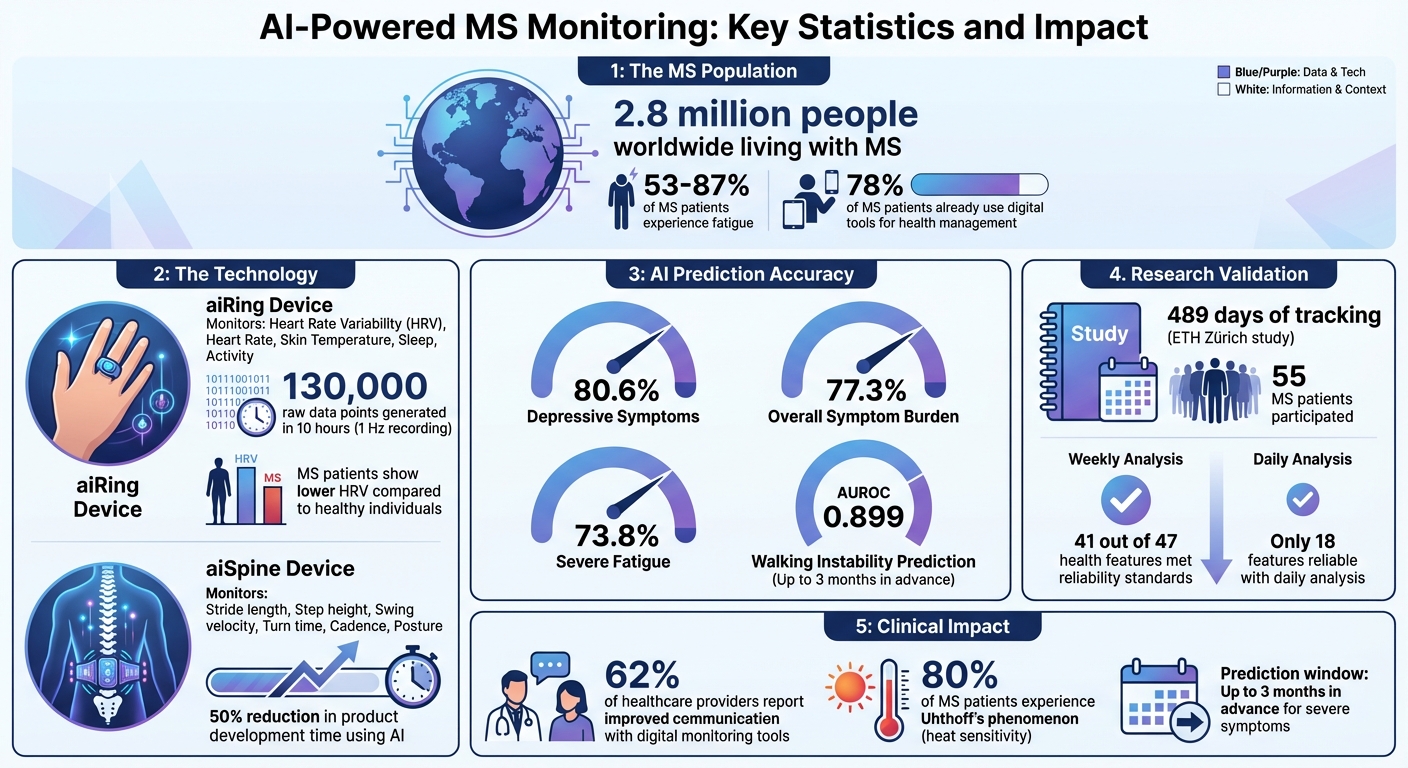
AI-Powered MS Monitoring: Key Statistics and Impact
AI-Powered Wearables for MS Monitoring
aiRing: Vital Signs Monitoring
The aiRing is designed to track how multiple sclerosis (MS) impacts the body’s autonomic nervous system by monitoring key vital signs. It uses precision sensors to measure heart rate variability (HRV), heart rate, skin temperature, sleep duration, and daily activity levels.
Studies indicate that people with MS often have lower HRV compared to healthy individuals, making it a crucial marker for tracking the disease. By collecting this data passively throughout the day and night, the aiRing provides insights into symptoms like fatigue, a condition that affects between 53% and 87% of MS patients. For example, by analyzing HRV patterns alongside sleep data, the device can detect declining energy levels before patients even notice the effects.
To put this into perspective, a single sensor recording at 1 Hz for 10 hours generates 130,000 raw data points. The aiRing’s AI algorithms process this massive dataset, revealing patterns that would be impossible to identify manually.
While the aiRing focuses on internal vital signs, its counterpart, aiSpine, zeroes in on motor functions.
aiSpine: Posture and Mobility Tracking
The aiSpine complements the aiRing by monitoring motor functions, a critical area in detecting slow, progressive changes in MS. Equipped with tri-axial accelerometers, the aiSpine translates movement into detailed metrics like stride length, step height, swing velocity, turn time, and cadence.
This information is particularly valuable because mobility issues in MS often develop subtly over time. The aiSpine can identify small changes in walking patterns or balance that might otherwise go unnoticed between clinic visits. Additionally, real-time vibration alerts help users maintain proper posture and conserve energy.
One example of this technology in action is from Celestra Health Systems, which developed smart insoles powered by the Edge Signal AI platform. CEO Bruce Ford highlighted how their system provides detailed gait metrics via a smartphone app. By using AI, they reduced their product development time by 50% and successfully introduced the tool to patients in the US, UK, and Canada.
Building a Personalized Health Baseline
Combining data from the aiRing and aiSpine, the AIH Health App creates a detailed, personalized health baseline for each user. This baseline is built by collecting continuous data during everyday activities.
The accuracy of this approach improves over time. While daily data can be inconsistent due to one-off events like a restless night or an unusually active day, weekly aggregated data offers much more reliable insights. A study involving 55 MS patients by ETH Zürich and University Hospital Zürich tracked participants over 489 days and found that 41 out of 47 health features met reliability standards when analyzed weekly, compared to just 18 when analyzed daily.
This personalized tracking is vital because MS symptoms vary widely from person to person. By monitoring individual patterns, the AI can differentiate between normal fluctuations – like a higher heart rate after exercise – and significant changes that could indicate disease progression. With 78% of MS patients already using digital tools to manage their health, AI-powered wearables elevate self-monitoring to a new level, combining precision with clinical relevance.
sbb-itb-44aa802
AI Algorithms and Real-Time Symptom Detection
Smart Alerts for Symptom Changes
AIH LLC‘s aiRing and aiSpine devices, paired with the AIH Health App, generate an immense amount of data every hour. However, raw data alone isn’t enough to make sense of what’s happening. This is where advanced AI algorithms step in, transforming this constant data flow into actionable insights through a process called digital phenotyping. Essentially, this technique uses passively collected data to measure behavior and physiology in everyday settings.
The AI breaks the data into two categories: "action features", which are immediate metrics like heart rate or step count, and "context features", which are historical patterns that establish a personalized baseline. By comparing these two, the system can identify meaningful changes in a patient’s health status.
Between late 2019 and early 2021, researchers at the University of Pittsburgh and Carnegie Mellon University tested this approach with 104 MS patients. Using machine learning models like Support Vector Machines and AdaBoost, they achieved prediction accuracies of 80.6% for depressive symptoms, 77.3% for overall symptom burden, and 73.8% for severe fatigue.
When the AI detects a significant shift – like a sudden drop in heart rate variability or changes in gait – it sends out smart alerts. These notifications help bridge the gap between a patient’s daily life and the infrequent visits to their doctor. As Dr. Zongqi Xia from the University of Pittsburgh explains:
"Symptom monitoring in the patient’s own environment coupled with effective prediction of symptom severity could facilitate triage for timely clinical intervention and reduce the delay in symptom management before worsening."
These alerts are designed to highlight real MS-related changes, filtering out normal variations in daily activity.
Distinguishing MS Symptoms from Daily Variations
While smart alerts are great at flagging significant changes, not every deviation signals a symptom flare-up. Everyday fluctuations – like moving less on a rainy day or feeling off after a bad night’s sleep – can sometimes resemble symptoms. To tackle this challenge, the AI incorporates environmental factors to differentiate these normal variations from actual MS-related changes, offering both patients and doctors clearer insights.
Take elevated temperatures, for instance. Around 80% of MS patients experience temporary symptom worsening in heat, a phenomenon known as Uhthoff’s phenomenon. In the elevateMS study, conducted from August 2017 to October 2019 with 495 participants, researchers observed that higher local temperatures reduced finger-tapping speed (β = –0.14, P < 0.001) without indicating disease progression.
A patient’s own symptom history plays a critical role in these evaluations. Findings from the MS Mosaic study revealed that past symptom patterns are the strongest predictors of future severity across all five symptoms examined. As the study team noted:
"The most predictive feature for a particular symptom is its past trajectory – consistent across all five symptoms… The next most predictive features are not predictable and can be either other symptoms, functional tests, or passive signals."
Turning Data into Action for Patients and Doctors
Integrated Data for Complete Health Analysis
The AIH Health App combines data from the aiRing and aiSpine devices to give users a full picture of their health. By merging these inputs, the app uncovers patterns and connections that might otherwise remain hidden.
Raw sensor data is transformed into easy-to-read visual trends, allowing users to track how their symptoms evolve over time. For instance, patients can view gait metrics, heart rate variability, and posture data side by side, which aids in spotting early warning signs. This eliminates the need to rely on memory when recalling past symptoms. The result? Patients are better informed, and communication with clinicians becomes more efficient and precise.
Improving Doctor-Patient Collaboration
Objective data from the AIH Health App plays a key role in enhancing conversations with healthcare providers. Instead of relying on vague descriptions or memory, patients can share clear, historical trends directly from the app. In fact, 62% of healthcare providers report that data from digital monitoring tools improves their communication with patients and influences their clinical decisions.
Real-time alerts further strengthen this collaboration. When the app detects significant changes – like declining mobility or irregular heart rate patterns – it notifies patients, who can then contact their doctors before symptoms worsen. Dr. Arman Eshaghi from UCL Queen Square Institute of Neurology highlights this potential:
"AI will unlock the untapped potential of the treasure trove of hospital information to provide unprecedented insights into MS progression and how treatments work and affect the brain."
This proactive system allows for timely adjustments to treatment plans, even between the typical 6–12 month appointment windows, potentially preventing serious relapses.
Empowering Patients Through Continuous Monitoring
Continuous monitoring doesn’t just support clinical collaboration – it puts patients in the driver’s seat. The app’s daily health dashboard offers a clear view of trends in fatigue, mobility, and vital signs, enabling users to make lifestyle changes before issues escalate.
To ensure high-quality data for analysis, the app includes reminders for active assessments, like taking regular short walks. This consistency helps detect pattern shifts – such as reduced steps or changes in posture – that signal the need for immediate adjustments. By turning passive data collection into an active process, the AIH Health App fosters a partnership between patients, their devices, and their healthcare providers, giving users more control over their health journey.
How can AI help with MS care?
Conclusion
AI-powered tools like aiRing and aiSpine are reshaping how multiple sclerosis (MS) is managed, benefiting both patients and doctors. By capturing real-time data, these devices address the challenges of infrequent doctor visits and reliance on patients’ memory for symptom reporting. Patients now have access to objective metrics that detect subtle changes in mobility, posture, and vital signs – often before symptoms escalate.
With continuous data collection, AI analytics take things further by offering predictive insights. For example, AI can forecast severe symptoms, such as walking instability, up to three months in advance with an impressive accuracy (AUROC 0.899). This kind of early warning system allows for timely interventions, potentially preventing relapses and slowing disease progression.
For healthcare providers, the AIH Health App delivers a comprehensive view of patient health, improving communication and enabling precise treatment adjustments. This integrated approach not only equips doctors with better tools but also gives patients an active role in their care.
Through passive monitoring and active engagement, patients gain more control over their health. Considering that around 2.8 million people worldwide live with MS, the AIH Health App represents a meaningful advancement in care. Transitioning from periodic clinical check-ins to continuous, AI-driven monitoring signals a major shift in MS management – empowering patients and providers to take a proactive stance against disease progression.
FAQs
How accurate are AI symptom predictions for MS?
AI models designed to predict MS symptoms are showing impressive accuracy, particularly in forecasting depressive symptoms, which reach about 80.6% accuracy. These systems harness longitudinal data collected from mobile devices and wearable sensors. By detecting patterns in symptom severity over time, they offer dependable insights that can benefit both patients and healthcare providers.
How does the app know what’s “normal” for me?
The app works by analyzing your health data and tracking symptom patterns over time to establish what’s "normal" for you. With continuous inputs from wearables and regular assessments, it monitors key areas like mobility, mood, and pain levels. By using advanced AI models, it distinguishes between everyday variations and more serious changes. This allows it to provide tailored insights and alert both you and your doctor to any shifts that might indicate symptom progression or the need for prompt medical attention.
What happens when the system sends an alert?
When the system sends an alert, it offers practical insights designed to help both patients and doctors manage multiple sclerosis (MS) symptoms more effectively. These insights can play a key role in tracking symptoms and adjusting treatments, empowering timely and well-informed decisions to enhance care.