
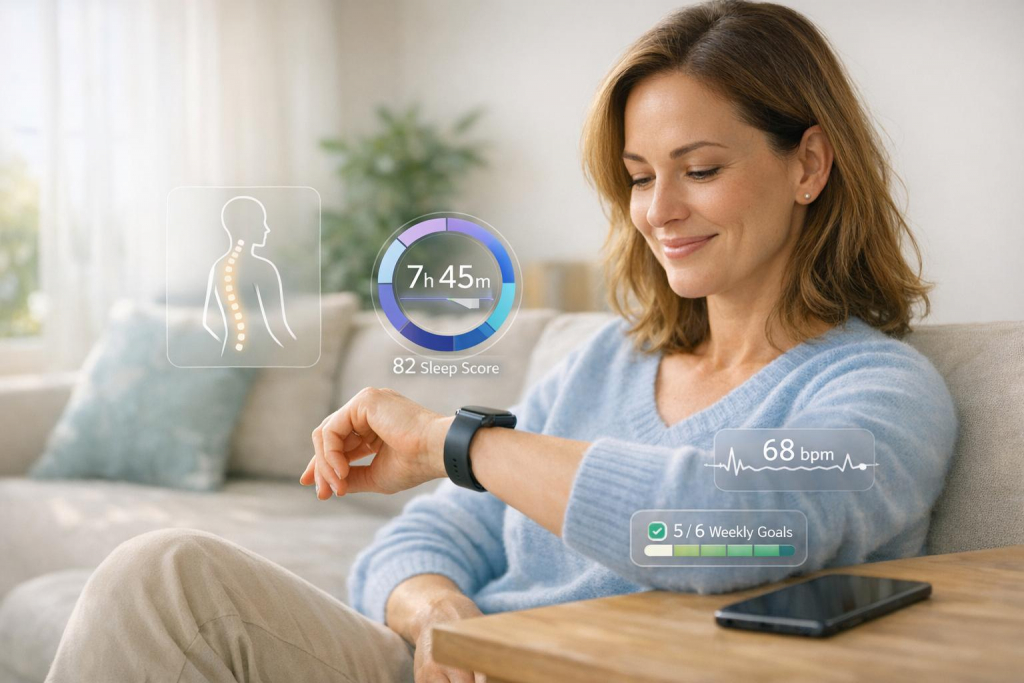
AI is changing how we manage health by using wearable devices to provide real-time, tailored feedback. Instead of generic advice, it analyzes data like heart rate, sleep, and posture to deliver insights specific to your habits and health patterns. Wearables like aiSpine and aiRing gather continuous data and connect to the AIH Health App, which processes this information to suggest actionable steps for improving your well-being.
Key Highlights:
- Continuous Monitoring: Devices track metrics like heart rate, sleep quality, and posture in real time.
- Tailored Insights: AI learns your baseline and provides specific advice, like adjusting exercise or sleep habits.
- Health Goal Tracking: The app refines goals over time, such as predicting stress or preventing injuries.
- Chronic Disease Support: Tools help manage conditions like hypertension or cardiovascular issues through early detection and alerts.
AI-powered tools are shifting healthcare from reactive to preventive, helping users make informed decisions and improve their health daily.
How AI Wearables Deliver Personalized Health Insights: Data Collection to Action
How AI Analyzes User Data for Personalized Health Insights
Data Collection from AI-Powered Wearables
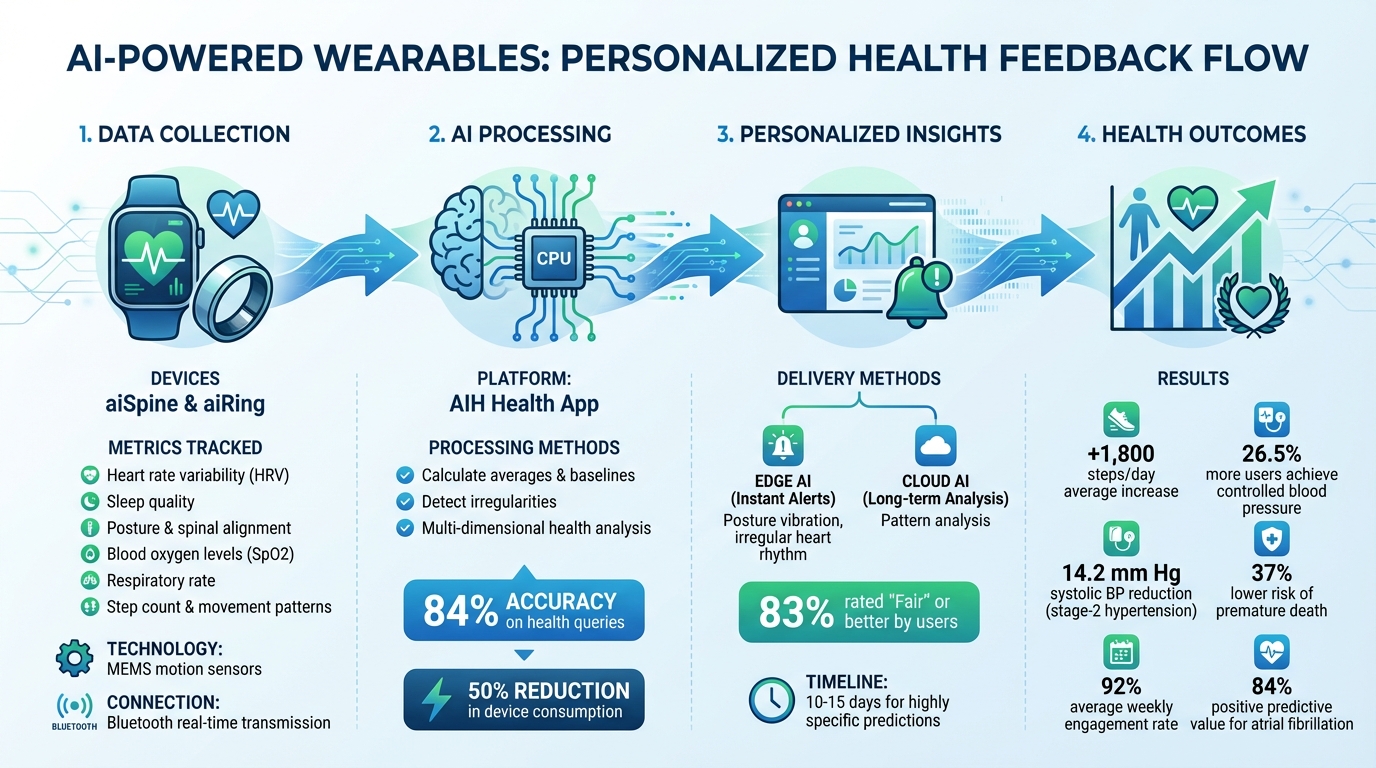
Today’s wearable devices, like aiSpine and aiRing, are equipped with advanced sensors that continuously gather health data. These devices use MEMS (Micro-Electromechanical Systems) motion sensors to monitor aspects like posture, step count, sleep quality, and daily activities.
The aiSpine focuses on biomechanical data, tracking spinal alignment, load distribution, and movement patterns throughout the day. On the other hand, the aiRing monitors vital signs, including heart rate variability (HRV), respiratory rate, and blood oxygen levels (SpO2). Both devices connect effortlessly to the AIH Health App via Bluetooth, enabling real-time data transmission.
This continuous flow of information helps uncover trends and patterns that traditional health assessments might overlook. It’s this constant data stream that feeds into the AIH Health App for in-depth analysis.
AI Algorithms and Data Processing in the AIH Health App
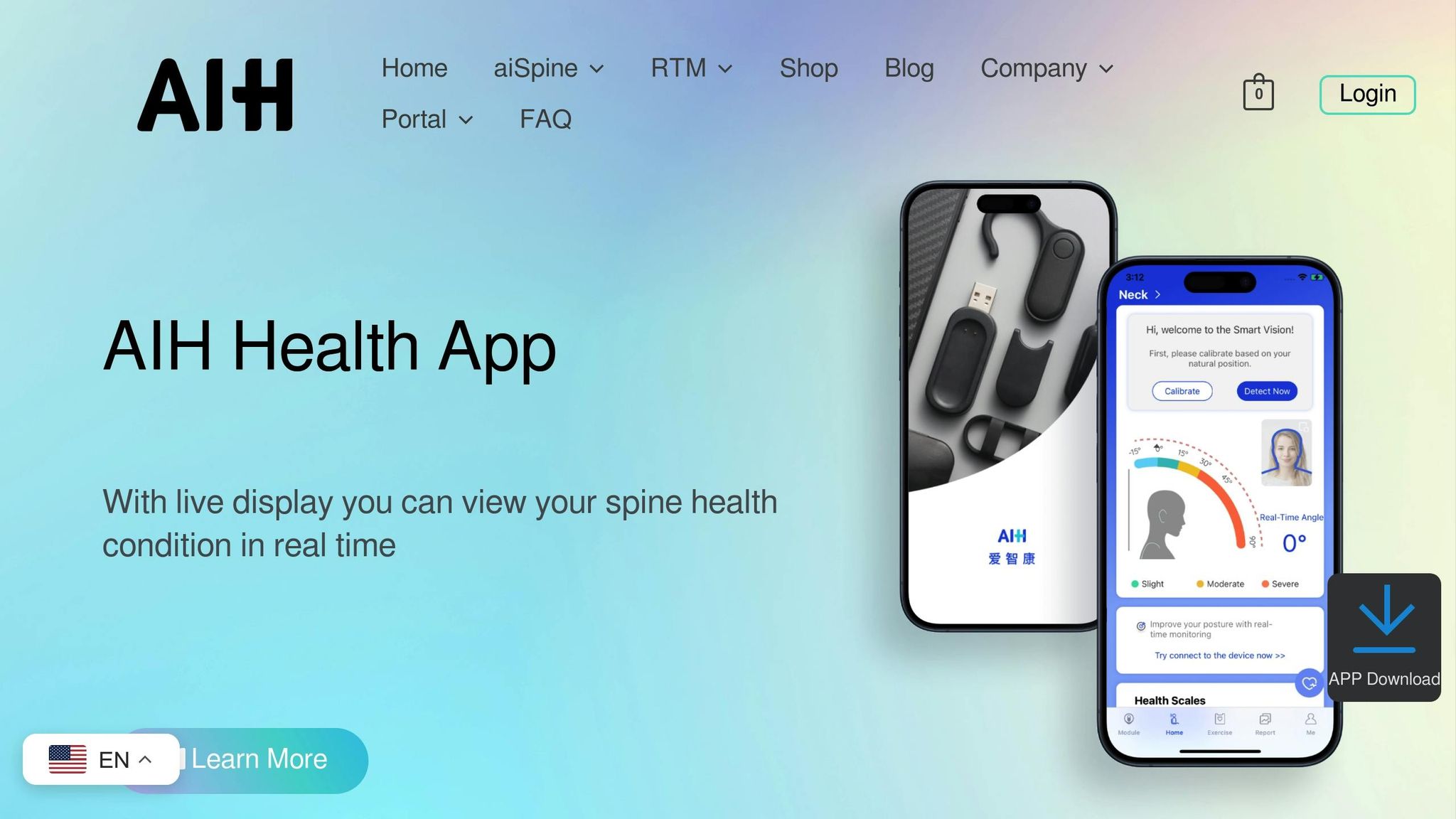
Once the wearables collect data, the AIH Health App gets to work, processing and interpreting the information. It combines sensor readings with workout logs and medical notes, creating a detailed snapshot of your overall health.
The app’s algorithms analyze this data by calculating averages, identifying deviations from normal baselines, and detecting irregularities in sleep patterns or vital signs. Using advanced code-generation techniques, the system performs precise, multi-dimensional analyses of your health metrics. Research indicates that these models achieve impressive accuracy when handling complex health queries, showcasing the power of AI in this field.
The next step involves integrating personal data with broader medical knowledge. This allows the AI to translate trends into actionable advice, such as modifying your exercise routine, improving sleep habits, or correcting posture issues. These insights are delivered in real time, helping users make informed health decisions. Additionally, the system employs reinforcement learning to optimize energy usage, cutting device power consumption by 50% and extending battery life.
How Generative AI Is Turning Wearables Into Intelligent Companions
How AI Delivers Tailored Health Feedback
The AIH Health App transforms raw data into actionable insights, making it easier to understand your health metrics and take meaningful steps forward. Instead of overwhelming you with charts, it provides clear explanations and practical next steps. This approach supports real-time monitoring of posture and vital signs while helping you set and track personalized health goals.
Real-Time Feedback for Posture and Vital Signs
Devices like aiSpine and aiRing are designed to provide instant feedback. For example, aiSpine vibrates to alert you when it detects poor posture, encouraging you to adjust immediately. It’s smart enough to recognize whether you’re sitting, standing, or bending, so you don’t have to manually input what you’re doing.
On the other hand, aiRing continuously monitors vital signs like heart rate variability, respiratory rate, and blood oxygen levels. If it notices an irregular heart rhythm or a drop in oxygen saturation, you’ll get a notification via the AIH Health App. The system uses Edge AI for split-second alerts and Cloud AI for deeper, long-term insights.
In a study conducted by Google Research in May 2025, the Personal Health Insights Agent (PHIA) was tested over 650 hours with 19 human annotators. Analyzing over 4,000 health-related questions, PHIA achieved 84% accuracy on objective numerical queries, far surpassing standard models, which scored just 22%. Users rated 83% of the AI’s insights as "Fair" or better, and multi-step reasoning doubled its chances of earning "Excellent" ratings.
Setting and Tracking Personalized Health Goals
The AIH Health App goes beyond instant alerts by using your data to refine your health goals over time. After analyzing 10–15 days of data, it shifts from general advice to highly specific predictions, such as forecasting your next-day stress levels or assessing your risk of injury with notable precision.
You can also ask the app about your unique health patterns. For example, if you’re curious about poor sleep or low activity levels, the AI breaks down your query step by step. It examines your recent activity, evaluates changes in your sleep patterns, compares your metrics to medical guidelines, and delivers tailored advice. For instance, if you’re averaging just 10 active minutes a day, it will highlight the recommended 150 minutes per week and suggest manageable ways to increase your activity.
The app doesn’t just set goals – it evolves with you. Research shows that wearable trackers can encourage users to take an additional 1,800 steps per day. Even small increases in physical activity, like an extra 5 kJ/kg/day, have been linked to a 37% lower risk of premature death. The AIH Health App tracks your progress, celebrates milestones, and adjusts your goals as your health improves.
sbb-itb-44aa802
Benefits of AI-Powered Wearables for Chronic Health Management
AI-powered wearables are changing healthcare by shifting the focus from treating illnesses after they occur to preventing them before they escalate. These devices help detect early signs of chronic conditions, reducing the need for emergency interventions and improving overall management.
A study conducted by the University of California, San Diego, from November 2021 to February 2023, tested wearable trackers and Bluetooth blood pressure monitors on 141 participants. The AI-based lifestyle coaching, delivered through text messages, led to a 26.5% increase in participants achieving controlled blood pressure over 24 weeks. For those with stage-2 hypertension, systolic blood pressure dropped significantly by 14.2 mm Hg. These results highlight how AI-driven tools, like the AIH Health App, can deliver personalized feedback and support continuous care.
Improved Spine Health and Posture Monitoring
AI-powered wearables are also making strides in spine health. Devices like aiSpine use built-in accelerometers and gyroscopes to monitor spine movements in real time. This allows for precise measurements of spine angles, motion range, and movement speed. Such detailed tracking can identify triggers for low back pain and help prevent repetitive stress injuries before they worsen.
Continuous Management of Vital Signs and Chronic Diseases
When it comes to chronic disease management, continuous monitoring of vital signs is a game-changer. Devices like aiRing track heart rate variability, respiratory rate, and blood oxygen levels around the clock. This is particularly useful for managing cardiovascular conditions. For example, the Apple Heart Study, which included over 419,000 participants, used AI algorithms with photoplethysmography sensors and achieved an 84% positive predictive value for confirmed atrial fibrillation. Similarly, the Fitbit Heart Study, involving 455,699 participants, reported a 98% positive predictive value for atrial fibrillation detection using a PPG-based deep learning algorithm.
The AIH Health App combines Edge AI for instant alerts with Cloud AI for long-term data analysis. This dual approach enables real-time warnings when anomalies arise and provides insights to anticipate potential health problems. By continuously monitoring and analyzing health data, these tools are revolutionizing how chronic diseases are managed.
"AI-enabled digital health tools are set to transform cardiovascular care pathways through scalable, low-cost strategies that can improve the timely detection, prevention, and management of cardiovascular disorders directly in the communities." – npj Cardiovascular Health
Conclusion
AI is reshaping how we manage personal health by tapping into data from wearables like aiSpine and aiRing, offering insights tailored to your individual body, habits, and health objectives. With edge AI providing instant alerts and cloud-based analytics delivering deeper insights, the AIH Health App bridges the gap between immediate feedback and long-term health planning. Research highlights that AI-driven health coaching achieves an impressive 92% average weekly engagement rate, along with measurable improvements in chronic conditions. This comprehensive system enhances daily health monitoring while addressing potential issues before they grow into significant problems.
From tracking spine health and vital signs to managing chronic conditions, this technology operates quietly in the background, identifying patterns and delivering personalized recommendations at just the right moment. The goal? To catch and address concerns early, ensuring they don’t escalate into serious complications.
"AI is perhaps the most transformational technology of our time, and healthcare is perhaps AI’s most pressing application." – Satya Nadella, CEO, Microsoft
FAQs
How do AI-powered devices like aiSpine and aiRing help manage chronic diseases?
AI-powered devices like the aiSpine and aiRing are transforming how chronic diseases are managed by offering continuous, real-time health monitoring paired with personalized feedback. These wearables gather essential health data – such as posture and vital signs – and use advanced AI algorithms to analyze it. This allows them to detect potential health issues early, enabling timely interventions that can reduce complications and improve overall health outcomes.
By combining information from various sources, these devices deliver customized health insights and practical recommendations. For example, the aiRing can provide feedback to help adjust medications or daily routines, making it a valuable tool for managing conditions like cardiovascular problems or musculoskeletal disorders. With AI-driven guidance, patients can take a more active role in their health, while healthcare providers benefit from precise, data-informed insights to deliver better care.
What data do aiSpine and aiRing use to deliver personalized health insights?
The aiSpine and aiRing devices gather a variety of biological, physiological, and activity-related data to offer personalized health insights. These metrics include details such as posture, vital signs (like heart rate and oxygen saturation), and biomechanical movement patterns.
Using advanced AI-driven analysis, these devices transform the collected data into practical insights and recommendations. This allows users to track their health in real time and make smarter choices to support their overall well-being.
How does the AIH Health App use AI to create and monitor personalized health goals?
The AIH Health App leverages cutting-edge AI to interpret data from wearable devices and other inputs like heart rate, sleep patterns, activity levels, and vital signs. With this information, it delivers tailored health insights and practical recommendations designed to suit your individual needs.
By tracking real-time data, the app updates your health goals dynamically, ensuring they stay relevant as your condition changes. Devices such as the aiRing and aiSpine work seamlessly with the app, creating a holistic health tracking system. This integration helps you make smarter choices about fitness, nutrition, stress management, and managing chronic conditions. With consistent, data-driven feedback, the app keeps you motivated and on track toward achieving your health goals.