
The short answer
Over-the-counter continuous glucose monitors (CGMs) are sensor-based devices that estimate glucose in interstitial fluid and can be purchased without a prescription. Their main benefit is convenience and access: you can start tracking glucose patterns on your own schedule, see trends across the day and night, and use that information to build awareness of how food, activity, and daily routines relate to your glucose. The main limitations are equally practical. CGM readings are estimates, not direct blood measurements, and they can lag behind blood glucose by several minutes. Over-the-counter versions typically do not include the clinical support, alarm features, or insurance coverage that prescription systems may provide, and they are not intended to diagnose diabetes or guide insulin dosing on their own.
What the evidence supports
Research on continuous glucose monitoring has focused mainly on prescription or real-time CGM (RT-CGM) in people with diabetes. A 2015 review in the Journal of Diabetes Science and Technology found that RT-CGM, alone or combined with an insulin pump, improved hemoglobin A1c with a neutral effect on hypoglycemia rates in the studies reviewed. The same review noted that RT-CGM benefits were most consistent in people with higher baseline A1c, and that adoption was limited by cost, psychosocial factors, and education. These findings come from clinical populations and prescription devices, so they should not be read as proof that an over-the-counter CGM will produce the same results for every user.[source]
Practical considerations
If you are comparing an over-the-counter CGM with a traditional blood glucose meter, the key difference is what each tool measures and when. A blood glucose meter measures glucose in a drop of capillary whole blood at a single moment, while a CGM estimates glucose in interstitial fluid continuously. That makes a meter useful for spot checks and confirmation, and a CGM useful for seeing direction and patterns. Many people use both: a CGM for trend awareness and a meter for individual readings. The table below summarizes the practical distinctions supported by the evidence and general device characteristics.
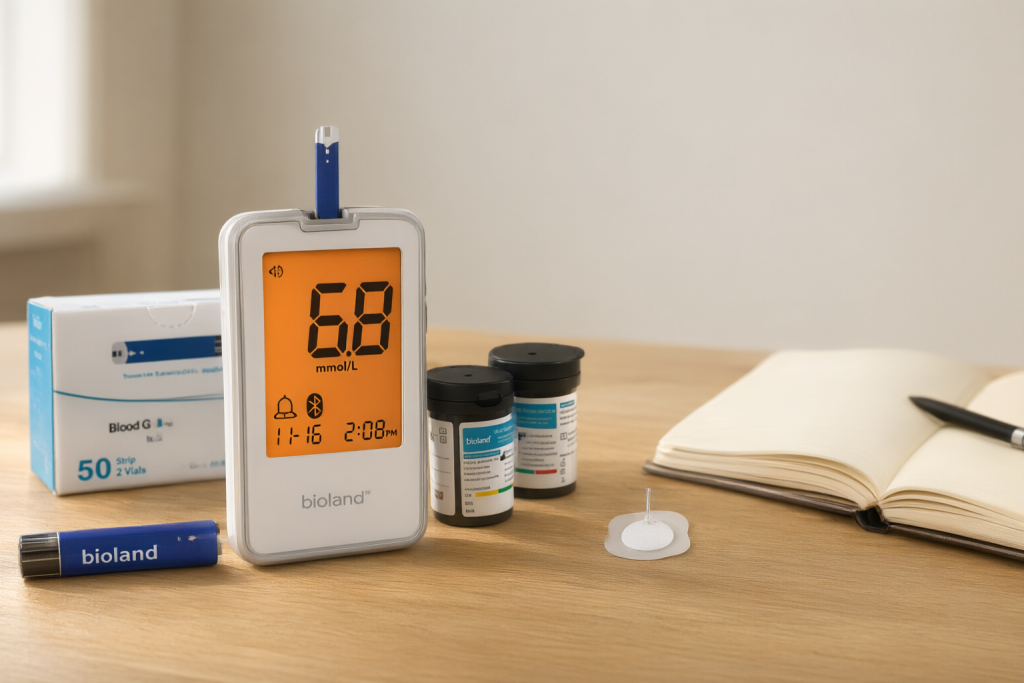
For readers who also use a connected blood glucose meter such as aiGlucoCare, the confirmed product facts are straightforward: it is a no-code meter that measures glucose in fresh capillary whole blood, reports a result in approximately five seconds using a 0.7 microliter sample, stores up to 500 results, and connects with the aiCare platform through Bluetooth for supported blood-glucose data workflows. aiGlucoCare belongs to the aiCare ecosystem, which brings supported AIHNET device data together into one health-data experience. These capabilities describe the meter and its data workflow; they do not turn CGM or meter readings into a diagnosis or treatment plan.
| Feature | Over-the-counter CGM | Blood glucose meter (e.g., aiGlucoCare) |
|---|---|---|
| What it measures | Estimates glucose in interstitial fluid | Measures glucose in fresh capillary whole blood |
| Reading style | Continuous estimates with a lag of several minutes | Spot measurement at a single moment |
| Typical use | Seeing trends and patterns over time | Checking a specific reading |
| Prescription | Available over the counter | Available over the counter |
| Data workflow | Varies by product; may sync to an app | Connects with aiCare through Bluetooth for supported blood-glucose data workflows |
| Storage | Varies by product | Stores up to 500 results on the meter |
Limits and responsible use
An over-the-counter CGM is an educational and tracking tool, not a diagnostic device or a substitute for professional medical care. It cannot tell you whether you have diabetes, and it should not be used to make insulin dosing or treatment decisions without guidance from a qualified clinician. CGM readings are estimates and can differ from blood glucose meter readings, especially when glucose is changing quickly. If you are using a CGM and a meter together, treat the meter reading as the confirmation for that moment. For any concerns about your glucose levels or diabetes risk, speak with a healthcare professional. This article is general education and does not provide personalized medical advice.
If you are considering an over-the-counter CGM, it also helps to review the product's own instructions for sensor wear, calibration, and data sharing, because those details vary by manufacturer. For readers using aiGlucoCare, the confirmed documentation covers the meter's measurement range of 1.1–33.3 mmol/L, its no-code operation, and its Bluetooth connection to aiCare. For questions about how a specific CGM or meter fits your routine, the most reliable next step is to check the product documentation or ask a healthcare professional.
Next steps
For current appointment, location, or contact information, visit the official website.[source]
References
- The Benefits, Limitations, and Cost-Effectiveness of Advanced Technologies in the Management of Patients With Diabetes Mellitus – PMC — pmc.ncbi.nlm.nih.gov
- Official website — www.aihnet.com