
The short answer
A pulse oximeter is a small device that clips onto a fingertip and estimates how much of your hemoglobin is carrying oxygen. That estimate is called SpO2, or peripheral oxygen saturation. It is expressed as a percentage, and it is an estimate rather than a direct blood measurement. The device does not draw blood; instead it shines two wavelengths of light through the fingertip and compares how much light is absorbed by oxygen-rich versus oxygen-poor blood. Because oxygenated and deoxygenated hemoglobin absorb light differently, the changing absorption pattern across each pulse gives the device enough information to calculate an SpO2 value.[nhlbi.nih.gov]
A fingertip pulse oximeter uses light to estimate blood oxygen saturation and pulse rate. The FDA describes both outputs as estimates.[FDA]
The important limit is that SpO2 is an estimate, not a diagnosis. A reading tells you what the sensor calculated at that moment under those conditions. It does not by itself explain why a value is what it is, and it cannot replace a clinical assessment. Cold fingers, poor contact, motion, nail polish, and weak circulation can all affect signal quality. For that reason, a single number is best read alongside the signal indicator and the conditions of the measurement.[FDA]
aiOxy measurements, display and stated specifications
The underlying light-absorption method explains why the result is an estimate. Oxygenated and deoxygenated blood absorb light differently; the device uses that difference to estimate oxygen saturation. This general principle does not establish the accuracy or intended use of any particular model. Check those details in the instructions for the exact device.[nhlbi.nih.gov]
For a concrete example, the aiOxy spot-check pulse oximeter (manufacturer model AOJ-70B) is designed to measure SpO2 and pulse rate and to display a perfusion index. Its OLED reading view presents the reading together with pulse waveform or bar-graph signal information, so you can see both the number and an indication of signal quality during a check. The perfusion index is a separate figure from SpO2: it describes the strength of the pulse signal at the sensor site, so it speaks to signal quality rather than to oxygen saturation. On aiOxy the stated perfusion-index range is 0–50%. The stated SpO2 measurement range is 0–100%, with a display range of 35–100% and stated accuracy of ±2% at 70–100%; below 70% the manual leaves accuracy unspecified. The stated pulse-rate range is 25–250 bpm with stated accuracy of ±2 bpm.
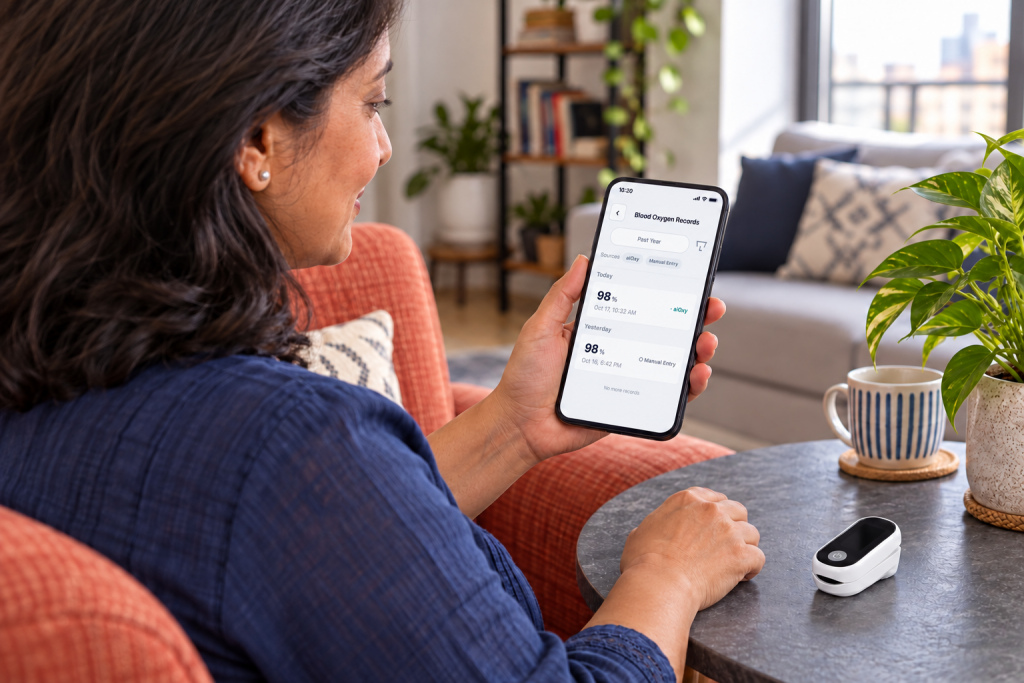
Physically, aiOxy is a compact fingertip unit measuring about 63.4 x 36.0 x 33.6 mm and weighing 38.1 g without batteries. It runs on two AAA batteries and, per the supplied manual, uses Bluetooth 4.2. The table below consolidates the stated ranges and physical specifications in one place so you can check them against the manual. It belongs to the aiCare ecosystem and connects with aiCare through the confirmed product workflow for supported SpO2 and pulse-data workflows, so readings taken during a spot check can be part of a broader record rather than an isolated number on a screen.
| Feature | Stated specification | Boundary to keep in mind |
|---|---|---|
| SpO2 | Measurement 0–100%; display 35–100% | Stated accuracy ±2% at 70–100%; below 70% unspecified |
| Pulse rate | 25–250 bpm | Stated accuracy ±2 bpm |
| Perfusion index | 0–50% | Separate from the SpO2 percentage |
| Display | OLED with pulse waveform or bar-graph signal information | Read the instructions for the exact display |
| Dimensions | 63.4 x 36.0 x 33.6 mm | Physical dimensions, not measurement performance |
| Weight | 38.1 g without batteries | Batteries are excluded from this stated weight |
| Power | Two AAA batteries | Follow the supplied instructions |
| Connection | Bluetooth 4.2; supported aiCare SpO2 and pulse-data workflow | Does not establish additional app or clinical capabilities |
How to read the spot-check display
When you use a spot-check oximeter, the quality of the reading depends heavily on how you set it up. A warm, still hand and a clean fingertip give the sensor the best chance of a clear signal. If the waveform or bar-graph indicator looks weak or irregular, the number beside it deserves less confidence than a reading taken with a strong, steady signal. Repeating a check after warming the hand and holding still is a reasonable way to see whether the signal improves.[FDA]
It also helps to know what each part of the display is telling you. The table below summarizes the main elements you will see on a spot-check oximeter like aiOxy and what each one represents.
| Display element | What it represents | What to keep in mind |
|---|---|---|
| SpO2 percentage | Estimated oxygen saturation of arterial blood at the fingertip | An estimate, not a blood draw; affected by signal quality |
| Pulse rate (bpm) | Heartbeats per minute derived from the pulsatile signal | Stated range on aiOxy is 25–250 bpm, ±2 bpm |
| Pulse waveform or bar graph | Signal strength and rhythm of the detected pulse | A weak or irregular trace lowers confidence in the numbers |
| Perfusion index | Strength of the pulse signal at the sensor site | Stated range on aiOxy is 0–50%; describes signal, not oxygen |
Limits and responsible use
The FDA notes that pulse oximeters have limitations and may be inaccurate in some circumstances. Do not rely on a pulse oximeter alone to assess health; discuss questions about readings and symptoms with a health care professional.[FDA]
For aiOxy, the supplied manual states SpO2 accuracy of ±2% at 70–100%, with accuracy below 70% unspecified. This is the manufacturer’s stated specification, not a clinical performance result or an assurance for an individual reading.
This article explains how the technology works and what the numbers represent; it does not interpret your readings or recommend any action based on them. If you are monitoring your oxygen levels as part of a care plan, the meaning of a given value in your situation is a question for your clinician, who can consider the reading alongside your symptoms and history. For product-specific questions about ranges, setup, or how aiOxy connects with aiCare, the product documentation and support team are the right sources. You can review the aiOxy product page at https://www.aihnet.com/shop/aipulse/ for the confirmed specifications and workflow details.
Next steps
For current appointment, location, or contact information, visit the official website.
Frequently Asked Questions
What does SpO2 mean on a pulse oximeter?
SpO2 is an estimate of blood oxygen saturation, expressed as a percentage. It is distinct from pulse rate and does not identify the cause of a reading.
Does a fingertip pulse oximeter draw blood?
No. It uses light to estimate oxygen saturation and pulse rate. Its estimate has limitations and does not replace medical advice.
What does aiOxy display?
The confirmed AOJ-70B specifications cover SpO2, pulse rate, perfusion index and an OLED reading view with pulse waveform or bar-graph signal information. The specification table separates the stated ranges and their limits.
Can aiOxy readings be part of an aiCare record?
aiOxy connects with aiCare through Bluetooth for supported SpO2 and pulse-data workflows. Check the product instructions for the confirmed workflow; do not infer additional app functions from the device display.
References
- Official website — www.aihnet.com