
What a Meter and Strip Cost Comparison Actually Covers
When people search for a blood glucose meter and strip cost comparison, they usually want to know one thing: which option will cost less to use over time. The honest answer is that total cost involves more than the meter's purchase price. It includes the meter itself, the compatible test strips you will use repeatedly, and the supplies and support needed to keep testing on an ongoing basis.[FDA]
This article compares cost factors and buying questions rather than listing specific prices. It does not rank meters by price and does not recommend a meter for any individual. Instead, it lays out the dimensions regulators and clinicians suggest weighing together, so you can bring a clearer set of questions to your own decision and to a conversation with a healthcare provider.[FDA]
If you are new to home testing, our overview of how a meter fits into an everyday testing routine is a useful companion to this cost-focused guide.
Why the Meter Price Alone Rarely Tells the Whole Cost Story
A meter is typically bought once, while test strips are used every time you test. Because of that difference in use pattern, the meter's sticker price alone does not describe the practical cost of monitoring over months or years. A lower upfront meter price paired with strips you use frequently may not represent the ongoing cost of testing, and a higher meter price paired with strips you use less often may look different over time.
FDA guidance on choosing a blood glucose meter lists the cost of the meter and strips among the selection considerations, alongside accuracy, ease of use, and other factors. Treating meter cost and strip cost as two separate line items — and thinking about how often you expect to test — gives a more realistic picture than either number alone. This is general cost education, not a claim about any product's price or savings.[FDA]
Cost Factors to Compare Side by Side
Rather than comparing a single number, it helps to line up the factors that FDA guidance names as selection considerations. These are comparison dimensions, not scores, and no single factor should decide the choice on its own.[FDA]
| Factor | What to check | Why it matters for cost and routine |
|---|---|---|
| Cost of meter and strips | The meter price and the price of compatible strips, considered together | Strips are used repeatedly, so they often shape ongoing cost more than the meter |
| Accuracy | How the system is described and what documentation says about performance | A meter you cannot rely on may lead to repeat tests and wasted strips |
| Ease of use | How simple the testing steps are for you | Fewer mistakes and less friction can mean fewer wasted strips |
| Amount of blood needed | The stated sample volume | Smaller samples may be easier to obtain consistently |
| Result storage | How many results the meter keeps | Stored results support later review without re-testing to recall past readings |
| Data transmission | Whether and how results can be transferred | Affects how easily you can keep records for appointments |
| Support and accessibility | Available help and features that suit your needs | Good support can reduce frustration and repeat purchases |
Strip Compatibility and Supply Planning
Test strips must be appropriate for the meter system you use. FDA guidance advises using new, appropriate strips and following the meter and strip instructions. A strip that does not match the meter is a supply you cannot use, which is why compatibility belongs in any cost comparison.[FDA]
Supply planning also matters. Knowing which strips your meter takes, how they are packaged, and how often you expect to test helps you avoid running short or overstocking. FDA also describes over-the-counter blood glucose systems as intended for single-patient use and not to be shared, so a household with more than one person testing should plan supplies per person rather than pooling them.[FDA]
How Older Cost Comparisons Differ From Today's Buying Questions
Some of the cost language you may encounter online comes from older research. A 1980s comparison of home blood glucose monitoring methods concluded that a visually read reagent strip was the least expensive method of glucose measurement available at that time, noting that it did not require a reflectance meter with frequent recalibration and ancillary equipment.[europepmc.org]
That finding reflects the technology and market of its era. It should not be read as current pricing guidance, and it does not tell you which option is least expensive today. The practical takeaway is to check current product information for the meter and strips you are actually considering rather than relying on historical cost conclusions.[europepmc.org]
Where aiGlucoCare Fits in a Cost-and-Routine Decision
If you are weighing meters, it helps to see confirmed product facts in one place. aiGlucoCare is AIHNET's blood glucose meter, and the details below describe how it is designed to be used — not what it costs or how it performs clinically.
| Feature | Confirmed detail |
|---|---|
| Operation | No-code operation |
| Measurement range | 1.1–33.3 mmol/L (stated) |
| Result storage | Up to 500 results |
| Result time | Approximately five seconds (stated) |
| Sample volume | 0.7 microliters (stated) |
| Sample type | Fresh capillary whole blood |
| Connectivity | Bluetooth connection with aiCare for supported blood-glucose data workflows |
What the aiCare Connection Adds to Your Records
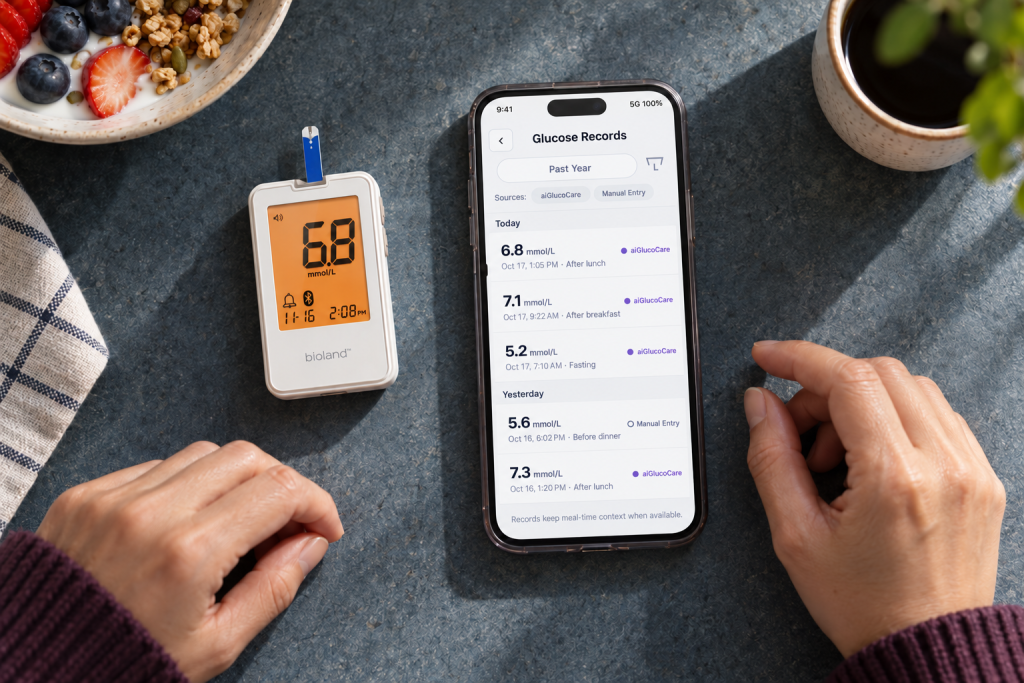
aiCare is AIHNET's connected-health software platform. aiCare brings supported AIHNET device data together into one health-data experience. aiCare helps users organize and view supported health information over time. For blood glucose, aiGlucoCare connects with aiCare through Bluetooth for supported blood-glucose data workflows.
In practical terms, that connection supports the task of reviewing your readings later — for example, looking back at stored results and trends when preparing for an appointment — rather than relying on memory or scattered notes. It does not replace advice from your clinician, and it does not interpret readings for you. You can see the product details on the aiGlucoCare page.
Questions to Ask Before You Decide
Turning the comparison factors into a short checklist makes the decision easier to discuss with a healthcare provider. FDA guidance advises discussing the right meter with a healthcare provider, so these questions are a starting point for that conversation, not a substitute for it.[FDA]
A practical pre-purchase checklist
- Confirm strip compatibility Check that the strips you plan to buy are the ones specified for your meter system.
- Estimate your testing frequency Think about how often testing is expected in your routine, since strip use drives ongoing cost.
- Review support and accessibility Look at the help available and whether the meter's features suit your needs.
- Check data handling Decide whether result storage and data transmission matter for how you keep records.
- Ask your healthcare provider Discuss which meter is right for you before committing to a meter-and-strip combination.
What This Comparison Cannot Tell You
This article does not list current prices, does not rank products by cost, and does not establish accuracy, efficacy, or clinical outcomes for any meter. Prices and supply details change, so verify current product and supply information directly before you buy.
Frequently Asked Questions
Is a cheaper meter always less expensive over time?
Not necessarily. A meter is usually bought once, while strips are used repeatedly. FDA selection guidance lists the cost of the meter and strips together as a consideration, so the ongoing strip cost and supply compatibility can matter more than the initial meter price. This article does not name prices or declare any option cheapest.
Do test strips work with any glucose meter?
No. Strips must be appropriate for the meter system you use. FDA guidance advises using new, appropriate strips and following the meter and strip instructions. Check the specified strips for your meter before buying.
Can I share a blood glucose meter with someone else?
FDA describes over-the-counter blood glucose systems as intended for single-patient use and not to be shared. If more than one person in a household tests, plan separate meters and supplies.
What confirmed features does aiGlucoCare offer?
Confirmed features include no-code operation, a stated measurement range of 1.1–33.3 mmol/L, storage of up to 500 results, a stated result time of approximately five seconds, a stated 0.7 microliter sample volume, measurement in fresh capillary whole blood, and Bluetooth connection with aiCare for supported blood-glucose data workflows. These are product facts, not cost, accuracy, or outcome claims.
Does connecting aiGlucoCare to aiCare replace advice from my clinician?
No. aiCare organizes supported readings, history, and trends; it does not provide diagnosis, treatment, or individualized medical advice. Discuss monitoring decisions with a healthcare provider.
Should I rely on older studies about the cheapest testing method?
Older comparisons reflect the technology and market of their time. For example, a 1980s study found a visually read reagent strip least expensive then, but that should not be treated as current pricing guidance. Check current product information instead.