
Choosing the right health monitoring device can be overwhelming, but getting it right is crucial – especially if you’re managing chronic conditions or posture-related issues. Here’s a quick guide to help you make an informed decision:
- FDA Clearance: Confirm the device is FDA-cleared to ensure safety and accuracy for medical use.
- AI Features: Look for AI-driven personalization that adapts to your unique health data for tailored insights.
- Sensor Accuracy: Verify the precision of sensors for metrics like heart rate, blood pressure, and posture.
- App Integration: Check for seamless compatibility with your smartphone and healthcare systems.
- Data Security: Ensure HIPAA compliance, encryption, and robust privacy measures.
- Battery Life: Opt for devices with at least 7 days of battery life to avoid interruptions.
- Professional Support: Choose devices that enable remote monitoring and easy sharing of data with healthcare providers.
Quick Overview of AIH Devices:
- aiSpine: Tracks posture with real-time alerts for back health.
- aiRing: Monitors vital signs and sleep quality.
- aiNeuro: Predicts risks for neurological and cardiovascular conditions.
The right device depends on your specific health goals. Use this checklist to evaluate options and make a choice that fits your needs.
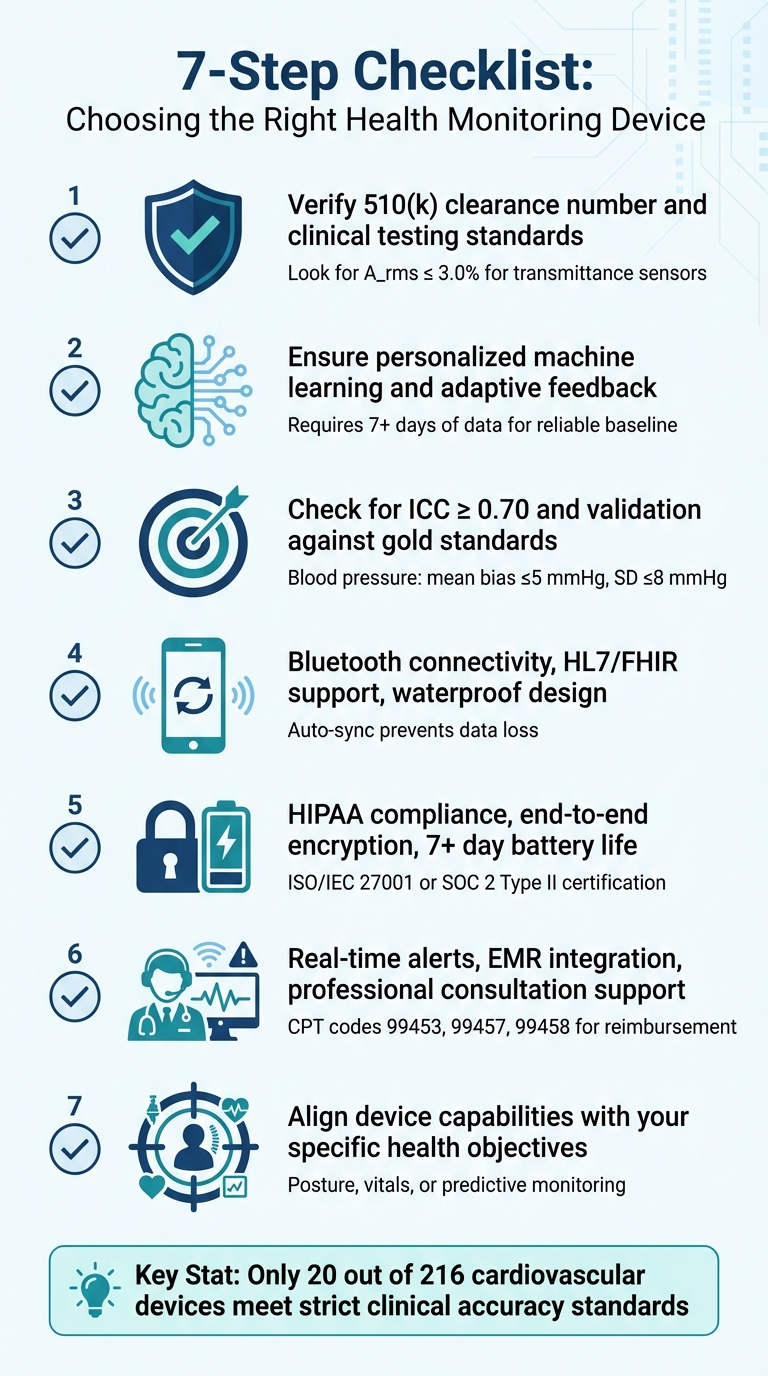
7-Step Checklist for Choosing Health Monitoring Devices
Top 10 Personal Health Monitoring Devices You Need in 2025!
Step 1: Check FDA Clearance and Clinical Testing
When considering a health monitoring device, the first step is to confirm it has FDA clearance – this is especially critical if you’re managing a chronic condition. FDA clearance signals that the device has been reviewed and meets the necessary safety and performance standards for its medical purpose. Essentially, this ensures the device is both technically precise (verification) and clinically useful (validation) for your specific health needs.
Here’s why this matters: just because a device accurately measures something like acceleration (verification) doesn’t mean it effectively tracks metrics relevant to conditions like Parkinson’s disease (validation). For those dealing with chronic illnesses, FDA clearance is crucial to ensure the device can deliver safe and reliable data for key health indicators like heart rate, oxygen levels, and posture. Without accurate readings, you risk missing critical warnings or making poor treatment decisions.
Take these examples of FDA-cleared devices:
- In April 2025, Dexcom, Inc. received FDA clearance (K243214) for its Dexcom G7 15 Day Continuous Glucose Monitoring System, confirming its sensor-based accuracy for diabetes management.
- In September 2024, Apple Inc. secured FDA clearance (K240929) for its Sleep Apnea Notification Feature, designed to reliably detect moderate to severe obstructive sleep apnea in adults aged 18 and older.
- In November 2024, Movano Health’s Evie Med Ring earned FDA clearance (K241090) under product code DQA, proving its ability to measure blood oxygen saturation and pulse rate – even in a compact, ring-style wearable.
To verify a device’s FDA clearance, use resources like the FDA’s 510(k) Premarket Notification Database or the sDHT Medical Devices List. Look for a 510(k) number (formatted as ‘K’ followed by six digits) on the packaging or manufacturer’s website, and review the accompanying "Summary of Safety and Effectiveness." For devices like pulse oximeters, clinical testing should involve at least 10 healthy volunteers with diverse skin tones, including at least two individuals with darker pigmentation or 15% of the test group. This ensures the device performs accurately across a broad range of users. Accuracy standards typically require a Root Mean Square Difference (A<sub>rms</sub>) of ≤ 3.0% for transmittance sensors and ≤ 3.5% for reflectance sensors.
"The FDA encourages the development of innovative, safe, and effective medical devices, including devices that incorporate sensor-based digital health technology (sDHT)." – FDA
If a device lacks FDA clearance or doesn’t provide transparency about its clinical testing, that’s a major red flag – especially if you’re relying on it to manage a serious health condition. Once you’ve confirmed FDA clearance, you can move on to evaluating the device’s sensor accuracy and the range of health metrics it offers.
Step 2: Review AI-Powered Features for Personalized Health Tracking
AI-powered health devices go beyond standard tracking by interpreting sensor data to deliver tailored feedback and predict health risks. Once a device receives FDA clearance, it’s essential to evaluate how effectively its AI transforms raw data into meaningful insights. The real distinction between a basic health tracker and a smart, AI-driven device lies in its ability to analyze your historical data, recognize patterns, and offer personalized recommendations instead of relying solely on generic benchmarks. These devices use machine learning classifiers and advanced signal-processing algorithms to filter out noise and motion artifacts, converting raw sensor inputs into clinically useful information.
One of the standout benefits of AI is its ability to personalize. Devices equipped with machine learning models trained on your unique data can make more precise predictions. Your baseline heart rate, sleep patterns, and activity levels are unique to you. A device that learns these patterns can detect subtle changes – like irregular heart rhythms – that might signal an emerging health issue far earlier than one that uses one-size-fits-all thresholds.
"Personalized machine learning models (those trained on data from individual users rather than the general population) significantly outperformed generalized models." – Li and Washington
AI-driven personalization is particularly impactful for managing posture and chronic conditions. For the best results, devices need continuous monitoring and at least seven days of consistent data to establish a reliable baseline. Look for features like "adaptive feedback" or "personalized machine learning", which indicate the device tailors insights to your health history rather than relying on average metrics. The market for AI-powered wearables is expected to surpass $39 billion by 2026, with nearly 44.5% of U.S. adults projected to use at least one wearable health tracker by 2025.
Real-Time Posture Correction
Devices like aiSpine are revolutionizing posture monitoring with real-time feedback. These tools use AI to identify poor posture and provide immediate vibration alerts when slouching or misalignment occurs. This feature is especially beneficial for those who spend long hours at desks or experience chronic back pain.
The aiSpine device offers multiple wearing modes and integrates with the AIH Health App to log posture data over time. This allows users to spot patterns, such as specific times of day when their posture tends to decline, and make adjustments accordingly. With Bluetooth 4.0 connectivity and a 7-day standby battery, the device ensures uninterrupted tracking.
Chronic Disease Tracking
AI also enhances chronic disease monitoring by analyzing long-term trends in health data. For conditions like hypertension, diabetes, or asthma, AI can process extensive data sets to identify early warning signs of health deterioration. Instead of simply displaying a single blood pressure reading, AI compares current measurements with historical data to detect trends, such as a gradual rise in systolic pressure or irregular heart rhythms that could indicate atrial fibrillation.
Predictive monitoring features further enhance early detection of metabolic and cardiovascular risks. Devices with "fatigue-aware" interfaces adjust feedback based on physiological markers like heart rate variability (HRV), a feature that has been shown to improve usability ratings by 22% among older users. The aiRing device exemplifies this approach, using precision sensors and autonomous algorithms to provide continuous tracking – even in waterproof conditions – and offering intuitive touch controls. These advancements demonstrate how AI-powered wearables meet both clinical standards and the demand for personalized health insights.
Step 3: Check Sensor Accuracy and Health Metrics Coverage
When it comes to monitoring chronic conditions like hypertension or cardiovascular disease, the reliability of sensors is non-negotiable. Accurate sensors are the backbone of effective health tracking, providing the kind of data that can guide meaningful decisions. Without them, the insights you rely on for managing your health could be misleading – or worse, unsafe.
Here’s why this matters: Nearly 120 million adults in the U.S. have high blood pressure, and continuous monitoring can capture daily fluctuations that a single doctor’s visit might miss. A systematic review of 216 cardiovascular monitoring devices revealed that only 20 met the strict standards for clinical accuracy and precision. This highlights the importance of thoroughly vetting a device’s sensor performance before making a purchase.
Sensor Types and Their Strengths
Different sensors come with their own sets of strengths and challenges. For example:
- ECG sensors found in chest-strap monitors are highly accurate for heart rate tracking.
- PPG sensors in wearables are convenient but can be affected by motion or skin tone variations.
- Accelerometers are great for tracking body movement and posture, which is essential for sleep and activity monitoring. However, they can sometimes mistake quiet wakefulness for sleep when movement is minimal.
If you’re managing a chronic condition, it’s crucial to choose devices that have been validated against gold-standard methods. For example, Polysomnography (PSG) is the benchmark for sleep tracking, while Electrocardiography (ECG) sets the standard for heart rate monitoring. Look for devices that meet precision benchmarks, such as an Intraclass Correlation Coefficient (ICC) of ≥0.70 as defined by the COSMIN Risk of Bias tool. For blood pressure monitors, accuracy is typically defined as a mean bias of ≤5 mmHg with a standard deviation of ≤8 mmHg. Devices should also comply with standards like AAMI/ESH/ISO or complete the V3 Framework (Verification, Analytical, and Clinical Validation).
Health Metrics to Track
The metrics you choose to monitor should align with your health goals and any chronic conditions you’re managing. Some key metrics include:
- Heart Rate (HR) and Heart Rate Variability (HRV): Essential for cardiovascular health and stress monitoring.
- Blood Oxygen Saturation (SpO2): Helps detect respiratory issues.
- Blood Pressure: Critical for managing hypertension.
- Sleep Metrics: Total sleep time, sleep stages, and sleep efficiency provide insight into recovery and overall well-being.
- Activity Levels: Steps, calories burned, and exercise intensity help track fitness progress.
- Skin Temperature: Useful for identifying sleep onset or tracking fertility cycles.
For posture and spinal health, accelerometer data is invaluable. Devices like aiSpine use triaxial sensors to monitor body alignment and offer real-time feedback when poor posture is detected. For more comprehensive health tracking, consider devices such as the aiRing, which combines multiple precision sensors in a waterproof and comfortable design.
Comparing Sensor Accuracy
To ensure you’re getting a reliable device, look for peer-reviewed validation studies on platforms like PubMed or the manufacturer’s website. These studies typically compare the device to gold-standard equipment.
Pay attention to how the device is used. For instance, proper sensor placement and skin contact are critical for accurate readings. For PPG or EDA sensors, clean the skin with a non-alcohol-based cleanser, remove hair at the contact point, and ensure the device fits snugly but not too tight. Wrist-worn blood pressure monitors require precise positioning – held at heart level during readings – to deliver accurate results.
Additionally, check if the device allows raw data export in formats like .csv or .json, rather than limiting you to proprietary summary scores. Devices that integrate multiple sensors, such as combining accelerometry with PPG and temperature tracking, often provide a more detailed view of your health.
Once you’ve confirmed the sensor’s accuracy, you’ll be ready to evaluate connectivity and app integration in the next step.
Step 4: Verify Compatibility, Connectivity, and App Integration
When it comes to modern wearables, Bluetooth connectivity is the backbone of how these devices communicate with your smartphone. Double-check that your wearable is compatible with your phone’s operating system and meets the required software version. This step ensures smooth functionality and prevents your device from becoming outdated prematurely. Reliable connectivity is crucial for seamless data sharing, which ties into the next point on integration.
If you’re looking to integrate your wearable with an electronic health record (EHR) system, make sure it supports standardized protocols like HL7 and FHIR. This is particularly important if you’re managing a chronic condition and need to share data with your healthcare provider. For personal use, prioritize devices that automatically sync data instead of requiring manual uploads – this reduces the chance of missing important health information.
Water resistance is another key feature to consider. Devices designed for continuous wear, such as the aiSpine and aiRing, allow you to keep tracking your health even while showering, swimming, or doing chores. Constantly removing a device can interrupt tracking, so waterproofing helps maintain uninterrupted monitoring.
App Integration Features
A good companion app can make all the difference. Look for apps that provide real-time tracking, historical data, and personalized insights. For instance, the AIH Health App acts as a central hub, offering an easy-to-use interface for daily monitoring while also providing a cloud-based portal for healthcare professionals to access remotely.
If you’re someone who enjoys diving deeper into your data, check if the app allows raw data exports in formats like .csv or .json. This makes it easier to analyze your information using third-party tools or share it with specialists. Studies show that remote monitoring programs with robust data-sharing capabilities can cut hospital readmissions by 25% to 30%, thanks to timely interventions.
Multi-Device Linking
For a more comprehensive health overview, consider linking multiple sensors. For example, pairing the aiSpine for posture tracking with the aiRing for monitoring vital signs creates a system that addresses both structural and cardiovascular health.
To simplify your experience, ensure the platform you choose automatically syncs data from all your devices into a single dashboard. This unified approach provides a clear and consistent view of your health, making it easier for both you and your healthcare team to track progress and make informed decisions. Automated integration ensures that your data flows seamlessly, giving you a holistic picture of your well-being.
sbb-itb-44aa802
Step 5: Check Data Security, Privacy, and Battery Life
Step 5 focuses on three critical aspects: data security, privacy, and battery life. These elements ensure continuous and secure health monitoring. Since health data is highly sensitive, compliance with HIPAA (Health Insurance Portability and Accountability Act) standards is non-negotiable. The HIPAA Security Rule mandates that Protected Health Information (PHI) be encrypted both while stored on the device and during transmission to your phone or a cloud server. This encryption safeguards your data whether it’s on your device or traveling through the internet. Additionally, multi-factor authentication (MFA) and role-based access controls give you the power to decide who can access your health information – whether it’s your doctor, a specialist, or a family member.
HIPAA-compliant manufacturers are also required to have breach notification procedures in place. If your data is compromised, they must notify you within 60 days. It’s worth asking if the manufacturer conducts regular security risk assessments and maintains audit controls to track who accesses your data and when. These safeguards are essential, especially when it comes to limiting access to servers storing your PHI. As Mathieu Chevalier, Principal Security Architect at Genetec Inc., emphasizes:
"Organizations should expect clear limits on how their data is used, strong controls throughout its lifecycle, and technology that is designed to respect privacy by default, not as an afterthought".
Here’s a closer look at the key security features you should check before choosing a device.
Data Security Features
When evaluating a device, confirm that it uses end-to-end encryption to protect data both at rest and in transit. Another essential feature is auto log-off, which ensures your account is secure in case you leave your phone unattended. Devices with data backup contingency plans are also valuable – they store readings locally if you lose connectivity, so your critical health data is never lost.
Transparency is another must. Take the time to review the end-user license agreement (EULA) to understand how your data will be used, shared, and stored. For added peace of mind, look for independent security certifications like ISO/IEC 27001 or SOC 2 Type II, which demonstrate a commitment to strong data protection practices.
While data security is vital, don’t overlook the importance of reliable battery performance. After all, a device is only useful if it’s powered up when you need it.
Battery Performance
Battery life plays a direct role in how effectively your device can monitor your health. Ideally, a device should last at least seven days on a single charge. As Jessica K Lu, MEng from the Centre for Healthy Longevity, points out:
"Daily charging disrupts continuous monitoring".
Frequent charging not only creates gaps in your data but also makes it easier to forget to put the device back on after charging, reducing overall adherence.
When comparing devices, check for features like low battery alerts or notifications for poor signal, which can help prevent unintentional data loss. Keep in mind that environmental factors like temperature and humidity can also impact battery performance. Monitoring the battery’s State of Health (SOH) is equally important; medical-grade batteries typically reach end-of-life when their SOH drops to 70%. Finally, devices with an integrated Battery Management System (BMS) are a smart choice. These systems optimize charging cycles and prevent overheating, extending the overall lifespan of the device.
Step 6: Review Remote Monitoring and Professional Support Options
Remote monitoring transforms personal health trackers into powerful tools that connect you directly with your healthcare team. This connection is especially critical for managing conditions that account for the majority of deaths in the U.S.. Reliable remote monitoring isn’t just a convenience – it’s a cornerstone of chronic condition management. The right device creates a constant feedback loop between you and your provider, enabling early interventions before minor concerns become major problems. This real-time connection sets the stage for timely care, which we’ll explore further in the next section.
When choosing a device, make sure it meets established clinical standards and supports automatic data transmission. These features are essential for Medicare and most insurance reimbursements. Consistent and reliable data transmission is also critical to the device’s clinical effectiveness.
Remote Monitoring Capabilities
For remote monitoring to be effective, it needs to provide continuous data streaming and real-time alerts that notify your care team when your vitals fall outside safe ranges. Devices with cellular connectivity are particularly valuable because they enable automatic, uninterrupted data transmission. Additionally, they should integrate seamlessly with Electronic Medical Records (EMRs) to allow your healthcare provider to review your data efficiently.
"Remote patient monitoring allows a patient to collect their own health data… using a connected medical device that automatically transmits the data to their health care provider. The provider then uses this data to treat or manage the patient’s condition".
Professional Consultation Integration
While automated data streaming is a key feature, engaging with your healthcare provider through integrated platforms is equally important. Building on the continuous tracking and sensor accuracy mentioned earlier, the most effective devices also connect you with professional support. For instance, the AIH Health App offers direct physician connectivity, allowing your doctor to review your data under "general supervision" billing. This ensures you receive timely insights without overwhelming your provider.
It’s also crucial to confirm that the platform includes patient education and setup services (CPT code 99453). Without proper training, the quality of your health data could be compromised. Look for devices that support ongoing communication between you and your provider (CPT codes 99457 and 99458). These codes cover the time your doctor spends reviewing your data and discussing any necessary treatment adjustments each month. Under Medicare’s 2025 rates, providers can earn approximately $90–$110 per patient per month by using these RPM billing codes. This system not only incentivizes comprehensive care but also ensures you stay connected to professional guidance.
Applying the Checklist: AIH LLC Devices
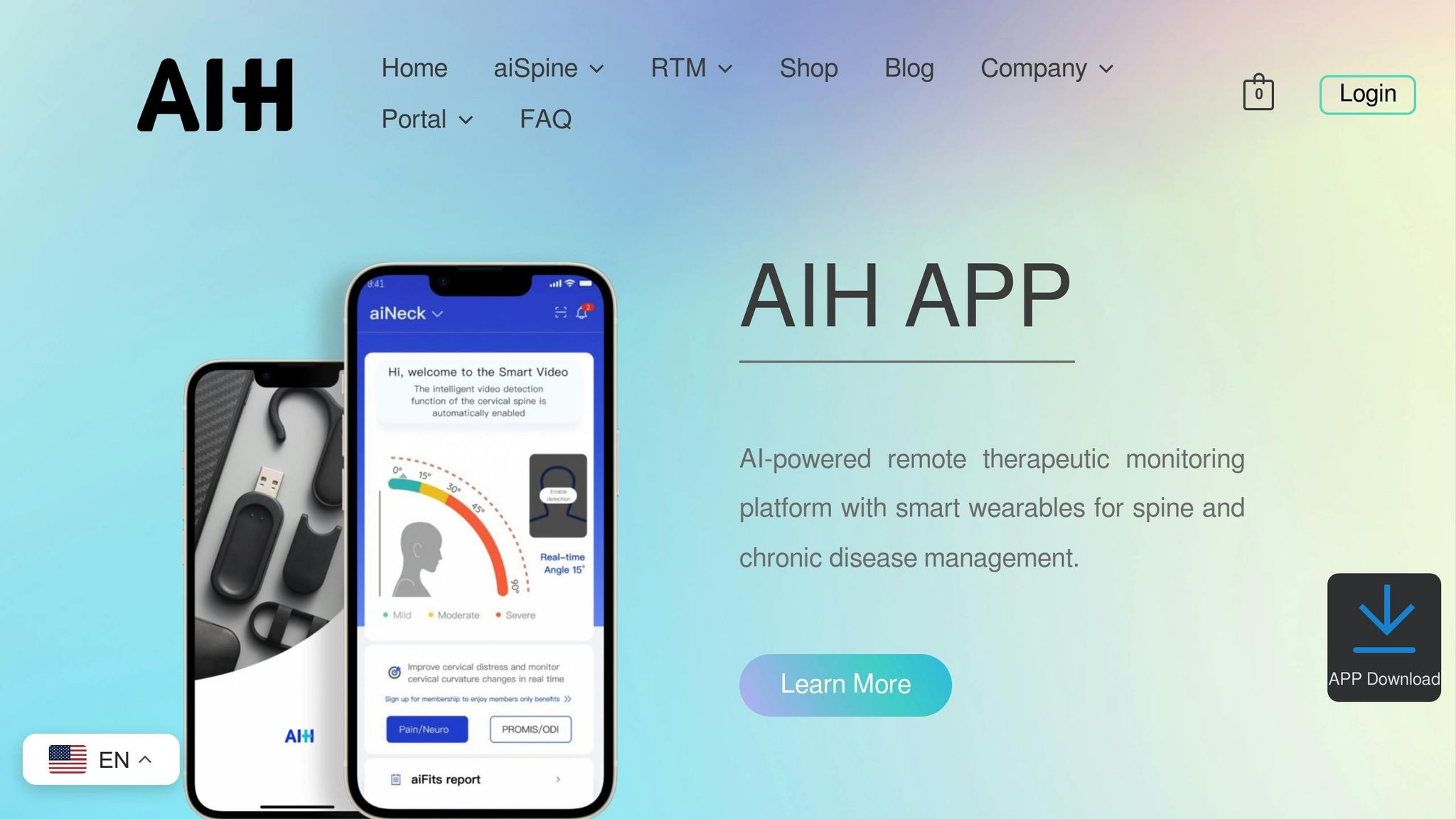
When selecting an AIH LLC device, it’s all about aligning the device’s capabilities with your specific monitoring goals. Whether you’re aiming for better posture, keeping tabs on vital signs, or staying ahead of potential health risks with predictive insights, there’s a device tailored to your needs.
The aiSpine is your go-to for posture correction. Using a triple-axis accelerometer, it measures gravitational acceleration across multiple axes. This allows it to detect issues like kyphosis and shoulder tilt with pinpoint accuracy. Combined with image recognition, the device sets personalized posture standards. It’s sensitive enough to catch forward tilt changes as small as 0.01159G, triggering corrective reminders validated by clinical research. With Bluetooth connectivity and a battery that lasts up to 7 days on standby, it’s a practical choice for tackling back pain and poor posture habits. This directly ties into the checklist’s focus on sensor accuracy and AI-powered features.
For those needing continuous monitoring of vital signs, the aiRing is a solid option. It tracks heart rate, blood oxygen levels, and sleep quality. AI algorithms analyze sleep patterns and provide actionable feedback, helping users make lifestyle adjustments. Its precision meets the Intraclass Correlation Coefficient (ICC) threshold of ≥ 0.70, ensuring reliable data. Thanks to its waterproof design and intelligent touch controls, the aiRing works seamlessly whether you’re exercising, sleeping, or simply going about your day.
Looking for something cutting-edge? The aiNeuro takes monitoring to the next level. Using predictive AI, it identifies subtle trends and early risk patterns before symptoms become apparent. Unlike traditional devices that alert you only after readings hit critical thresholds, aiNeuro’s Explainable AI (XAI) explains the data and reasoning behind its alerts. This increases transparency and builds trust with healthcare professionals. It’s an excellent example of AI-powered personalization and professional support integration.
Here’s a quick comparison of the devices to help you decide:
Device Comparison Table
| Feature | aiSpine | aiRing | aiNeuro |
|---|---|---|---|
| Primary Focus | Posture correction & spine health | Vital signs & sleep monitoring | Predictive neurological & cardiovascular monitoring |
| Key Sensors | Triple-axis accelerometer | Optical heart rate & SpO₂ sensors | Advanced biometric & neurological sensors |
| Unique AI Capability | Image recognition for personalized calibration | AI-driven sleep pattern analysis | Explainable AI (XAI) with predictive alerts |
| Connectivity | Bluetooth | Bluetooth | Bluetooth band integration |
| Battery Life | 7-day standby | Not specified | Not specified |
| Best For | Chronic back pain, kyphosis, office workers | Sleep disorders, cardiovascular monitoring, fitness tracking | Stroke risk, neurological conditions, advanced chronic disease management |
| Wearability | Multiple wearing modes with vibration reminders | Waterproof design with intelligent touch control | Real-time tracking with vibration reminders |
| Data Precision | Detects tilt changes as small as 0.01159G | Meets ICC ≥ 0.70 standard | Trend-based early risk detection |
If you’re focused on improving posture, the aiSpine is your best bet. For tracking vital signs and sleep, opt for the aiRing. And for predictive health monitoring, the aiNeuro is the clear choice.
Conclusion
Selecting the best health monitoring device involves balancing several important factors: FDA clearance, personalized AI features, sensor precision, connectivity, data security, long battery life, and integration with professional healthcare systems. These elements are key to achieving your health goals, whether you’re managing a chronic condition, improving posture, or tracking vital signs.
The FDA emphasizes:
"Verification is confirmation… that the parameter that the DHT measures (e.g., acceleration, temperature, pressure) is measured accurately and precisely. Validation is confirmation… that the selected DHT appropriately assesses the clinical event or characteristic in the proposed participant population".
Devices from AIH LLC meet these rigorous standards. For instance, the aiSpine employs triple-axis accelerometer technology to detect even the smallest posture changes, offering real-time feedback to support spine health. The aiRing provides continuous monitoring of vital signs with a high level of clinical precision. Meanwhile, the aiNeuro helps identify early risk patterns, enabling proactive care before symptoms develop.
Chronic diseases impose a massive economic burden, costing the global economy approximately $53.6 billion annually. This makes it critical to choose a device that excels in accuracy, security, and professional integration. Features like a battery life lasting over seven days, waterproof construction, and smooth app compatibility ensure consistent use and improved health outcomes.
Take the time to evaluate your options carefully. Use a checklist to match device capabilities with your specific needs, and ensure the device has been clinically validated and offers professional support integration. The right health monitoring device isn’t just about tracking – it’s about enhancing your overall well-being.
FAQs
How do I check if a health monitoring device is FDA-cleared?
To determine if a health monitoring device is FDA-cleared, start by examining the product’s packaging or user manual. Manufacturers typically highlight this information clearly. Another reliable option is to search the FDA’s official database of approved medical devices to verify its status. If you’re still unsure, reach out to the manufacturer directly and ask for documentation confirming the device has been reviewed by the FDA.
Pay attention to terms like FDA-cleared or FDA-approved, but stay alert for misleading claims. Only devices that meet the FDA’s strict safety and effectiveness standards will carry official clearance.
What are the advantages of AI features in health monitoring devices?
AI-powered health monitoring devices are changing the game by offering precise and tailored health insights through data analysis from wearable sensors. These tools can spot subtle patterns or irregularities in your health metrics, paving the way for early detection of issues like chronic illnesses or irregularities. The result? Health tracking that’s more accurate and forward-thinking.
What’s more, these devices adapt to your personal health profile, delivering customized recommendations for lifestyle adjustments, medication schedules, or rehabilitation plans. Whether it’s improving your posture, monitoring your heart health, or analyzing your sleep patterns, AI tools continually learn and evolve with your data, making interventions more effective and outcomes better.
On top of that, AI simplifies how your health data integrates with digital platforms. This means you – and your healthcare team – can access real-time, detailed health information effortlessly. The outcome is proactive, personalized care designed specifically for you.
Why is it important for health monitoring devices to have accurate sensors when managing chronic conditions?
Accurate sensors play a key role in managing chronic conditions by delivering dependable data on health metrics like heart rate, blood pressure, and glucose levels. This level of precision ensures that health trends are monitored correctly, enabling both you and your healthcare provider to make well-informed decisions about your treatment plan.
On the flip side, inaccurate readings can lead to misguided adjustments in medication, lifestyle choices, or other treatments, potentially harming your health. Opting for a device with reliable sensors allows you to monitor your condition with confidence and take meaningful steps to maintain or enhance your well-being.