
Why Forehead and Oral Readings Often Don't Match
If you take a forehead reading and an oral reading within a few minutes of each other, the two numbers may not agree. That is normal, and it does not automatically mean one device is wrong.[source]
The practical takeaway is that there is no single universal conversion value that turns a forehead reading into an equivalent oral reading. Because the measurement site, the device, and the way the measurement is taken all shape the number, a forehead result and an oral result should not be treated as interchangeable. Instead of converting one into the other, treat each number as belonging to the method that produced it. That single habit prevents most confusion when you compare readings later, whether you are reviewing a log before an appointment or simply checking whether a routine is being followed consistently.
What Changes the Number: Site, Device, and Technique
Three variables explain most of the gap between two readings taken close together. The first is the measurement location: a forehead surface and the area under the tongue are different places, and a device designed for one site is not measuring the other. The second is the device and its mode, since different thermometers and different settings within the same thermometer are built around different measurement approaches. The third is technique, meaning how and where the device is actually applied during the measurement.[source]
Because a reading reflects the method used, a number without its site and device context is hard to compare with anything else. This is also why it is not accurate to say that one site is universally more accurate than another for every person and situation. What you can control is consistency: choose a method, use it the same way, and note which method produced each number. If you are comparing devices at home, the useful question is not which number is higher, but whether each number was taken the same way as the one you are comparing it to.
Confirmed aiThermo Measurement Facts
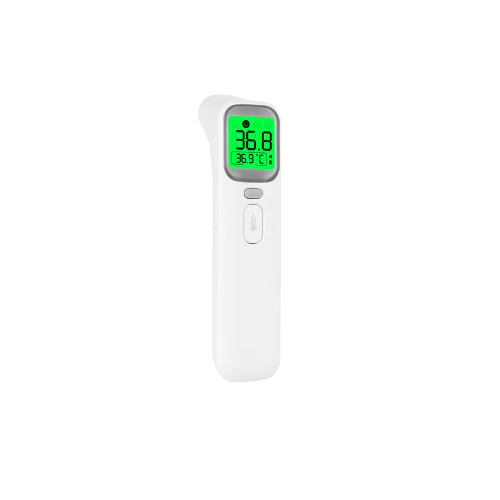
aiThermo (manufacturer model AOJ-20A) is an infrared thermometer that supports forehead and ear temperature measurement. It is worth being precise about that scope: aiThermo does not measure oral temperature, so it is not a like-for-like substitute for an oral thermometer.
The table below lists the confirmed specifications from the product documentation. The accuracy figures are manufacturer-stated laboratory values, quoted as stated; they describe the specification rather than a guarantee that every individual reading will be correct for every user and circumstance.
| Specification | Confirmed detail |
|---|---|
| Measurement sites | Forehead and ear (infrared) |
| Body temperature range | 32.0–42.9 °C |
| Direct/object mode range | 0–100 °C |
| Stated laboratory accuracy | ±0.2 °C in body mode; ±1.0 °C in direct mode |
| Units and display | °C/°F selectable, 0.1 °C display resolution |
| Display | Four-color backlight |
| Power | Two AAA batteries |
| Wireless | Bluetooth 4.2 |
Labeling Each Reading So Records Stay Comparable
The simplest way to keep records comparable is to label every entry with the method that produced it. Record the site (forehead or oral), the device or mode used, the time of the reading, and the unit shown. With those four labels, a later reader can tell whether two numbers were produced the same way, which is what makes a comparison meaningful in the first place.[source]
A simple labeling routine for each reading
- Note the site Write forehead, ear, or oral so the location is never ambiguous.
- Note the device or mode Record which thermometer was used and, where applicable, which mode it was in.
- Note the time Add the date and time so entries can be placed in sequence.
- Note the unit Record °C or °F exactly as displayed, without converting after the fact.
Where aiCare Fits in a Home Temperature Routine
aiThermo belongs to the aiCare ecosystem and connects with aiCare through Bluetooth for supported temperature-data workflows. In practice, that means aiCare can organize supported temperature readings into history and trend views, so a series of entries can be reviewed together rather than as scattered notes. If you already keep a written log, the same labeling habit described above still applies: the site and method are what make the history interpretable.
You can review the product details on the aiThermo product page before setting up a routine.
Limits to Keep in Mind
aiThermo does not diagnose a condition, determine treatment, or provide individualized medical advice, and its readings are not a replacement for a clinician. Manufacturer-stated accuracy is a specification, not a guarantee that every reading is correct for every user and circumstance. For any medical question about a temperature or what it might mean, speak with a healthcare professional.[source]
Next steps
For current appointment, location, or contact information, visit the official website.[source]
Frequently Asked Questions
Can I convert a forehead temperature to an oral temperature?
There is no single universal conversion value that makes a forehead reading equivalent to an oral reading, because the site, the device, and the technique all affect the number. Rather than converting, record the site alongside each reading so later comparisons stay within the same method.
Does aiThermo measure oral temperature?
No. The confirmed aiThermo specifications describe forehead and ear infrared measurement, not oral measurement, so it is not a like-for-like substitute for an oral thermometer.
What should I write down with each temperature reading?
Record the site (forehead, ear, or oral), the device or mode used, the date and time, and the unit shown. Those labels let you compare readings taken the same way rather than mixing methods.
How accurate is aiThermo?
The manufacturer states laboratory accuracy of ±0.2 °C in body measurement mode and ±1.0 °C in direct mode. These are stated specifications, not a guarantee that every reading is correct for every user and circumstance.
Does aiThermo send readings to aiCare automatically?
Automatic synchronization is not confirmed by the supplied product information. What is confirmed is that aiThermo connects with aiCare through Bluetooth for supported temperature-data workflows.
Should I use a temperature reading to decide on treatment?
No. Readings are educational information and do not diagnose a condition, determine treatment, or replace a clinician. For medical questions, consult a healthcare professional.
References
- Fever: MedlinePlus — medlineplus.gov
- Official website — www.aihnet.com