
The short answer
If you are choosing between a finger-stick meter and a continuous glucose monitor (CGM) for your first monitoring plan, the most useful starting point is not a product ranking but a set of questions. The two formats record glucose in different ways. A finger-stick meter measures glucose in a drop of blood at the moment you test, so it gives you individual readings tied to specific times. A CGM uses a sensor worn on the body to estimate glucose from the fluid between your cells, called interstitial fluid, and records a series of readings over a wear period so you can review how your glucose changes and spot trends.[source][source]
Four questions tend to organize the decision. First, what does each method actually measure and record? Second, how much effort does each ask of you, and when? Third, what will you be able to look back at, and what does each format help you discuss at a visit? Fourth, if you choose finger-stick testing, what does a connected meter add to your routine? Answering these before you commit to a plan keeps the choice grounded in your actual routine rather than in a single specification. This article is general education; your care team's instructions for your own monitoring plan take priority over any general comparison here.[source]
What each method actually records
A finger-stick meter produces a point-in-time glucose value from a small blood sample. Each test is a discrete event: you get a number for that moment, and the value is only as representative as the moment you chose to test. Because readings are separate events, the usefulness of finger-stick data depends heavily on when you test and how consistently you record those times. This is why a finger-stick routine is often described in terms of a schedule of checks rather than a continuous trace.[source][source]
A CGM works differently. That difference matters for what you can review later: a finger-stick log shows the moments you tested, while CGM data shows a series of readings and trends across the wear period. The two formats answer different questions, and neither replaces a conversation with your care team about which pattern they want to see.[source]
For CGM confirmation and limitations, follow the exact labeling for your model and your individual care plan. Some CGM models may require a finger-stick test to calibrate the system, while others may not, so check your model's instructions rather than assuming. If you doubt a CGM reading, are changing an insulin dose, or receive a warning alert, your care team may ask you to compare the CGM reading with a finger-stick test.[source]
Practical considerations before you choose
The effort question is where the two formats diverge most in daily life. Finger-stick testing asks for discrete actions: preparing supplies, obtaining a sample, and recording the result at the times your plan specifies. A CGM asks for less frequent interaction during wear but involves sensor placement, wear duration, and attention to the device over a period. Neither is effort-free; they distribute effort differently. It helps to ask your care team how many checks or how much continuous coverage your plan actually calls for, because that answer changes which format fits your routine.[source][source]
The review question is equally practical. Ask what you will bring to a visit: a list of individual readings with times, or a series of readings and trends across days. Then ask what each format helps you discuss. A finger-stick log supports a conversation about specific moments you chose to test; CGM data supports a conversation about patterns across a period. If your care team has asked for one kind of record, that request should guide the choice more than a general preference for one device type.[source][source]
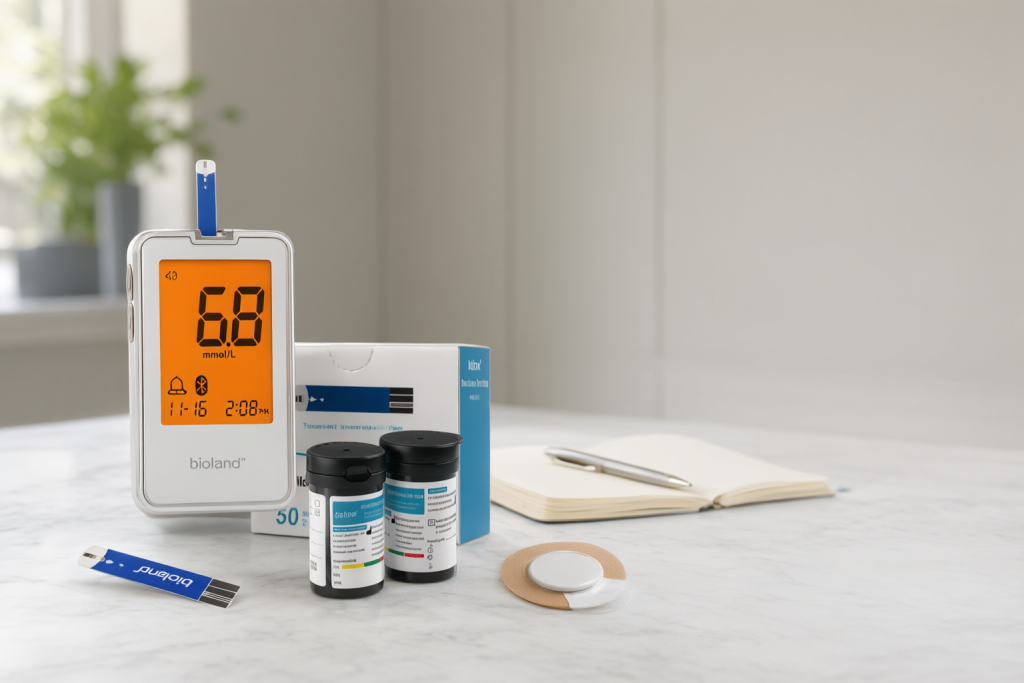
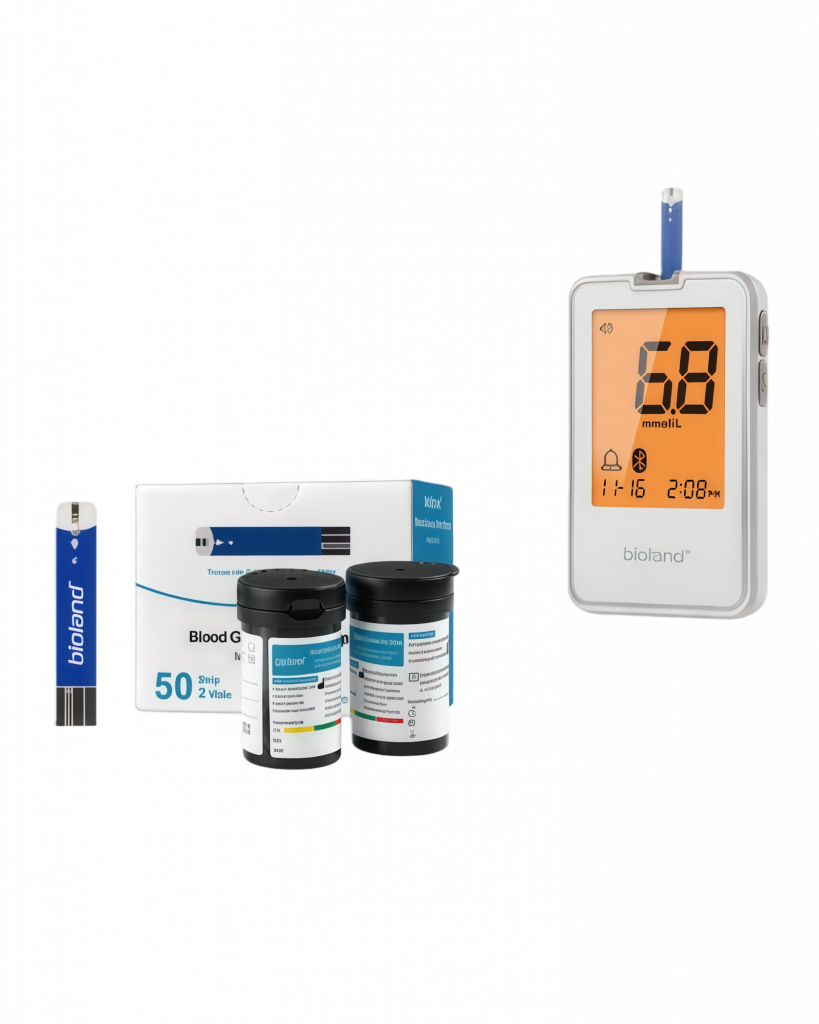
If finger-stick testing fits your plan, the next question is what a connected meter adds. aiGlucoCare is AIHNET's blood glucose meter, corresponding to the manufacturer model Bioland G-427B. It measures glucose in fresh capillary whole blood, with a stated measurement range of 1.1–33.3 mmol/L, a stated sample volume of 0.7 microliters, and a stated result time of approximately five seconds. It uses no-code operation and stores up to 500 results on the device. It belongs to the aiCare ecosystem and connects with aiCare, AIHNET's connected-health software platform, through the confirmed product workflow, so supported blood-glucose readings can be organized and viewed over time. In practical terms, the connected meter keeps the finger-stick routine you already have while giving you a place to review your recorded results later. Confirm the current shipped manual and market eligibility before relying on any specification for your routine.
Cost is a legitimate part of the decision and varies by format, supplies, and coverage. A separate guide covers meter and test-strip costs and insurance basics, and it is worth reading before you finalize a plan.
| Question | Finger-stick meter | CGM | What to confirm with your care team |
|---|---|---|---|
| What does it record? | Glucose in a blood sample at the moment you test; individual readings tied to specific times. | Estimates glucose from interstitial fluid at frequent intervals; a series of readings and trends over a wear period. | Which pattern they want to see, and whether your model's labeling calls for any finger-stick confirmation. |
| What daily tasks does it involve? | Discrete actions: preparing supplies, obtaining a sample, recording the result at the times your plan specifies. | Sensor placement, wear duration, and attention to the device over a period. | How many checks or how much continuous coverage your plan actually calls for. |
| What can you review later? | A log of the moments you tested. | A series of readings and trends across days. | What record they want brought to a visit. |
| What does a connected meter add? | A place to organize and view supported recorded results over time. | Not applicable to a finger-stick meter. | Whether a connected workflow fits your routine and which app features are supported. |
A plan to bring to your care team
Before you buy or begin, it helps to arrive at your appointment with a short written plan rather than a device preference. The items below are prompts for that conversation; your care team fills in the specifics, and no universal schedule is implied.[source]
What to bring to the conversation
- Purpose of monitoring Ask what your care team wants the readings to show, and how they plan to use them.
- Expected timing Ask when checks or coverage are expected, without assuming a fixed schedule; the answer belongs in your care plan.
- Training and handling Ask for instruction on using the device correctly, including hand washing and following the meter's instructions, and on any calibration your specific CGM model requires.
- Supplies and replenishment Ask which supplies your plan needs and how you will replenish them; do not assume what is included in a package.
- Device-specific instructions Bring your model's manual or labeling so your care team can check its instructions with you.
- Who reviews records Agree on who looks at your readings and how often, and what you should report.
Limits and responsible use
A comparison like this can clarify the questions, but it cannot establish which method is right for you. That depends on your health context, your care team's plan, and practical factors such as routine and cost. Neither format, and no connected meter, replaces professional medical advice, and a stored result is a record to review with your care team rather than something to interpret on your own. If you are unsure what your plan requires, ask before you buy or begin.[source]
For product-specific details, confirm the current specifications and supported workflows in the official product documentation before relying on them for your routine.
Next steps
If finger-stick testing fits your plan, the aiGlucoCare product guide is an optional next step for understanding the meter and its supported workflow. It is not proof that the product is suitable for everyone.
For current appointment, location, or contact information, visit the official website.
Related reading
Cost of Meters and Test Strips and Insurance Coverage Basics
Frequently Asked Questions
Does a finger-stick meter record the same thing as a CGM?
No. A finger-stick meter measures glucose in a blood sample at the moment you test, giving individual readings tied to specific times. A CGM estimates glucose from interstitial fluid at frequent intervals and records a series of readings and trends over a wear period.
Which method requires less daily effort?
They distribute effort differently rather than one being effort-free. Finger-stick testing involves discrete actions at the times your plan specifies, while a CGM involves sensor placement and attention to the device over a wear period. Ask your care team how many checks or how much coverage your plan calls for.
Does every CGM require calibration with a finger-stick test?
Not necessarily. Some CGM models may require a finger-stick test to calibrate the system, while others may not. Follow the exact labeling for your model and your individual care plan, and ask your care team whether a finger-stick comparison is needed if you doubt a reading, are changing an insulin dose, or receive a warning alert.
What does a connected meter like aiGlucoCare add to finger-stick testing?
aiGlucoCare measures glucose in fresh capillary whole blood and stores up to 500 results on the device. It belongs to the aiCare ecosystem and connects with aiCare through the confirmed product workflow, so supported blood-glucose readings can be organized and viewed over time. It does not change what a finger-stick reading is.
Can this article tell me which method to choose?
No. It explains how the formats differ in what they record and how they are used. The right choice depends on your care team's plan and your routine, so confirm the decision with them.
References
- Diabetes Tests | ADA — diabetes.org
- Blood Glucose Monitoring Devices | FDA — www.fda.gov
- Continuous Glucose Monitoring – NIDDK — www.niddk.nih.gov