
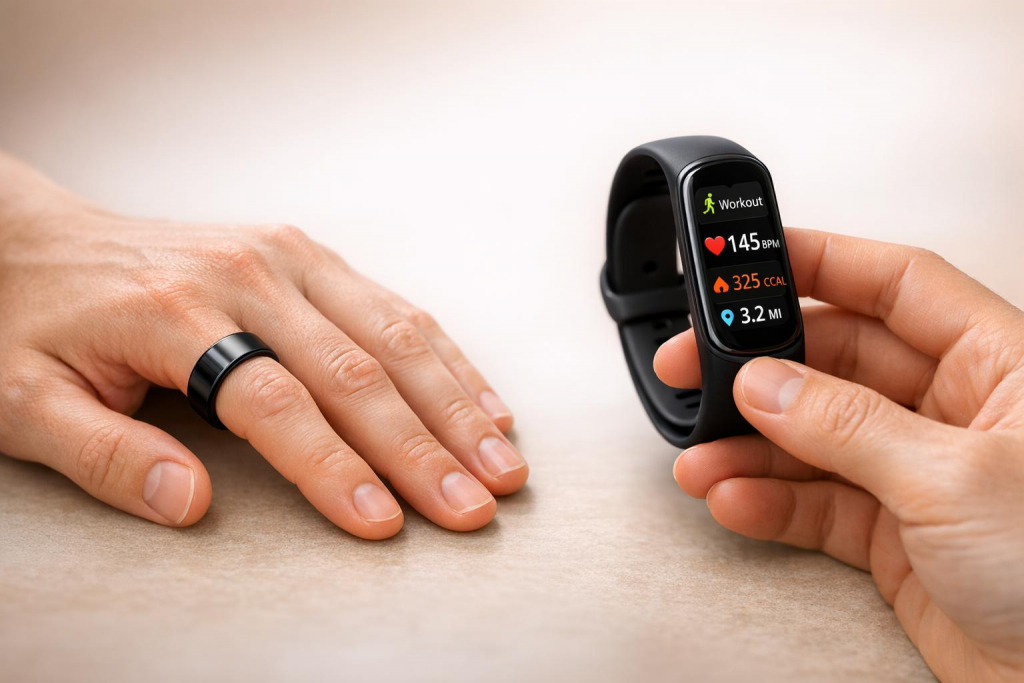
Smart rings and fitness trackers each have their strengths, depending on what you’re looking for in a wearable device. Here’s the quick takeaway:
- Smart Rings: Best for passive health monitoring like sleep, recovery, and stress tracking. They’re lightweight, discreet, and designed for 24/7 wear. With battery life lasting 5–10 days, they focus on precision but lack active workout features like GPS or real-time stats. Prices range between $199–$399, with some requiring a subscription (e.g., $5.99/month for advanced features).
- Fitness Trackers: Ideal for active exercise tracking, offering features like GPS, workout modes, and real-time feedback on a display. They’re bulkier but better suited for dynamic activities. Prices start around $120, with premium models costing up to $399. Battery life varies from 1–10 days, depending on the model and usage.
Quick Comparison
| Feature | Smart Rings | Fitness Trackers |
|---|---|---|
| Best For | Sleep, recovery, stress tracking | Active workouts, real-time stats |
| Design | Small, discreet, jewelry-like | Wrist-worn, includes a display |
| Battery Life | 5–10 days | 1–10 days |
| Cost | $199–$399 (+ optional subscription) | $120–$399 |
| Tracking Accuracy | Better at rest (e.g., sleep, HRV) | Better during movement (e.g., runs) |
| Workout Features | Limited | Advanced (e.g., GPS, workout modes) |
Choose a smart ring if you want a comfortable, low-maintenance device for health insights. Go for a fitness tracker if you need detailed exercise stats and interactive features.
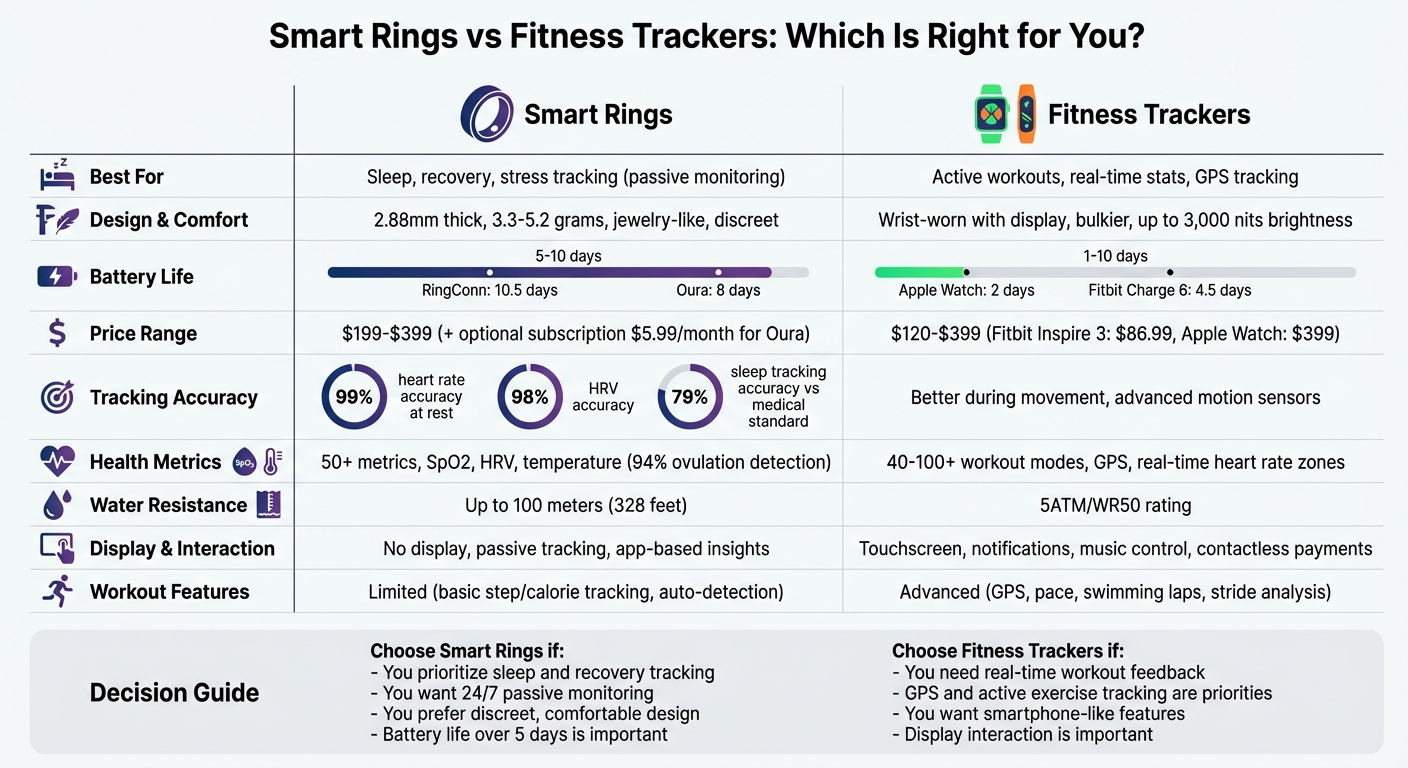
Smart Rings vs Fitness Trackers: Complete Feature Comparison Chart
Is Smart Ring or Smart Band Better for Health Tracking? Ultrahuman Ring Air REVIEW

What Smart Rings Offer
Smart rings combine powerful health monitoring with a lightweight, subtle design. Weighing just 3.3 to 5.2 grams, these finger-worn devices are built for all-day wear, providing constant health tracking without the bulk of traditional wrist-worn gadgets. They resemble regular jewelry and require no active interaction, making them both functional and discreet.
Dr. Massimiliano de Zambotti, a sleep researcher at Oura, highlights the unique advantage of finger placement:
"There is increasing evidence that the finger form factor offers a significant advantage in the robustness of the signal and overall device performance, making it the preferred site for high-fidelity physiological monitoring."
The finger’s rich blood flow and higher vascular density deliver cleaner, more accurate signals compared to the wrist, which often faces interference from movement or body hair. This precision allows smart rings to achieve 99% accuracy for heart rate and 98% accuracy for heart rate variability, rivaling medical-grade ECG devices.
Health Metrics Monitored
Smart rings track over 50 health and wellness metrics using advanced LED sensors to measure SpO2, heart rate, and HRV. Many models also feature temperature sensors capable of detecting even the smallest changes in body temperature. For example, they can achieve a 94% accuracy rate in detecting ovulation, comparable to standard prediction kits.
One standout feature is sleep tracking. In a 2024 study conducted at Brigham and Women’s Hospital, Dr. Rebecca Robbins and her team tested the Oura Ring against gold-standard polysomnography equipment. The results showed 79% agreement with the medical standard, outperforming the Apple Watch and Fitbit Sense in deep sleep detection, with the Oura Ring achieving 79.5% sensitivity, compared to Fitbit’s 61.7% and Apple Watch’s 50.5%.
Beyond sleep, these rings monitor activity levels, stress indicators through HRV analysis, and recovery metrics, helping users determine when to push their physical limits or take a rest day. The best part? All this tracking happens passively – there’s no need to start workouts manually or remember to wear the device.
Design and Comfort
Smart rings are designed for comfort, with a thickness of just 2.88mm, comparable to a wedding band. For example, the Oura Ring 4 features recessed sensors that are only 0.3mm high, ensuring a smooth interior surface that won’t irritate the skin, even with extended wear.
They’re also built to withstand everyday life. High-end models are water-resistant up to 100 meters (328 feet), so you can shower, swim, or wash dishes without removing them. This durability eliminates the data gaps often caused by users removing wrist-worn devices for charging or comfort. Plus, the sleek, understated design blends seamlessly into professional or casual settings – unlike the sometimes flashy appearance of smartwatches.
Battery Life and Charging
Smart rings boast impressive battery life, typically lasting 5 to 10 days on a single charge. For instance, the Oura Ring 4 offers up to 8 days of battery life and charges fully in just 20 to 80 minutes. Meanwhile, the RingConn Gen 2 Air has been tested to last an impressive 10.5 days.
Charging options vary by model. Some rings use stationary docks that plug into the wall, while others – like the Samsung Galaxy Ring – include portable charging cases similar to those used for wireless earbuds. These cases often store extra power, allowing for on-the-go charging. Battery life can also depend on ring size; larger sizes can house bigger batteries, with Samsung Galaxy Ring sizes 12 and 13 offering an extra day of use compared to smaller sizes.
The absence of a display is key to this extended battery life. Without the power drain of screens or constant notifications, smart rings focus entirely on their sensors and data collection. This efficiency allows for uninterrupted, long-term monitoring, setting them apart from traditional fitness trackers that often require more frequent charging.
What Fitness Trackers Offer
Fitness trackers act as active wrist companions, delivering real-time updates, GPS functionality, and interactive apps – features that smart rings typically lack. Unlike the more passive nature of smart rings, these wrist-worn devices keep you connected to your workout stats, notifications, and even third-party apps, all without needing to reach for your phone. Let’s dive into the standout features that make fitness trackers a go-to choice for monitoring exercise and daily activities.
Activity and Fitness Monitoring
Fitness trackers shine when it comes to tracking a variety of exercises, offering anywhere from 40 to over 100 workout modes. For instance, the Fitbit Charge 6 supports 40 sports profiles, doubling its previous generation’s offerings. Meanwhile, the Samsung Galaxy Watch 8 takes it further with over 100 workout options, covering everything from walking to archery.
These devices monitor a wide range of metrics, including:
- Heart rate with real-time zones
- Steps and calories burned
- Blood oxygen levels (SpO2)
- Skin temperature and respiration
- Stress levels via electrodermal activity (EDA) sensors
- Advanced running metrics like stride length, ground contact time, and vertical oscillation
- Body composition through bioelectrical impedance analysis (BIA)
- Swimming metrics, including water depth
Built-in GPS allows you to track pace and distance during outdoor activities without needing your phone. Plus, many devices feature automatic workout detection, so your activity is tracked even if you forget to start a session manually. Unlike the passive data collection of smart rings, fitness trackers provide immediate feedback, making them ideal for dynamic exercise routines.
Display and Interaction
Fitness trackers don’t just track – they make interacting with your data easier. Their larger touchscreen displays offer a significant edge over smart rings. As Andrew Gebhart, Senior Writer at PCMag, puts it:
"If you’re trying to check your heart rate or elapsed time during a run, having a device with a screen is more convenient than a ring, which makes you pull out your phone and open the relevant app."
Some displays reach brightness levels of up to 3,000 nits, ensuring visibility even in direct sunlight. Beyond workout stats, these screens let you:
- Read and respond to texts
- View social media notifications
- Control music playback
- Make contactless payments
- Use apps like Google Maps or Strava
High-end models even include voice command capabilities. For example, the Garmin Venu X1 features a vibrant 2-inch AMOLED display designed for health and fitness tracking.
Durability and Versatility
Fitness trackers are built to withstand the demands of an active lifestyle. Many premium models use materials like stainless steel or titanium for durability, along with hardened screens to resist scratches. Their secure wrist placement, combined with advanced motion sensors, ensures accurate heart rate monitoring during intense workouts.
Most devices also come with water resistance ratings of 5ATM or WR50, making them safe for swimming. But their versatility doesn’t stop at the gym. Advanced models offer cellular connectivity, enabling you to make calls, send texts, and stream music during outdoor activities – all without your smartphone.
Battery life varies depending on the model and usage. For example, the Apple Watch Series 11 lasts nearly two days (43 hours) during testing, while the Fitbit Charge 6 offers approximately 4.5 days with the always-on display turned off. Pricing spans a wide range, from budget-friendly options like the Fitbit Inspire 3 at $86.99 to premium models such as the Apple Watch Series 11 at $399.00.
Smart Rings vs Fitness Trackers: Direct Comparison
Comparison Table
Here’s a side-by-side look at how smart rings and fitness trackers measure up in the areas that matter most for health monitoring:
| Feature | Smart Rings | Fitness Trackers |
|---|---|---|
| Primary Strength | Focused on sleep, recovery, and discreet 24/7 vitals | Ideal for real-time exercise tracking and smartphone integration |
| Battery Life | Lasts 5–10 days (e.g., RingConn Gen 2 Air: 10.5 days) | Ranges from 1–5 days for smartwatches; over 10 days for simpler models |
| Sleep Tracking | Highly accurate, comfortable for overnight use | Moderate accuracy; some users find them bulky for sleep |
| Activity Monitoring | Covers basics like steps, calories, and auto-detection of walking/running | Advanced tracking with GPS, pace, swimming laps, and more |
| Comfort/Size | Lightweight (2–6 grams), sleek, and jewelry-like | Heavier, wrist-worn with a display |
| Subscription Costs | May require subscriptions (e.g., Oura: $5.99/month) or none at all (e.g., Samsung Galaxy Ring: $399.99, RingConn: $199.00) | Usually offer optional premium subscriptions or bundle costs with the device |
| Chronic Disease Management | Emerging uses like AFib and blood pressure monitoring | Established for features like heart rate alerts and sleep apnea detection |
This table highlights the main differences, but how do these features translate into everyday usability? Let’s dive deeper.
Strengths and Weaknesses
Smart rings shine when it comes to passive, continuous monitoring. Their lightweight design – typically weighing between 2 and 6 grams – makes them barely noticeable, so users are more likely to wear them around the clock. This constant use ensures steady data collection, especially for sleep and recovery metrics.
On the other hand, fitness trackers excel at active, real-time feedback. With built-in GPS, touchscreens, and advanced motion sensors, they’re perfect for tracking exercise data like running routes, heart rate zones during workouts, or swimming laps. Dr. Robert Sackin, a patent attorney and engineer, summarizes it well:
"Fitness watches… are better equipped to capture heart rate data accurately during exercise".
When it comes to heart rate accuracy, the two devices have their own strengths. Smart rings tend to be more precise when you’re at rest, thanks to the fingertips’ rich network of blood vessels. However, they can be less reliable during movement. Dr. Bhaskar Semitha, a cardiologist at Fortis Hospital Vashi, explains:
"A ring has a much smaller contact area than a fitness watch. If it shifts even slightly or if the wearer’s hands are cold, the readings can be off".
Meanwhile, fitness trackers are better equipped to handle motion, making them a reliable choice for high-intensity activities like gym workouts or running.
Cost is another factor to consider. The Oura Ring 4 is priced at $349.00, with an additional $5.99 monthly subscription. In contrast, the Samsung Galaxy Ring ($399.99) and the RingConn Gen 2 Air ($199.00) come without ongoing fees. Fitness trackers, on the other hand, often include optional premium subscriptions rather than mandatory charges.
When it comes to managing chronic conditions, smart rings are starting to show promise. For example, a 2024 study demonstrated that a smart ring prototype for hand hygiene monitoring achieved 97.8% accuracy, outperforming hospital electronic systems by 10.2% to 15.9%. Additionally, the Ultrahuman Ring AIR has received FDA clearance for detecting atrial fibrillation. Fitness trackers, however, currently offer more well-established health features like heart rate alerts and sleep apnea detection.
sbb-itb-44aa802
Accuracy and Reliability for Health Monitoring
When it comes to tracking health metrics, where the sensor is placed can make all the difference. Smart rings gather data from the finger, an area where blood vessels are closer to the skin compared to the wrist. This anatomical edge allows for more precise photoplethysmography (PPG) readings, particularly during rest. Research published in Frontiers in Physiology highlights this advantage:
"Fingers produce more accurate heart rate measurements than wrists, simply because they have a more robust network of blood vessels that are located closer to the skin."
However, the accuracy of these devices can vary depending on whether the user is stationary or active.
For sleep tracking, smart rings like the Oura Ring demonstrate impressive results. Studies show it achieves 79% accuracy compared to polysomnography (PSG), the gold standard used in sleep studies. A meta-analysis involving 388 participants revealed no significant differences between the Oura Ring and PSG for total sleep time, with an average discrepancy of just -2.97 minutes.
That said, motion can compromise the accuracy of smart rings. These devices are particularly prone to motion artifacts – signal disruptions caused by hand movements during exercise. A February 2023 study in BMC Medical Research Methodology evaluated the Oura Ring Gen 2 over a 14-day period with 32 participants. While the ring effectively tracked major changes in activity intensity (r ≥ 0.76), it underestimated energy expenditure during high-intensity activities, especially during very fast runs at about 9.3 mph. Dr. Bhaskar Semitha, a cardiologist at Fortis Hospital Vashi, elaborates on this limitation:
"If it shifts even slightly or if the wearer’s hands are cold, the readings can be off. When someone is exercising, the accuracy drops even more."
In contrast, fitness trackers, which are worn securely on the wrist and equipped with advanced motion sensors, deliver more stable readings during vigorous activities. This makes them a better option for real-time workout data, such as monitoring heart rate zones during high-intensity intervals or tracking metrics during strength training.
These differences become especially important in chronic disease management, where consistent and reliable monitoring is key. Smart rings excel in detecting subtle physiological changes through continuous monitoring. For instance, they’ve been shown to achieve 97.8% accuracy in clinical applications like hand hygiene monitoring, outperforming hospital electronic systems by 10.2% to 15.9%. The Ultrahuman Ring AIR has even received FDA clearance for detecting atrial fibrillation. Meanwhile, fitness trackers are more established for features like heart health alerts and sleep apnea detection.
Daily Use and Chronic Disease Management
Smart rings and fitness trackers serve different purposes in health monitoring. Smart rings operate passively, gathering data continuously without requiring user interaction. This makes them a great option for individuals who want detailed health insights without the distraction of screens or notifications. On the other hand, fitness trackers act as active companions, offering real-time feedback, coaching prompts, and smartphone-like features that encourage regular engagement. These distinctions shape not only how people use these devices but also how they can be applied to manage chronic conditions.
When it comes to chronic disease management, smart rings stand out for their ability to detect subtle physiological changes that often precede noticeable symptoms. For example, a study involving 309 patients with inflammatory bowel disease (IBD) found that smart rings could predict disease flare-ups up to seven weeks in advance with 72% accuracy. In mental health, wearables have shown promise as well. A study of 127 patients with bipolar disorder revealed that these devices could identify depressive episodes about a week earlier than sleep pattern changes alone, achieving 79% sensitivity.
Healthcare integration is also advancing rapidly. Platforms like Oura now allow users in the United States to incorporate blood test data directly into their apps. Meanwhile, AI-powered tools such as Google’s Gemini for Fitbit and the Oura Advisor translate raw biometric data into actionable insights through "Insight" cards. Despite these advancements, challenges remain. A systematic review highlighted that 89% of wearable studies rely on proprietary algorithms, which creates a lack of transparency and hinders clinical trust. Additionally, adherence to wearable device use tends to decline over time – dropping from 80% at three months to just 43% at 12 months – posing a challenge for collecting consistent, long-term data necessary for chronic condition monitoring.
Emerging research continues to explore smart rings’ potential in healthcare. Studies suggest they could help detect hand tremors, analyze reach-to-grasp motions to identify early cognitive impairment, and even predict postoperative pain outcomes. Dr. Robert Sackin, a patent attorney and engineer, shares his perspective:
"If these parameters can be tracked accurately, we may see increased use in medical applications, particularly in the early detection of various health issues, including heart disease and diabetes."
Ultimately, the choice between a smart ring and a fitness tracker depends on your specific needs. Smart rings are ideal for tracking long-term trends and identifying patterns in chronic conditions, while fitness trackers provide real-time alerts and interactive coaching for active management. For example, fitness trackers can monitor heart rate during prescribed exercises or remind users to move if they’ve been sedentary for too long. As Dr. Bhaskar Semitha points out, both devices are valuable for recognizing trends but should never replace professional medical evaluations.
aiRing Smart Ring vs Traditional Fitness Trackers
The aiRing Smart Ring takes advantage of its placement on the finger to deliver more accurate PPG (photoplethysmography) readings by reducing motion interference during passive monitoring. The finger’s dense network of blood vessels provides a prime location for PPG sensors, leading to a higher signal-to-noise ratio. This design makes it particularly effective for capturing reliable data during rest and sleep – something wrist-worn devices often struggle with.
Thanks to its precise sensor positioning, the aiRing offers 24/7 continuous monitoring, ideal for detecting subtle physiological changes that are crucial for managing chronic conditions. While smartwatches and fitness trackers excel at tracking active workouts with features like GPS and real-time displays, the aiRing focuses on passive, around-the-clock data collection. Its lightweight and discreet design makes it comfortable to wear overnight, unlike bulkier wrist devices that can feel intrusive or uncomfortable during sleep. This constant, passive monitoring also contributes to the device’s impressive battery performance and ability to deliver advanced health insights.
Speaking of battery life, the aiRing stands out with its endurance, lasting 5 to 10 days on a single charge. In contrast, most smartwatches need to be charged every 1 to 2 days. This extended battery life ensures uninterrupted data collection and reduces the hassle of frequent recharging.
When paired with the AIH Health App, the aiRing transforms raw biometric data into actionable insights. Users receive personalized wellness tips, energy scores, and even early warnings for potential health concerns. The app also provides advanced features, such as tools for aligning circadian rhythms and measuring stress resilience, to help users manage their overall health effectively. Traditional fitness trackers, on the other hand, are more focused on delivering real-time feedback for workouts and GPS-based activities. However, for those prioritizing comprehensive health monitoring – like sleep analysis or long-term tracking of chronic conditions – the aiRing’s passive tracking and precise sensors offer a distinct advantage.
For individuals managing conditions like inflammatory bowel disease or bipolar disorder, where early detection of flare-ups can significantly improve outcomes, the aiRing’s ability to monitor subtle physiological changes continuously provides a clear edge over traditional fitness trackers that prioritize active engagement over passive precision.
Conclusion: Making the Right Choice
When deciding between a smart ring and a fitness tracker, it all comes down to what you need most. If you’re after real-time workout feedback, a fitness tracker is the better choice. But if your focus is on 24/7 passive monitoring – like tracking sleep quality, recovery trends, and overall wellness – without the bulk of a wrist device, a smart ring offers unmatched comfort and reduces gaps in data collection. These differences in functionality also extend to cost and durability.
Smart rings are more suited for sleep and recovery tracking than for activities like weightlifting or gardening, where they can be prone to scratches. Fitness trackers, however, are designed to endure high-intensity sports and the demands of an active lifestyle.
Cost is another factor. The Oura Ring 4 is priced at $349 with a $5.99 monthly fee, while subscription-free options like the Samsung Galaxy Ring ($399.99) and the RingConn Gen 2 Air ($199) may offer better value over time. These practical details underline the importance of choosing a device that fits your lifestyle and health priorities.
"Between the comfort level and the longer battery life, smart rings are better than wrist-based trackers at holistic health tracking by measuring similar criteria with fewer gaps in data."
- Andrew Gebhart, Senior Writer, PCMag
One last tip: always use a sizing kit before buying a smart ring. Finger size can change throughout the day, and a proper fit ensures accurate sensor readings. Ultimately, the best device is the one you’ll wear consistently – because consistent use is what leads to meaningful health insights.
FAQs
What’s the difference in sleep tracking accuracy between smart rings and fitness trackers?
Smart rings and fitness trackers both keep an eye on your sleep patterns, but their accuracy can differ slightly. Research suggests that devices like the Oura Ring and wrist-worn options such as the Fitbit Sense or Apple Watch deliver similar results for total sleep time, often aligning closely with clinical benchmarks. That said, smart rings generally shine when it comes to tracking overall sleep duration, while fitness trackers often do a better job of breaking down sleep stages – like light and deep sleep – thanks to their extra motion sensors and more extensive algorithms.
If you prefer something subtle and compact, a smart ring might be your go-to for dependable overall sleep tracking. However, if diving into detailed sleep-stage insights is more your thing, a fitness tracker could be the better fit.
Do smart rings have any ongoing costs or subscription fees?
Most smart rings work without any recurring costs or subscription fees. That said, it’s worth reviewing the details of the specific product you’re considering. Some brands might provide optional premium features or services, like in-depth health data or tailored recommendations, which may require a subscription. These extras, however, are usually not necessary for the ring’s basic functionality.
Are fitness trackers or smart rings better for high-intensity workouts?
Fitness trackers, usually worn on the wrist, are a solid choice for monitoring high-intensity workouts. Their larger design accommodates advanced sensors like heart rate monitors and GPS, which can track detailed metrics such as calorie burn, heart rate zones, and workout duration. These features make them especially useful for activities like running, cycling, or weightlifting.
On the other hand, smart rings offer a more discreet and convenient way to track general activity and health metrics. However, they’re not as effective for monitoring intensive exercise. If your main goal is to focus on performance-driven workouts, a fitness tracker is likely the way to go.