
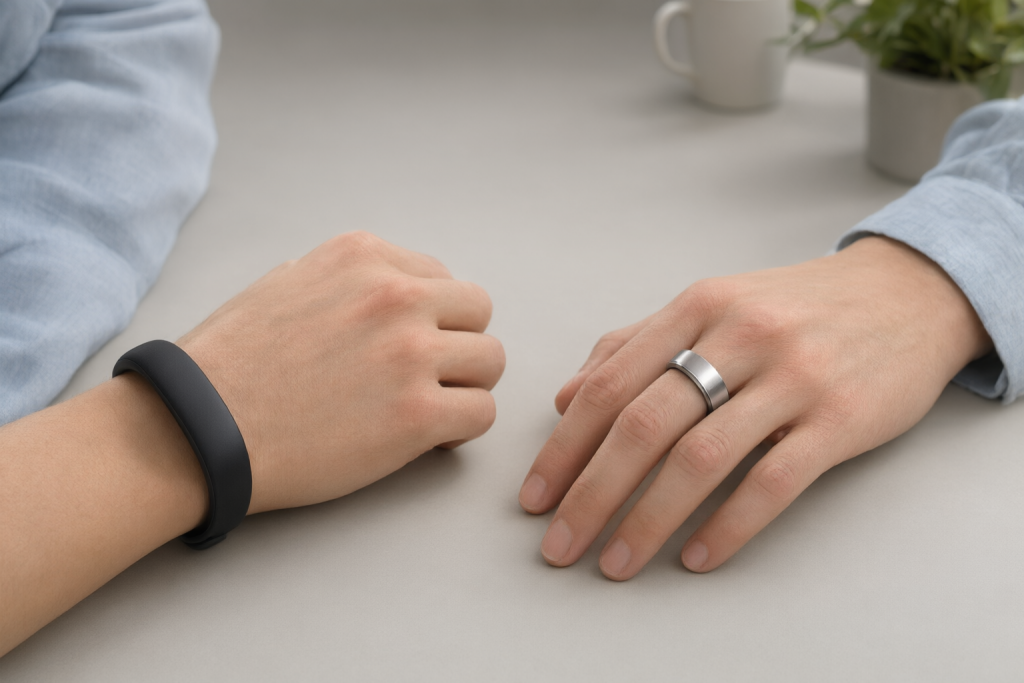
What Is the Difference Between Ring-Based and Wrist-Based Wearables?
The clearest difference between a ring-based wearable and a wrist-based wearable is where the device sits on your body. A ring-based wearable is worn on a finger. A wrist-based wearable is worn on the wrist, usually as a watch or a band. Both are wearable sensing platforms, meaning both are designed to be worn on the body and to collect information through built-in sensors. Neither form is universally better than the other. The choice usually comes down to fit, wear location, and the kind of everyday use you have in mind. Research on wearable technology describes these devices as typically built in the form of fashion accessories such as watches, glasses, or rings, with electronic systems integrated into them (https://pmc.ncbi.nlm.nih.gov/articles/PMC6948269). That description matches the two form factors discussed here: a ring and a wrist-worn watch or band are both wearable platforms, and the main structural difference is the body location they occupy.[source]
Because the two devices sit in different places, they interact with your body and your surroundings in different ways. A ring occupies a small, fixed spot on a finger. A wrist device occupies a larger area on the arm and is often visible while you move. These physical differences are the starting point for every practical comparison that follows, from how each feels during daily tasks to how easily each fits into an existing routine.
How Wear Location Shapes Everyday Use
Wear location matters because it changes how a device interacts with you and with the environment around you. Wearable devices are commonly built as fashion accessories such as watches, glasses, or rings, and clothing and accessories are physically the closest media to the human body and are worn for the longest time compared with other mobile items (https://pmc.ncbi.nlm.nih.gov/articles/PMC6948269). That constant presence is part of why form factor is not just an aesthetic detail. A device that sits comfortably and stays in place is more likely to be worn consistently, and consistent wear is what makes any wearable useful in daily life.[source]
The same research notes that wear location affects how a device interacts with the user and the environment, and that wearable sensing can measure signals from a range of body parts and detect movement (https://pmc.ncbi.nlm.nih.gov/articles/PMC6948269). In practical terms, a finger-worn ring and a wrist-worn watch or band each sit at a different point on the body, so each experiences daily activity differently. A ring may be less noticeable during tasks that involve the hands, while a wrist device may be more visible and may sit differently during activities that bend or rotate the wrist. These are general observations about location, not claims about accuracy or medical benefit for either form.[source]
A Comparison Table That Helps You Decide
The table below is organized around decisions rather than specifications. For each decision, it explains how a finger fit and a wrist fit tend to differ, and what to verify in the documentation for the exact model you are considering. Because sensing, charging, and app details vary by product, the table frames those items as checks to confirm rather than as fixed facts about either form factor.
| Decision | How finger fit affects it | How wrist fit affects it | What to verify in the exact model documentation |
|---|---|---|---|
| Fit during typing or gripping | A ring sits on a finger that bends and presses during typing or gripping, so it may feel noticeable or shift depending on how it is sized and worn. | A wrist device sits above the hand, so it may rest against a desk or surface during typing or gripping and can feel bulky or catch on objects. | Check the manufacturer's guidance on intended fit, sizing, and how the device is meant to be worn during hand-intensive tasks. |
| How you access readings | Readings are typically viewed on a paired phone or app rather than on the ring itself, since a ring has little surface for a display. | A wrist device may show some information on its own screen or rely on a paired phone or app, depending on the model. | Confirm where readings appear, whether the device has its own display, and which app or platform is required to view them. |
| Sensing capabilities | What a ring senses depends on the sensors built into that specific ring, not on the fact that it is worn on a finger. | What a wrist device senses depends on the sensors built into that specific model, not on the fact that it is worn on the wrist. | Check the manufacturer's documentation for the list of sensors and the measurements the model is designed to record. |
| Charging | A ring's small size can affect how it is charged and how often, but the method and interval vary by model. | A wrist device's larger body can affect how it is charged and how often, but the method and interval vary by model. | Verify the charging method, what is included, and the manufacturer's stated charging guidance for the exact model. |
| App compatibility | A ring still depends on a companion app or platform to display and store data, and that requirement is model-specific. | A wrist device may work with a companion app or platform, and that requirement is model-specific. | Confirm which operating systems and app versions the model supports, and whether an account is required. |
| Everyday wearability | Comfort depends on sizing, finger shape, and the activities you do, so a ring may suit some routines and not others. | Comfort depends on band fit, wrist shape, and the activities you do, so a wrist device may suit some routines and not others. | Check the manufacturer's sizing and fit guidance, and try the device in your own routine if possible. |
What Wearable Sensing Can and Cannot Tell You
Wearable sensing has been explored for measuring vital signals and detecting movement, and the type and placement of sensors determine what is measured (https://pmc.ncbi.nlm.nih.gov/articles/PMC6948269). For example, research describes wearable sensing used to measure and display heart-beat rates and body heat through a built-in screen and a smartphone application for health care, and sensors can be relocated to sense body conditions or environmental situations around the wearer (https://pmc.ncbi.nlm.nih.gov/articles/PMC6948269). This tells you that wearable sensing is a real and active area of technology, and that what a device measures is tied to its sensors and their placement.[source]
What this article cannot tell you is how accurate any particular device is, whether it performs at a medical grade, or whether it has diagnostic value. Those questions depend on the specific product and its documentation, and this educational comparison does not establish them for any device. If you want to understand what a specific model is designed to do, check that model's documentation directly, and speak with a qualified healthcare professional about any health concern rather than interpreting device readings on your own.
Factors to Weigh When Choosing a Ring or Wrist Wearable
Because comparable evidence does not support a definitive ranking of the two form factors, the most useful approach is to answer a few questions for yourself. The list below frames those questions around factors grounded in general wearable evidence: comfort and wearability during daily activity, how the device fits into your existing routines, whether the wear location suits the tasks you care about, and how the device is intended to be used.[source]
One practical consideration is how the device handles your daily environment. Research on wearable technology notes that wearable sensing can be directed at the wearer's body conditions or at the environmental situations around the wearer, depending on sensor type and placement (https://pmc.ncbi.nlm.nih.gov/articles/PMC6948269). If your routine involves a lot of hand movement, a ring may feel different than a wrist device; if your routine involves wrist-heavy tasks, the reverse may be true. Only you can judge which feels more natural, and trying a device in your own routine is the most direct way to find out.[source]
Questions to ask before choosing a form factor
- How does it feel during your typical day? Think about the activities you do most often and whether a finger-worn or wrist-worn device would interfere with them. Comfort is personal and depends on fit, activity, and preference.
- Does it fit your existing routine? Consider whether you already wear a watch or a ring, and whether adding a device in that location would feel natural or disruptive.
- Does the wear location suit the tasks you care about? Different locations interact with the body and environment differently. Decide which location better matches what you want to do with the device.
- How is the device intended to be used? Check the manufacturer's documentation for how the specific device is designed to be worn and used, since capabilities vary by product.
- What should you verify before buying? Confirm the sensing features, charging method, and app compatibility for the exact model, since these details differ from product to product.
When to Talk to a Healthcare Professional
This educational comparison cannot determine whether any specific device is a diagnostic device or how it is classified. That depends on the exact product and its documentation, which this article does not assess. If you have a concerning symptom or a health question, discuss it with a qualified healthcare professional rather than interpreting device data on your own. This article is educational and does not provide triage, emergency instructions, or individualized medical advice.
Frequently Asked Questions
Is a ring wearable more accurate than a wrist wearable?
This article does not claim that one form factor is more accurate than the other. Accuracy depends on the specific device, its sensors, and its documentation. Check the manufacturer's confirmed specifications for the product you are considering rather than assuming that wear location alone determines accuracy.
Which form factor is more comfortable for all-day wear?
Comfort is personal and depends on fit, activity, and preference. Wear location changes how a device feels during daily tasks, but neither form is universally more comfortable. A ring and a wrist device each sit at a different point on the body, so the better choice for you depends on your own routine and how each feels when you wear it.
Can a ring or wrist wearable diagnose a health condition?
This educational comparison cannot determine whether any specific device is a diagnostic device or how it is classified; that depends on the exact product and its documentation. If you have a health concern, speak with a qualified healthcare professional.
Do ring and wrist wearables measure the same things?
What a device measures depends on its sensors and design, not solely on whether it is worn on a finger or the wrist. Because specific measurements vary by product, check the manufacturer's documentation for the device you are considering rather than assuming that both form factors measure the same signals.
How do I check whether a wearable's readings are easy to access?
Access to readings depends on the model. Some devices show information on their own display, while others rely on a paired phone or app. Check the exact model's documentation to confirm where readings appear, which app or platform is required, and whether an account is needed.
What should I verify about charging and app compatibility before choosing?
Confirm the charging method, what is included, and the manufacturer's charging guidance for the exact model. Also check which operating systems and app versions the model supports, and whether a companion account is required. These details vary by product and are not determined by form factor alone.