
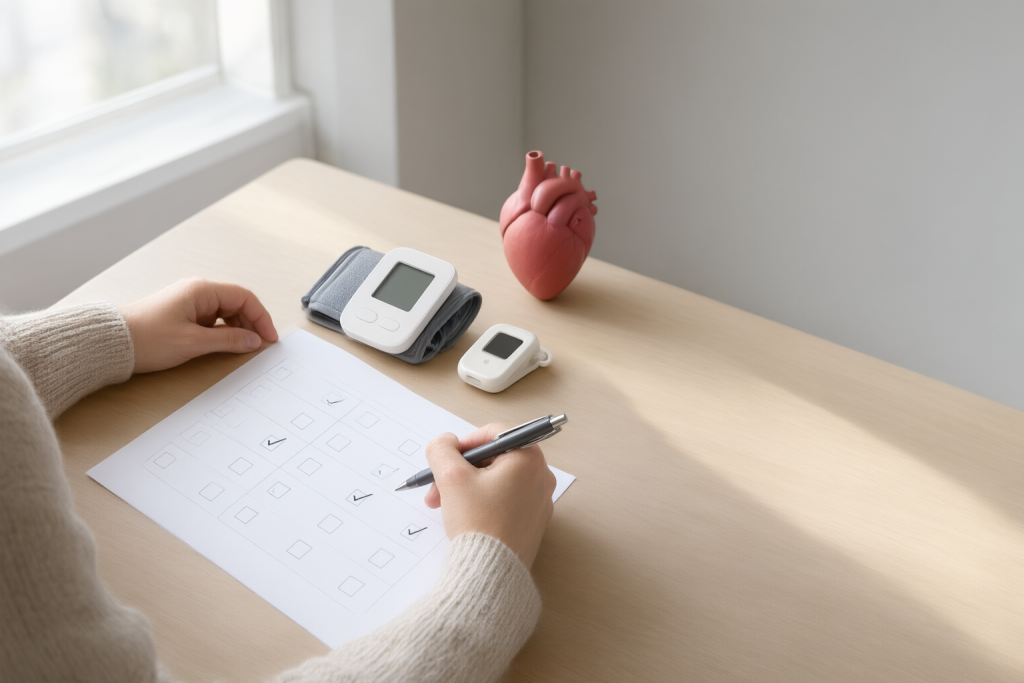
Choosing a Home Health Monitoring Device: A Practical Checklist
Use this home health monitoring device checklist to match the record you need with equipment you can use. Start by writing: "I want to record ___ so I can ___." Then use the decision table below and the two-model worksheet to build a shortlist and identify any unanswered essential question. These are practical shopping prompts, not a clinical scoring system.
Two boundaries shape the whole guide. First, evidence belongs to an exact model and intended use, so a study of one device does not establish the performance of another. Second, not every wellness feature carries the same regulatory status as a medical device; the FDA explains that some general-wellness software functions are treated differently from functions intended for medical purposes.[source]
1. Match the device to one real monitoring task
Start with a measurement or a record you will use. "More health data" is too broad to help you choose. A caregiver should also ask who will take the reading, who will record it and who needs to review it.
The blood pressure row reflects the American Heart Association's home-monitoring guidance on validated upper-arm monitors and cuff fit. The glucose-system description follows the FDA's guide to blood glucose meters. The weight and wearable rows are practical shopping prompts, not recommendations for diagnosing a condition. Read the official guidance.[source]
If you are deciding about glucose monitoring, use our questions for a first meter-versus-CGM discussion. Choose the plan before buying the hardware; a general health wearable should not be treated as a substitute for the measurement your care team has asked you to take.
| Your task | Starting category | What to check first |
|---|---|---|
| Bring home blood pressure readings to a healthcare visit | A validated upper-arm blood pressure monitor | Cuff fit and validation for the intended user, following AHA guidance |
| Take blood glucose readings under an agreed monitoring plan | A blood glucose meter and its compatible testing supplies | The exact meter, compatible strips, instructions and ongoing supply cost |
| Compare finger-stick testing with continuous glucose monitoring | Review the two approaches with your care team | What question the record must answer and which system is appropriate for you |
| Keep a body-weight record | A scale that fits your reading and recording routine | Display readability, placement instructions and how separate users keep records |
| Review everyday sleep or activity patterns | A wearable with the specific tracking features you want | Fit, supported metrics, charging and how you will review the record |
2. Check evidence for the exact model and purpose
A feature list tells you what a product offers. Validation tells you something different: how a particular measurement performed under the conditions that were tested. A study of a different model, sensor or population does not establish the performance of the device in your shopping cart.
For home blood pressure monitoring, the American Heart Association's home-monitoring guidance recommends an automatic upper-arm cuff monitor that has been validated, and it emphasizes choosing the right cuff size. Ask the seller or your care team whether validation covers the intended user, including children or pregnant people. Our upper-arm cuff-size guide explains the fit question in more detail. Read the official guidance.
Ask the seller for the model name, its intended use and the relevant instructions or evidence. If a medical-use claim relies on FDA clearance or another authorization, check the exact device and authorized use rather than relying on a logo or a statement about the brand.[source]
Not every wellness feature has the same regulatory status as a medical device. The FDA distinguishes certain general-wellness functions from functions intended for medical purposes, and its general-wellness explanation describes that distinction. Neither "AI-powered" nor an attractive dashboard demonstrates that a device can diagnose illness or guide treatment.[source]
3. Compare two models using the same worksheet
Copy this table into a note and complete one column for each candidate. A blank answer is a question for the seller, not a reason to assume the feature is present. These are editorial comparison prompts, not a clinical scoring system.
A simple way to use the result: mark each row "confirmed," "needs an answer," or "does not meet my need." A model that fails your essential task should leave the shortlist even if it offers more unrelated features. Do not invent a numerical winner by adding together unlike claims.
| Check | Model A | Model B | Evidence to request |
|---|---|---|---|
| My task and the exact measurement or record | Write here | Write here | Model instructions and intended use |
| Fit and ease of taking a reading | Write here | Write here | Cuff or ring sizing, display and controls |
| Phone and app requirements | Write here | Write here | Supported phone, operating system and pairing instructions |
| How I will review or share a record | Write here | Write here | A real demonstration of history, units and any sharing option |
| Consumables and ongoing cost | Write here | Write here | Compatible supplies, replacement availability and subscription terms |
| Battery or charging routine | Write here | Write here | Charging instructions and the stated conditions for battery life |
| Data access and account control | Write here | Write here | Privacy policy, permissions, sharing and deletion options |
| Returns, warranty and setup help | Write here | Write here | Current seller terms and a usable support contact |
4. Count the cost of keeping it useful
The purchase price is only one part of ownership. For a glucose meter, check the compatible test strips and other supplies you will need. The FDA's meter guide specifically includes cost, ease of use and special features among the factors to consider. Ask about the supplies for the actual model rather than assuming strips can be exchanged between meters.[source]
For an app-connected device, check whether the advertised feature requires a paid plan and what remains available without it. For any battery-powered device, choose a charging routine you can sustain; there is no single battery-life number that makes every kind of home monitor a good choice.
If buying for another person, include setup and assistance in the comparison. Can they read the display, follow the steps and find the previous result? A short demonstration can reveal more about everyday usability than a longer specification list.
5. Test the record-to-review workflow
Before choosing an app-connected model, ask to see one complete example: take a reading, find its date and unit, and locate it again in the history. Then check the sharing method you actually need. Bluetooth, an app and an account do not by themselves establish that your clinician will receive the record.
Sharing rules depend on the device. The FDA states that over-the-counter blood glucose monitoring systems are for single-patient use and should not be shared. For another type of household device, check whether its instructions permit shared use before asking how different people's readings stay separate. For a caregiver, agree who can access the account and how the person being monitored will remain involved. Our household blood pressure record guide gives a concrete example of keeping identities clear.[source]
Check privacy in the actual service you plan to use. Ask who receives your information, which permissions are necessary and how you can stop sharing or remove an account. For a personal-use app, confirm with the provider whether HIPAA applies to the data you enter; do not assume that every consumer app is HIPAA-covered. Review the HHS guidance on personal-device health information and ask the seller about the specific service.
6. Choose the next step that fits your purpose
If a clinician has asked for a particular measurement, confirm the appropriate equipment and recording routine with them. If your aim is everyday wellness tracking, use the worksheet to decide which features you will review and which you can leave out.
For readers considering a ring for everyday tracking, the aiRing Lite product page and the aiRing Ultra product page are places to compare the exact models. Use the same questions about fit, compatibility, records and ownership cost; this article does not assign either model a medical use or a competitor's research results.
Before buying, you should be able to name your task, explain why the model fits it and identify any unanswered essential question. If you cannot, ask for that answer or keep comparing. Buying nothing yet is a useful outcome when the device would not solve the problem you started with.
Frequently Asked Questions
What should I look for in a home health monitoring device?
Start with the measurement or record you need. Then compare evidence for the exact model, fit, usability, supplies, phone requirements, review options, privacy and ongoing cost. Use the worksheet rather than choosing by the number of advertised features.
Does every health wearable need FDA clearance?
No single clearance rule applies to every wellness feature. Regulatory status depends on the product and intended use. Check a medical-use claim against the exact authorization; do not treat a general wellness function as a validated medical measurement.
Does an app automatically share readings with my doctor?
Do not assume that it does. Ask for a demonstration of how the specific device and app store and share a reading, and confirm how your care team wants to receive records.
How do I choose a device for a family member?
Complete the comparison with the person who will use it. Check fit, readable controls and display, the steps to obtain a result, account access and how different people's records remain separate.
References
- Step 3: Is the Software Function Intended For Maintaining or Encouraging a Healthy Lifestyle? | FDA — www.fda.gov
- Blood Glucose Monitoring Devices | FDA — www.fda.gov
- https://www.heart.org/en/health-topics/high-blood-pressure/understanding-blood-pressure-readings/monitoring-your-blood-pressure-at-home — Authoritative source
- https://www.hhs.gov/hipaa/for-professionals/privacy/guidance/cell-phone-hipaa/index.html — Authoritative source