
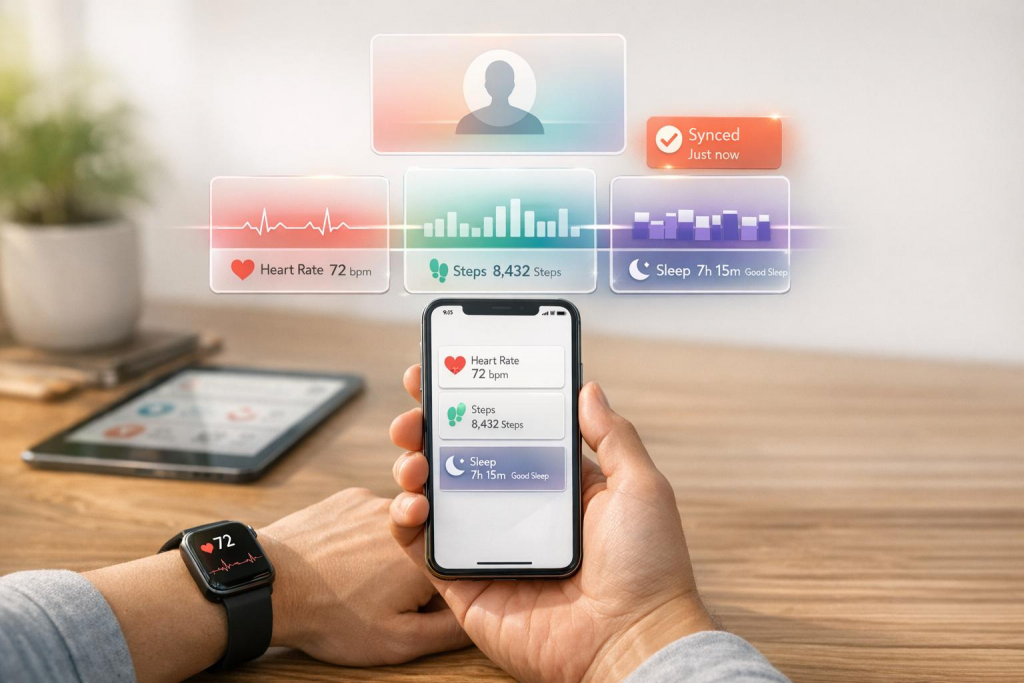
Ever feel like your health data is scattered across too many devices? Your smartwatch tracks steps, your fitness tracker monitors sleep, and your heart rate monitor collects pulse data – but none of them talk to each other. This creates fragmented information that makes it hard to see the big picture of your health.
AI changes this. It acts as a smart system that syncs data across devices, fixes timing errors, and merges information into one clear profile. By reducing synchronization delays from 30 milliseconds to just 0.356 milliseconds, AI ensures your devices stay in sync almost perfectly. It also filters out irrelevant data, learns your personal health patterns, and provides real-time alerts – helping you manage conditions like heart issues or posture problems more effectively.
Here’s what AI-powered health sync offers:
- Unified health data: Combines step counts, heart rate, and sleep metrics into one profile.
- Accurate timing: Fixes delays caused by Bluetooth or device errors.
- Personalized feedback: Alerts you to health risks based on your unique patterns.
- Real-time updates: Uses AI to process data instantly, reducing delays by 85%.
With tools like the AIH Health App, syncing your devices is simple. Pair wearables like aiSpine and aiRing, enable data integration, and set up cloud sync for continuous updates. The result? A complete view of your health that helps you make smarter decisions every day.
AI-Powered Health Sync Performance Metrics and Benefits
Embedded Edge | Innovation in Medical IoT: Wearable Biometrics, AI in Healthcare, and New Devices
Common Problems with Multi-Device Health Data Sync
Using multiple health devices might seem like a great way to track your well-being, but they often operate within their own ecosystems, leaving your health data fragmented and disconnected.
Isolated Data and Incomplete Health Pictures
Each device – whether it’s monitoring steps, heart rate, or sleep – tends to work independently, offering isolated snapshots rather than a well-rounded view of your health. For example, a sudden spike in heart rate might seem alarming if viewed alone, but without the context of your recent activity, like exercise or stress, it can be misleading.
"Having all these data doesn’t necessarily give the full picture of health." – npj Digital Medicine
This lack of integration makes it harder for healthcare providers and AI tools to build a complete, long-term profile of your health. Without this, spotting trends or predicting potential health issues becomes much more challenging.
Fragmentation becomes even trickier when you consider the differences in how devices handle data.
Different Data Formats Between Devices
Health devices vary widely in how they collect and store data. They sample at different intervals and use unique formats, making it difficult to align measurements. On top of that, hardware differences – like crystal reference drifts or sensitivity to temperature – can introduce errors over time.
Wireless technology adds another layer of complexity. For instance, Bluetooth Low Energy can cause delays due to signal interference or retries, while proprietary data formats from manufacturers create barriers to integration with other devices and clinical systems. As of 2021, over 100 million people used a single smartwatch brand, yet much of that data remained siloed, disconnected from broader health platforms or medical records.
Even when data is unified, the lack of intelligent analysis can make it less useful.
Generic Insights Without AI Processing
When fragmented or misaligned data is aggregated without AI processing, the results are often underwhelming. Traditional syncing methods simply collect numbers from various devices into separate apps, leaving users with raw, uncontextualized data. For example, your step count might appear in one app and your sleep score in another, but there’s no meaningful connection between the two.
Without AI to filter and interpret the data, users are left with information overload – too much data and no clear way to act on it. This can also be a problem for doctors, who may struggle to draw conclusions from such disorganized information. In some multi-device trials, a 2.7% failure rate was reported due to issues like software updates and battery problems, highlighting the fragility of these systems when they aren’t well-integrated.
How AI Improves Multi-Device Health Sync
AI is reshaping how wearable devices interact by addressing issues like fragmented data, timing misalignments, and generic insights. It creates a unified health profile by integrating data across multiple devices, offering a more complete view of your well-being.
AI Combines Data from Multiple Devices
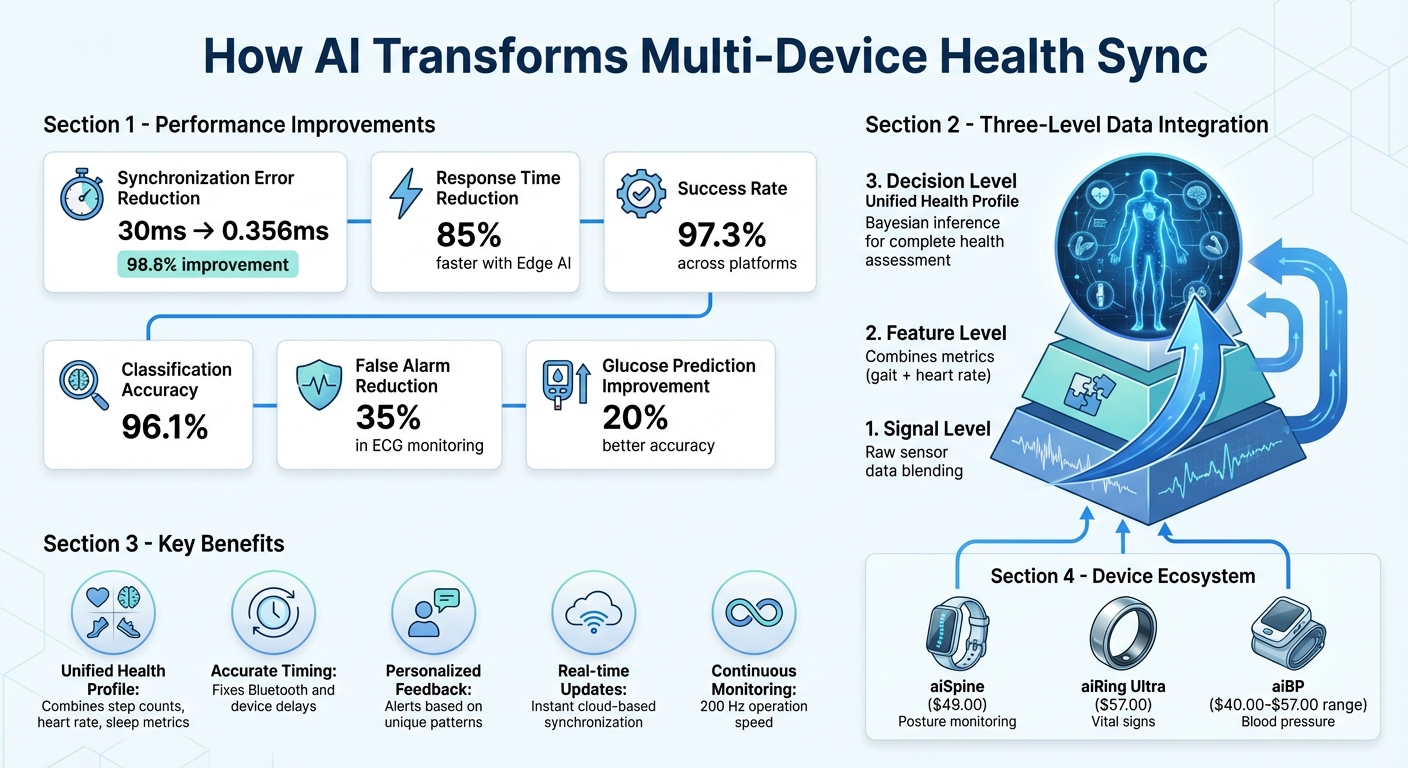
AI works on three levels to merge data from various devices into a cohesive health profile. At the signal level, it blends raw sensor data. At the feature level, it combines metrics like gait and heart rate. Finally, at the decision level, it employs methods like Bayesian inference to deliver a comprehensive health assessment.
"To get the full picture, we may often need to combine different data streams. It’s like putting together a puzzle of our health, instead of just looking at individual pieces." – Yunus Celik, Department of Computer and Information Sciences, Northumbria University
A great example of this is the AIH Health App, which integrates posture data from aiSpine with vital signs from aiRing to create a "digital twin" of your body. This means that if your heart rate suddenly spikes, the AI can determine whether you were exercising or sitting still by referencing posture data – context a single device can’t provide. The platform even builds personalized models based on your unique posture patterns, making real-time synchronization across devices possible.
Instant Cloud-Based Data Updates
AI ensures seamless synchronization between devices using neural networks to correct for hardware drifts and wireless delays, which are common culprits of timing errors. This technology has reduced synchronization errors from 30 milliseconds to just 0.356 milliseconds – a 98.8% improvement.
The system relies on a hybrid computing architecture. Edge AI processes real-time data directly on your device, giving you immediate feedback, while Cloud AI handles large-scale historical data to identify long-term health trends. This setup reduces response times by 85% compared to relying solely on cloud analysis. For instance, if aiSpine detects a posture issue, you’ll feel an instant vibration alert rather than waiting for a delayed notification.
Personalized Health Feedback and Warnings
With data synced across devices, AI provides tailored feedback based on your health patterns. The AIH Health App creates personalized models by learning your unique posture habits and baseline vital signs, alerting you when deviations occur. For example, by combining data from accelerometers and heart rate monitors, AI can detect risks like arrhythmias by analyzing your heart rate in the context of your activity level.
These alerts are delivered through app notifications and haptic feedback. AI-powered systems in wearable ECG monitors have already shown a 35% reduction in false alarms compared to traditional methods. In managing chronic conditions, AI integration has improved glucose fluctuation predictions by 20%. The upcoming aiNeuro device aims to take this further by offering preemptive stroke warnings based on posture monitoring.
sbb-itb-44aa802
How to Set Up AI-Powered Multi-Device Sync
Getting your AIH Health App ready for multi-device synchronization is quick and straightforward. By connecting your wearables, enabling AI integration, and syncing data across devices, you can create a seamless health monitoring experience. Here’s how to do it.
Step 1: Connect Your Devices to the AIH Health App
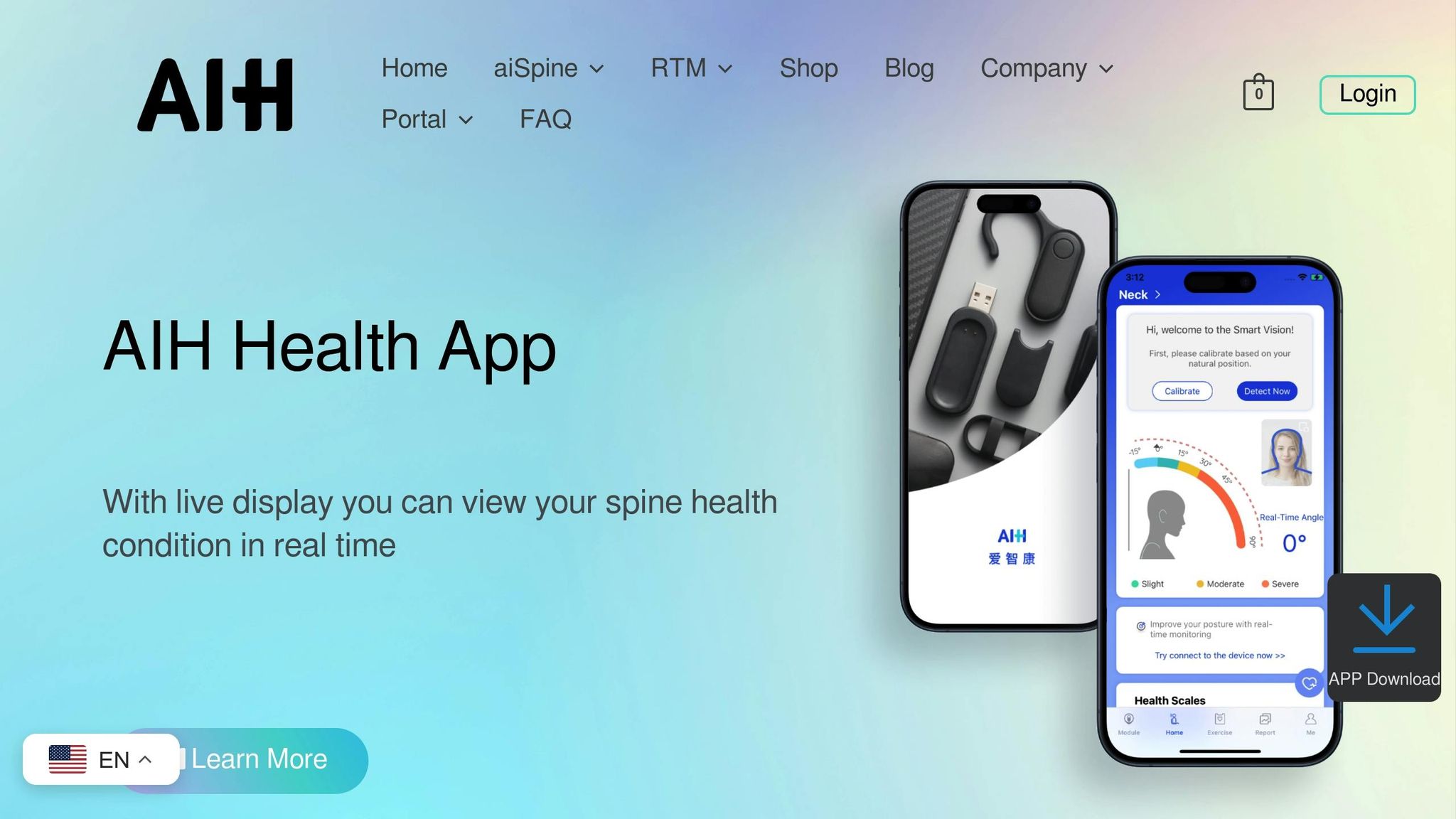
Start by ensuring Bluetooth is enabled on your smartphone. Both the aiSpine and aiRing devices use low-power Bluetooth 4.0 for stable connections. Open the AIH Health App, navigate to the device pairing section, and select your wearable from the list. The aiRing supports multi-device linking, letting you integrate several wearables into your health setup.
When configuring the aiSpine, choose your preferred wearing mode in the app. Options include over-ear, attached to glasses, or clip-on (front or back). Keep your phone nearby during this process to ensure a solid connection.
After pairing, move on to activating AI data integration to unify your sensor data.
Step 2: Activate AI Data Integration
Once your devices are linked, enable the AI Data Integration (or Sensor Fusion) feature in the app settings. This combines data from various sensors – like motion tracking from aiSpine and vital signs from aiRing – into a single health profile. The app’s AI filters out irrelevant noise and movement artifacts, ensuring the insights you receive are both accurate and actionable.
"The magic of wearables used to live in the sensor but now, it lives in the synergy between sensors, software, and artificial intelligence." – AJProTech
Make sure your AIH Health App is updated to the latest version (1.6.1) to access the newest AI enhancements.
With data integration active, the next step is enabling cloud sync for continuous updates.
Step 3: Enable Cloud Sync
Turn on cloud sync to back up your health data and enable Remote Therapeutic Monitoring (RTM) services. This feature ensures your data is accessible across devices and can be shared with healthcare providers if needed. By uploading your data to AIH’s RTM platform, you’ll receive real-time updates, even when switching devices.
For clinical use, confirm that RTM services are active in your account settings. Beyond backing up your data, cloud sync supports RTM, which has been shown to reduce hospital readmissions and lower healthcare costs.
Step 4: Customize Your Health Alerts
Set up personalized alert thresholds to ensure you only receive notifications that matter. In the app, you can adjust alerts for metrics like posture angles (aiSpine) or vital sign irregularities (aiRing). You can also enable vibration reminders on aiSpine for instant feedback when poor posture is detected.
Notifications are delivered via mobile alerts and haptic feedback directly on your wearable. By analyzing your baseline data, the AI minimizes false alarms, focusing only on changes that are clinically relevant.
Step 5: Check Your Data Accuracy
Use the Live Display feature in the app to monitor real-time health metrics during different activities. The dashboard consolidates data from all connected devices, making it easy to confirm that everything is syncing as it should. Check the Historical Data Analysis section regularly to track long-term trends for both aiSpine and aiRing.
If you notice any discrepancies, make sure your devices are fully charged – aiSpine, for instance, has a 7-day standby battery. High-precision sensors ensure reliable data, so addressing small calibration issues can improve results. Routine checks help refine your AI’s personalization over time.
Benefits of AI-Powered Multi-Device Sync
AI-powered synchronization offers practical advantages by combining streamlined data integration with real-time updates, making it more effective and user-friendly.
More Precise and Continuous Data
AI-driven synchronization eliminates timing errors and data gaps that are common in traditional systems. For instance, advanced neural networks reduce synchronization errors between Bluetooth wearables from 30 ms to just 0.356 ms. This ensures that real-time data – like posture tracking from aiSpine and heart rate monitoring from aiRing – aligns accurately, even when factors like temperature shifts or hardware inconsistencies come into play. Operating at speeds of up to 200 Hz, the system compensates for Bluetooth delays and fills small data gaps, delivering uninterrupted and precise information.
Improved Management of Chronic Health Conditions
For individuals managing chronic conditions like cardiovascular disease or spine issues, AI-powered multi-device sync provides tailored insights. By integrating posture data from aiSpine with vital signs from aiRing, the system creates a "digital twin." This allows it to distinguish between normal exercise-induced heart rate changes and potential arrhythmias by analyzing accelerometer and ECG data together. It also includes predictive features, such as forecasting blood sugar levels up to an hour in advance. Neural network synchronization has shown a 97.3% success rate across various platforms, further demonstrating its reliability.
Seamless Integration Across Devices
The AIH Health App simplifies connecting and syncing devices. Once you pair your aiSpine ($49.00) and aiRing Ultra ($57.00), the system uses low-power Bluetooth 4.0 for stable connections while preserving battery life. Edge AI processing enhances performance by analyzing data locally, cutting response times by 85% compared to cloud-only methods. This means you get instant feedback through app notifications or device vibrations. With aiRing’s waterproof design and aiSpine’s versatile wearing options, you can monitor your health continuously – whether you’re at the gym, at work, or asleep.
Conclusion
AI-powered multi-device synchronization brings all your health data together, creating a complete and detailed picture of your well-being. By cutting synchronization errors from 30 ms to just 0.356 ms and integrating data from devices like aiSpine and aiRing, this technology forms a digital twin of your health. This "twin" uncovers patterns that individual sensors alone might miss.
But it’s not just about precision. With 96.1% classification accuracy, AI-driven synchronization transforms healthcare from reactive to proactive. Alan Godfrey from Northumbria University explains it best:
Fusion techniques stemming from free-living wearable health monitoring offer a promising avenue for achieving a more comprehensive understanding of an individual’s health.
For those managing chronic conditions or simply looking to gain deeper health insights, the AIH Health App is a game-changer. It consolidates data from devices like aiSpine, aiRing Ultra, and aiBP, which are priced affordably between $40.00 and $57.00. Features like instant cloud updates, personalized alerts, and seamless integration provide real-time feedback, helping users make smarter, healthier choices.
FAQs
How does AI improve synchronization between health devices?
AI improves the coordination of health devices by analyzing and aligning timing data from multiple wearables. With advanced algorithms, it identifies and corrects any timing mismatches, ensuring all devices operate smoothly together. This leads to more precise, real-time health tracking and insights that are tailored specifically to you.
What are the advantages of using a ‘digital twin’ for your health data?
A digital twin of your health data is essentially a dynamic virtual version of your unique health profile. It’s constantly updated in real-time using data from wearable devices. This virtual model enables more precise health monitoring, early detection of potential issues, and the development of treatment plans tailored specifically to you.
By simulating different scenarios and predicting possible health outcomes, digital twins empower both patients and healthcare providers to make smarter, proactive decisions. When combined with AI-driven devices – such as those provided by AIH LLC – they deliver personalized insights and interventions, improving the overall quality of health monitoring and care.
How does AI create personalized health alerts from my wearable device data?
AI leverages cutting-edge algorithms to process data from wearable devices, including vital signs, activity levels, and other health-related metrics. By identifying patterns in this data, it can spot potential health issues and send real-time alerts that are tailored specifically to your health profile. These alerts enable you to address concerns early and make smarter choices about your well-being.
What makes this even more powerful is how AI integrates information from various sources – like wearable sensors, electronic health records, and remote monitoring tools. This creates a detailed, personalized picture of your health, ensuring the alerts you receive are not only timely but also highly relevant. The result? A more proactive approach to managing your health and staying ahead of potential issues.