
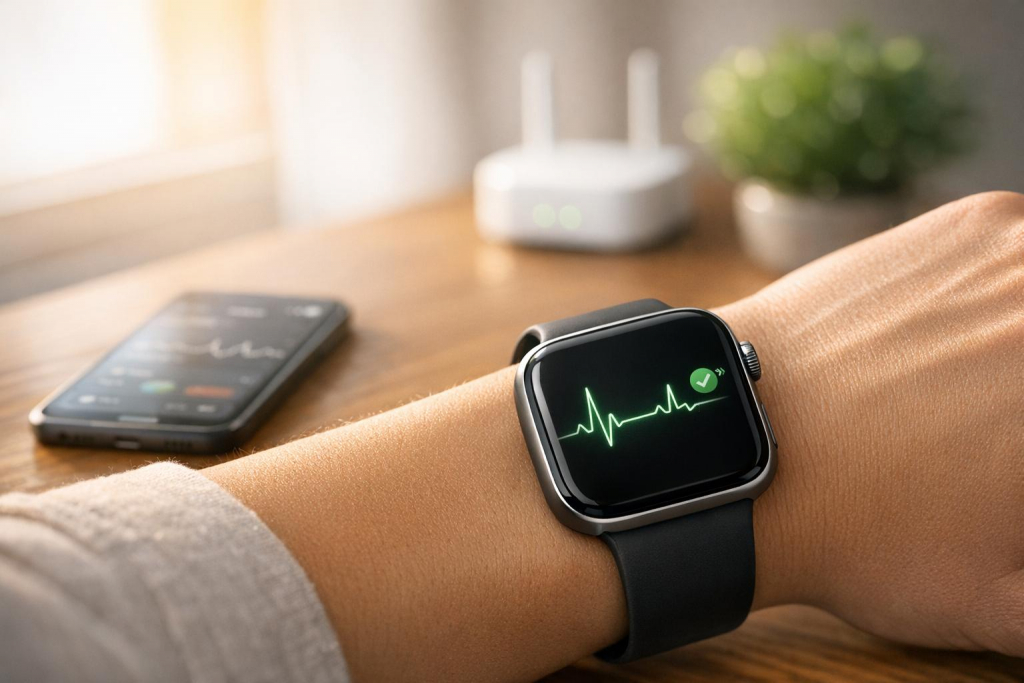
Data loss in wearable health devices can lead to missed health alerts, false alarms, and incomplete health records. This issue is critical for devices like the aiRing and aiSpine, which rely on continuous data streams to monitor vital signs and posture. Redundant protocols offer a solution by using multiple communication channels (e.g., Wi-Fi, BLE, Serial) to ensure uninterrupted data flow, even during connection failures.
Key Takeaways:
- Why it matters: Even a 20-minute gap in health data can disrupt monitoring and lead to delayed treatment.
- Common causes: Bluetooth interference, memory crashes, hardware errors, and gateway outages.
- The solution: Redundant protocols like dual-path backhaul (Wi-Fi + 5G) and local buffering can achieve 100% packet delivery.
- Real-world success: A 2026 study showed zero data loss using multi-protocol systems for ECG monitoring.
By combining multiple communication methods, caching data locally, and ensuring reliable cloud connections, wearable devices can maintain accuracy and reliability, even in challenging conditions.
How Data Loss Happens in Wearable Health Devices
Data loss in wearable health devices isn’t usually caused by one big failure. Instead, it often stems from a combination of smaller issues happening at the same time – like a dropped Bluetooth connection or an overloaded memory buffer – resulting in the loss of critical health data. Understanding these weak spots shows why having backup systems is so important.
Common Failure Points in IoT Communication
Wearable devices often rely on the 2.4 GHz ISM band, which is shared by both Bluetooth and Wi-Fi. This shared space leads to interference and packet loss, especially in crowded environments. When the spectrum gets too congested, packets can go missing without being noticed. Add physical barriers or too much distance between the wearable and its gateway, and the signal strength drops even further.
Hardware issues also play a role. Memory fragmentation can cause devices to crash after running continuously for several days. Random hardware errors, like spontaneous bit-flips, can unexpectedly take devices offline. On the software side, a poorly configured watchdog timer might either reset the device unnecessarily or fail to restart it when it freezes.
Gateways, such as smartphones or hubs, are another common weak spot. If the gateway loses power or goes offline, the wearable has to store data locally. But if the device’s buffer fills up before the connection is restored, that data is gone for good. As noted by Kinetik:
"There are times when interference occurs so the measurement results cannot be stored in the cloud database properly." – Kinetik
Here’s a quick look at some common failure categories and how they impact health data:
| Failure Category | Technical Cause | Impact on Health Data |
|---|---|---|
| Protocol | TCP session crash | Loss of all unsent data in RAM |
| Hardware | Memory fragmentation | System crashes after prolonged uptime |
| Network | BLE supervision timeout | Connection drops, creating gaps until reconnection |
| Environmental | RF interference in 2.4 GHz band | High packet loss in congested environments |
| Operational | Gateway power loss | Complete stop of data flow to the cloud |
How Data Gaps Affect Health Monitoring
When data goes missing, it doesn’t just leave incomplete records – it can disrupt the algorithms that rely on steady data streams. Continuity is key for tools like AI-driven anomaly detection and chronic disease management systems. These systems depend on uninterrupted time-series data to spot trends, and even brief gaps can lead to missed patterns or false alarms.
This problem is widespread. In both urban and rural areas, unreliable connectivity can lead to the loss of 20 to 40 minutes of continuous sensor data. For devices monitoring vital signs or spinal alignment 24/7, these gaps aren’t just inconvenient – they create unfillable holes in a patient’s health record. This highlights why ensuring consistent data flow is so critical.
To tackle these issues, robust backup systems and redundant protocols are essential. The next section will explore how these strategies can address these challenges.
sbb-itb-44aa802
How Redundant Protocols Prevent Data Loss
In healthcare, where uninterrupted data flow is essential, redundant protocols play a key role in preventing data loss. These protocols use multiple channels to ensure patient monitoring remains intact even if one channel fails. As Pelion‘s knowledge base explains:
"Network redundancy acts as a safety net, ensuring devices stay online, data remains intact, and operations continue uninterrupted even in the face of disruptions."
These strategies directly tackle common failure points and lay the groundwork for reliable IoT communication.
Core Redundancy Strategies in IoT
Several approaches work together to maintain reliable data flow in IoT systems:
- Path redundancy: This method employs multiple network interfaces – such as BLE, Wi‑Fi, and cellular – simultaneously. If one connection fails, another takes over immediately.
- Temporal redundancy: This approach deals with short-term disruptions by caching packets locally and retransmitting them once the connection is restored.
- Protocol-layer redundancy: Data is sent over multiple protocols at the same time. Using a "first-arrival-wins" strategy, the system processes the first packet received and discards duplicates.
Each method addresses specific challenges: path redundancy mitigates hardware and network failures, temporal redundancy handles brief interruptions, and protocol-layer redundancy reduces dependence on any single channel.
Redundant Protocol Examples in Practice
Practical applications of these strategies highlight their effectiveness, particularly in clinical-grade devices. A 2026 study by Nina Pearl Doe and Christian Herglotz demonstrated this using M5Stack ESP32-based sensor nodes and Raspberry Pi 5 gateways to transmit clinical ECG data over Serial/UART, Wi‑Fi, and BLE simultaneously. The results? A 100% packet delivery rate and no data loss, with a redundancy factor between 2.0 and 2.99. In protocol "races", Serial connections succeeded 65–100% of the time, while Wi‑Fi and BLE provided additional coverage. Their research emphasized:
"Systems that rely on single-protocol communications face potential limited fault tolerance and vulnerability to interference."
For added reliability, store-and-forward buffering complements multi-protocol transmission. When all external connectivity fails, devices save sensor data to a RAM ring buffer or flash memory, then retransmit it sequentially once the connection is restored. For instance, the AIH Health App, which supports continuous monitoring via devices like the aiRing vital signs ring, uses this technique to ensure health readings captured during outages are eventually synced to the user’s health record.
For cloud backhaul, combining Wi‑Fi’s low average latency (2–5 ms) with 5G’s consistent tail latency (P99 latency of 17–24 ms compared to Wi‑Fi’s 33–92 ms) provides reliable, end-to-end performance for critical health data.
Steps to Implement Redundant Protocols in Wearables
Building redundancy into wearables means covering every layer of the data flow – from the device itself to the cloud. Each layer plays a role in creating a smooth and reliable pipeline for transferring sensor data.
Short-Range Redundancy Between Devices
Redundancy starts at the wearable device. For example, devices like the aiRing or aiSpine can send sensor data through multiple channels simultaneously. Bluetooth Low Energy (BLE) is ideal for low-power, continuous data streaming, while Wi-Fi can act as a backup when BLE encounters interference. A study from October 2025 demonstrated how ESP32 microcontrollers using ESP‑NOW and a circular buffer cache kept packet loss below 1% across 20 sensor modules.
To further protect data, implement a two-stage buffer system. Use RAM for immediate storage of sensor readings and flash memory for longer-term storage during extended outages. When the connection is restored, the device can send the buffered data in sequence, ensuring no gaps in the health record.
Once device-level redundancy is in place, the next step is to secure reliable cloud connectivity.
Cloud Connectivity and Multi-Path Uplinks
Ensuring a continuous data connection between the wearable and the cloud is key to avoiding data gaps. One effective strategy is to run Wi-Fi and cellular connections simultaneously, allowing both to transmit data actively.
Robert Liao, an IoT Technical Support Engineer at Robustel, emphasizes this need:
"For mission-critical applications, a single connection path is never enough. You need redundancy."
Wi-Fi can handle most of the data traffic efficiently, with an average latency of 2–5 milliseconds. Meanwhile, a 5G or LTE-M connection acts as a reliable backup, offering a predictable P99 tail latency of 17–24 milliseconds – far more consistent than Wi-Fi’s 33–92 milliseconds under heavy load. For areas with spotty carrier coverage, eSIM or multi-IMSI technology allows the system to switch carriers automatically, ensuring uninterrupted connectivity.
Application-Layer Reliability Techniques
After securing redundant physical connections, the focus shifts to maintaining data integrity at the application level. To avoid duplicate processing when packets take multiple paths, assign each packet a unique, incrementing ID. This way, the system can retain the first packet to arrive and discard duplicates.
Additionally, implement acknowledgment and retry mechanisms. For routine vitals, set a window of 30 seconds for acknowledgment. If no acknowledgment is received, the device retransmits the packet automatically. For critical alerts, shorten the acknowledgment window to just a few milliseconds. Fine-tuning these failover windows ensures the system is efficient without adding unnecessary overhead.
How to Measure and Improve Redundant Architectures
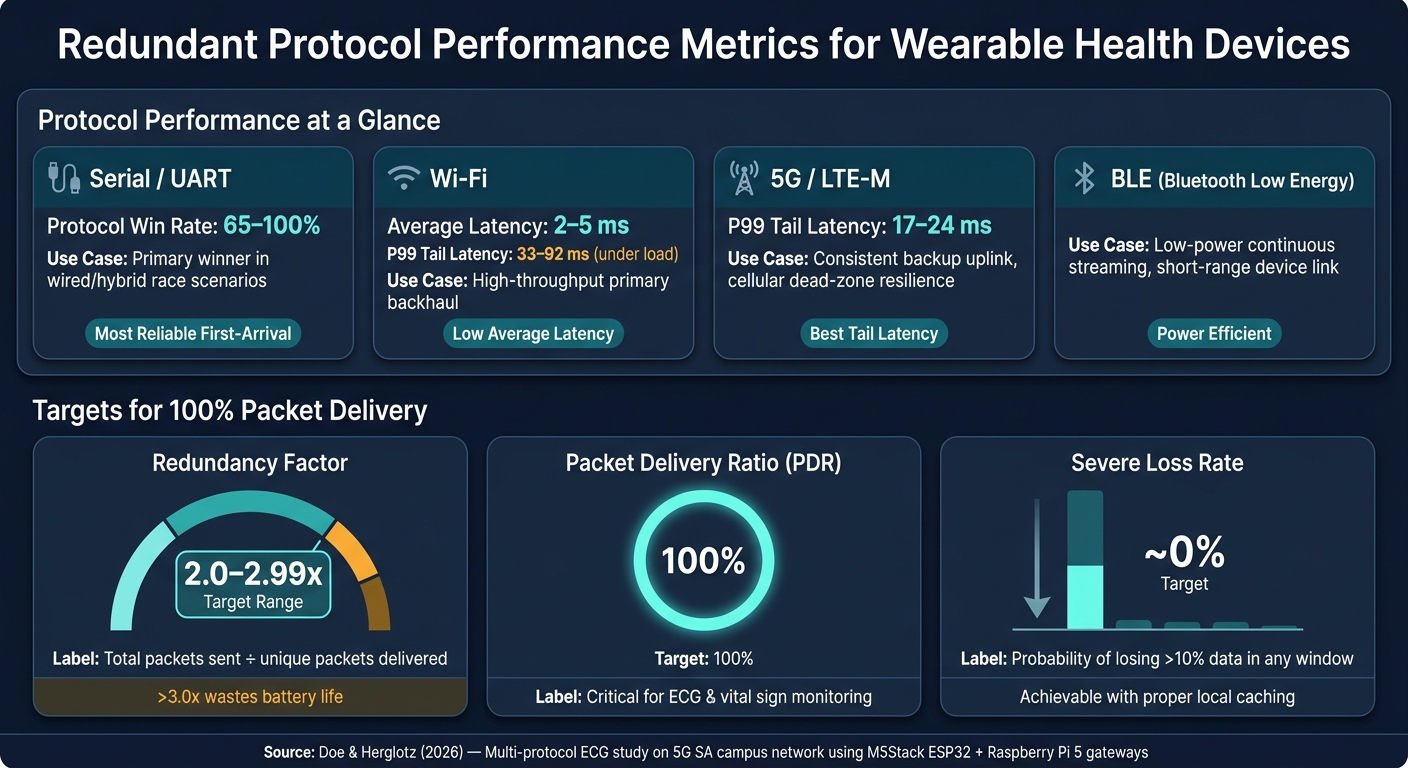
Redundant Protocol Metrics: Wi-Fi vs 5G vs BLE vs Serial for Wearable Health Data
To ensure your redundancy strategies are effective, you need to evaluate their performance using specific metrics. This step is crucial for verifying that your system can handle real-world demands.
Key Metrics for Measuring Reliability
Start with the Packet Delivery Ratio (PDR), which measures the percentage of unique packets that are successfully received. For applications like ECG monitoring, where reliability is critical, the goal is 100%. However, PDR alone doesn’t provide the full picture.
You should also track average latency and P99 latency. For instance, 5G networks consistently deliver better P99 latency (17–24ms) compared to Wi-Fi (33–92ms) under heavy load.
In addition to PDR and latency, there are three other metrics worth monitoring:
| Metric | What It Measures | Target |
|---|---|---|
| Redundancy Factor | Total packets sent ÷ unique packets delivered | 2.0–2.99x for 100% delivery |
| Severe Loss Rate | Probability of losing >10% of data in any window | Effectively 0% with proper caching |
| Protocol Win Rate | How often a specific protocol delivers a packet first | 65–100% for Serial over wireless |
The redundancy factor is particularly useful for balancing reliability and efficiency. If this factor exceeds 3.0x, you’re likely wasting battery life on unnecessary retransmissions. Staying within the 2.0–2.99x range ensures reliable delivery without overusing resources.
Testing Redundancy in Practical Scenarios
Defining metrics is just the beginning. To truly understand their effectiveness, you need to test your system under real-world conditions. Lab benchmarks often fail to capture the complexities of actual usage, so testing in challenging environments is essential.
For example, in early 2026, researchers Nina Pearl Doe and Christian Herglotz tested a multi-protocol setup for clinical ECG monitoring. Using M5Stack ESP32-based sensors on a 5G SA campus network, they streamed data over UART, Wi-Fi, and BLE at rates between 250 Hz and 1,000 Hz. Their results showed 100% packet delivery, with Serial/UART winning the protocol race 65–100% of the time. Meanwhile, Wi-Fi and BLE provided backup in wireless-only scenarios.
"This additional testing confirms that even protocols with strong single-path performance must be evaluated under compounded failure conditions."
For U.S.-specific scenarios, consider stress-testing your system in environments like subway commutes through cellular dead zones or during peak home Wi-Fi congestion in the evening. Simulate failures such as gateway outages or flash memory overflow to assess how well your store-and-forward system recovers. After reconnection, check whether buffered data uploads sequentially without overwhelming the network. This "drain protocol" behavior is a hallmark of a robust architecture that can handle real-world challenges.
Conclusion: Building Reliable Data Pipelines for Wearable Health
Data loss in wearable devices poses a serious risk to patient safety.
"Reliable sensor communication is critical for Internet of Things (IoT) applications where data loss has significant consequences."
To address this, combining edge protocols, dual-path backhaul, and local buffering ensures that wearables can maintain accurate data streams even when network paths fail.
Key Takeaways
These redundancy strategies create a strong framework for dependable health monitoring through wearable technology. The main takeaway? No single protocol can do it all. Using a multi-protocol edge transmission approach – integrating BLE, Wi-Fi, and Serial with first-arrival-wins deduplication – achieves 100% packet delivery within the optimal redundancy range. This balance ensures both reliable data transfer and efficient transmission.
For applications like chronic disease management or spine health monitoring, where continuous data collection is critical, these architectures are indispensable. Missing even a short data window during a cardiac event or a posture-related spinal issue could prevent timely intervention. Platforms such as the AIH Health App, which works with devices like the aiSpine and aiRing, rely on uninterrupted data streams to deliver real-time health insights and personalized feedback that both patients and clinicians can depend on.
FAQs
How much extra battery does redundancy use?
Redundant communication protocols can drain battery life faster since keeping multiple connections active demands more energy compared to systems using a single protocol. While the exact energy cost depends on various factors, research indicates that redundancy can boost data traffic by 2 to nearly 3 times. On the upside, advancements such as machine learning-based packet scheduling have shown promise, cutting transmission costs by as much as 72.87%. This approach helps strike a balance between conserving power and maintaining reliable connections.
How big should the on-device buffer be?
Wearable devices don’t have a one-size-fits-all buffer size because they operate under tight storage and energy limitations. To tackle this, smart management techniques come into play. Strategies like queue-based transmission protocols, data bundling, and adaptive sampling help prioritize critical data and avoid buffer overflow. These approaches ensure dependable, real-time health tracking while making the most of the device’s limited resources.
How do you prevent duplicate data with multi-path sending?
To prevent duplicate data in multi-path sending, systems often rely on techniques such as sequence-based deduplication or a first-arrival-wins strategy. Each data packet is tagged with a unique sequence number, enabling the receiving gateway to recognize and eliminate duplicates. Devices from AIH LLC, including aiSpine and aiRing, utilize reliable frameworks to handle data precisely, ensuring duplication is avoided – even during network changes or failover scenarios.