
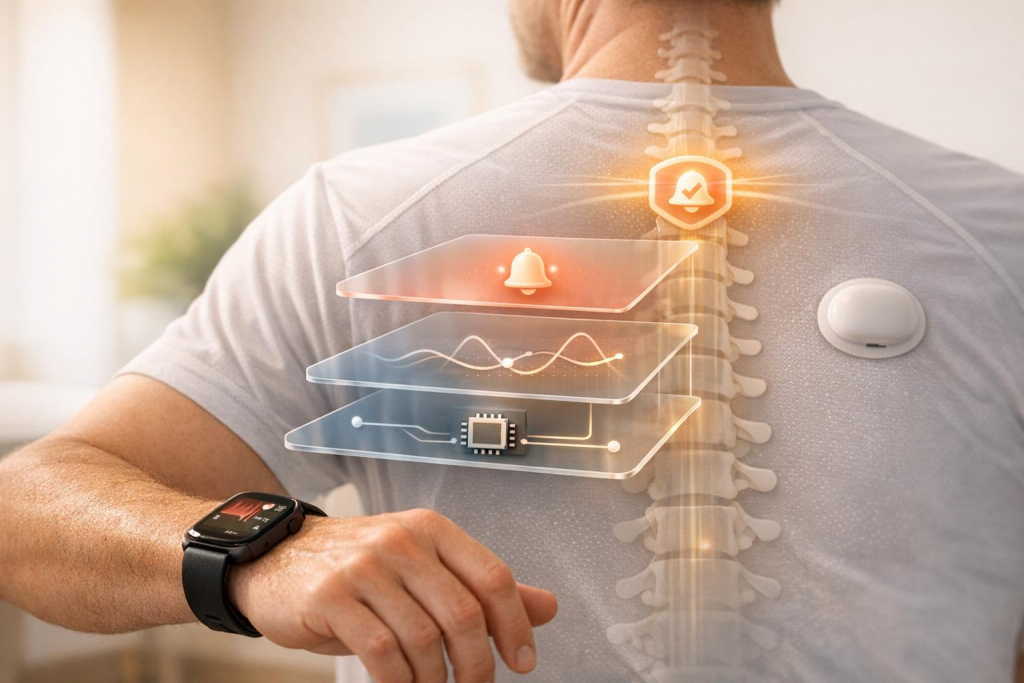
Wearable health devices generate massive, time-sensitive data streams. AI simplifies this by prioritizing critical health information, ensuring faster responses and better monitoring. Key points:
- Rule-based systems: Use simple "if-then" logic for instant alerts but struggle with nuanced patterns.
- Machine learning (ML): Learns individual baselines, detects subtle anomalies, and processes data in ~30 milliseconds.
- Hybrid approaches: Devices like AIH LLC‘s aiSpine and aiRing combine rule-based alerts with ML for precise, long-term health monitoring.
These methods ensure efficient, accurate tracking for spine health and chronic disease management, balancing speed and precision.
Expert Cardiologist: How AI & Wearables Are Changing Healthcare
sbb-itb-44aa802
1. Rule-Based Prioritization Systems
Rule-based prioritization systems rely on straightforward "if-then" logic. When a patient’s vital signs exceed preset clinical thresholds, the system immediately flags a potential issue. These thresholds, determined by healthcare professionals, are clear and reliable.
The main advantage of these systems is their simplicity and speed. They can trigger alerts for urgent situations without requiring complex calculations. For example, they work well in chronic disease monitoring when tracking specific physical parameters, like changes in spinal curvature or consistent blood pressure levels. As Luca Foschini, PhD, Co-founder and Chief Data Scientist at Evidation Health, explains:
Most people, if they are lucky, spend less than 1% of their time visiting a doctor. PGHD enables us to collect data about the remaining 99% of their time.
Accuracy
These systems improve accuracy by cross-referencing multiple data streams to separate genuine health signals from sensor noise. For instance, a sudden spike in heart rate paired with low activity levels could indicate a concern, while the same spike during exercise would be normal. Some systems even reduce false alarms by querying patient context to verify anomalies. They also establish personalized baselines to address issues like the "white coat effect". Tools like the Record Strength Score (RSS) help ensure the quality of incoming data before it’s processed.
Latency
Rule-based systems are designed for speed. With no need for complex computations, they deliver near-instant alerts when a threshold is crossed. This quick response is especially critical in remote monitoring situations, where timely identification of urgent cases can make all the difference. Their ability to act immediately makes them ideal for safety monitoring, where every second counts.
Scalability
Despite their strengths, rule-based systems face challenges with scalability. Static thresholds often fail to account for individual differences. What is normal for one person might be alarming for another, and individual baselines can shift over time. Additionally, handling large volumes of diverse data from multiple wearable devices can lead to fragmented information that simple logic struggles to unify. A fog-based framework using Intelligent Data Prioritization (IDP) demonstrated 93.5% accuracy in detecting anomalies, but machine learning models often outperform such systems. Another drawback is alert fatigue – frequent notifications without adequate context can desensitize clinicians, reducing the effectiveness of the alerts.
Suitability for Spine/Chronic Disease Monitoring
For spine monitoring, rule-based systems excel at tracking specific metrics like posture deviations or curvature angles. Devices like AIH LLC’s aiSpine integrate this data into Remote Therapeutic Monitoring (RTM) platforms. However, chronic disease management often involves more complex conditions that rigid rules may not fully capture. In such cases, combining rule-based logic for immediate safety alerts with machine learning for long-term pattern recognition offers a more comprehensive solution.
Next, we’ll explore how machine learning builds on these systems to tackle more intricate health monitoring tasks.
2. Machine Learning Anomaly Detection
Machine learning (ML) takes health data analysis to a new level by adapting to each patient’s unique physiological patterns instead of relying on static thresholds. For example, models like UniTS learn an individual’s baseline, enabling them to detect subtle changes that might signal health risks – even when vital signs stay within normal clinical ranges.
An enhanced Random Forest model demonstrated 93.5% accuracy and 90.8% precision in identifying health anomalies. Meanwhile, Transformer-based models achieved an impressive 96.1% classification accuracy. UniTS further improved performance, showing about a 22% boost in F1 score. These systems also incorporate contextual information, such as activity levels or environmental factors, to differentiate between actual anomalies and expected variations, which helps reduce false positives.
Latency
Real-time health monitoring demands ultra-fast data processing. Transformer models can process wearable health data with a latency of just 30 milliseconds. By deploying AI on fog nodes, delays are minimized, and privacy concerns are addressed simultaneously. Fog computing, paired with Intelligent Data Prioritization (IDP), ensures urgent alerts are sent to clinicians immediately, while less critical data is grouped for later review. This quick response time is crucial for wearables like those from AIH LLC, which will be discussed in the following section.
Scalability
ML systems are designed to handle large-scale operations. For instance, NoSQL databases like Apache Cassandra enable distributed processing of massive data streams from thousands of devices at once. Additionally, reinforcement learning-based adaptive sampling reduces wearable power consumption by 50% without compromising data quality. However, managing missing data due to connectivity issues remains a challenge, as it can disrupt time-series analysis.
Suitability for Spine/Chronic Disease Monitoring
ML algorithms are particularly effective for monitoring conditions that evolve over time, like spine health or chronic diseases. For spine health, these models can detect gradual changes in posture or spinal curvature that develop over weeks or months. AIH LLC’s aiSpine device uses these capabilities to monitor angular shifts in neck and back positioning. Similarly, the aiRing employs autonomous AI to continuously track vital signs for chronic disease management. A pilot study demonstrated that ML-based anomaly detection flagged anomalies with 93.75% true positive accuracy, highlighting the reliability of these systems for long-term health monitoring.
Next, we’ll dive into how AIH LLC incorporates these ML techniques into its aiSpine and aiRing devices.
3. AIH LLC‘s aiSpine and aiRing
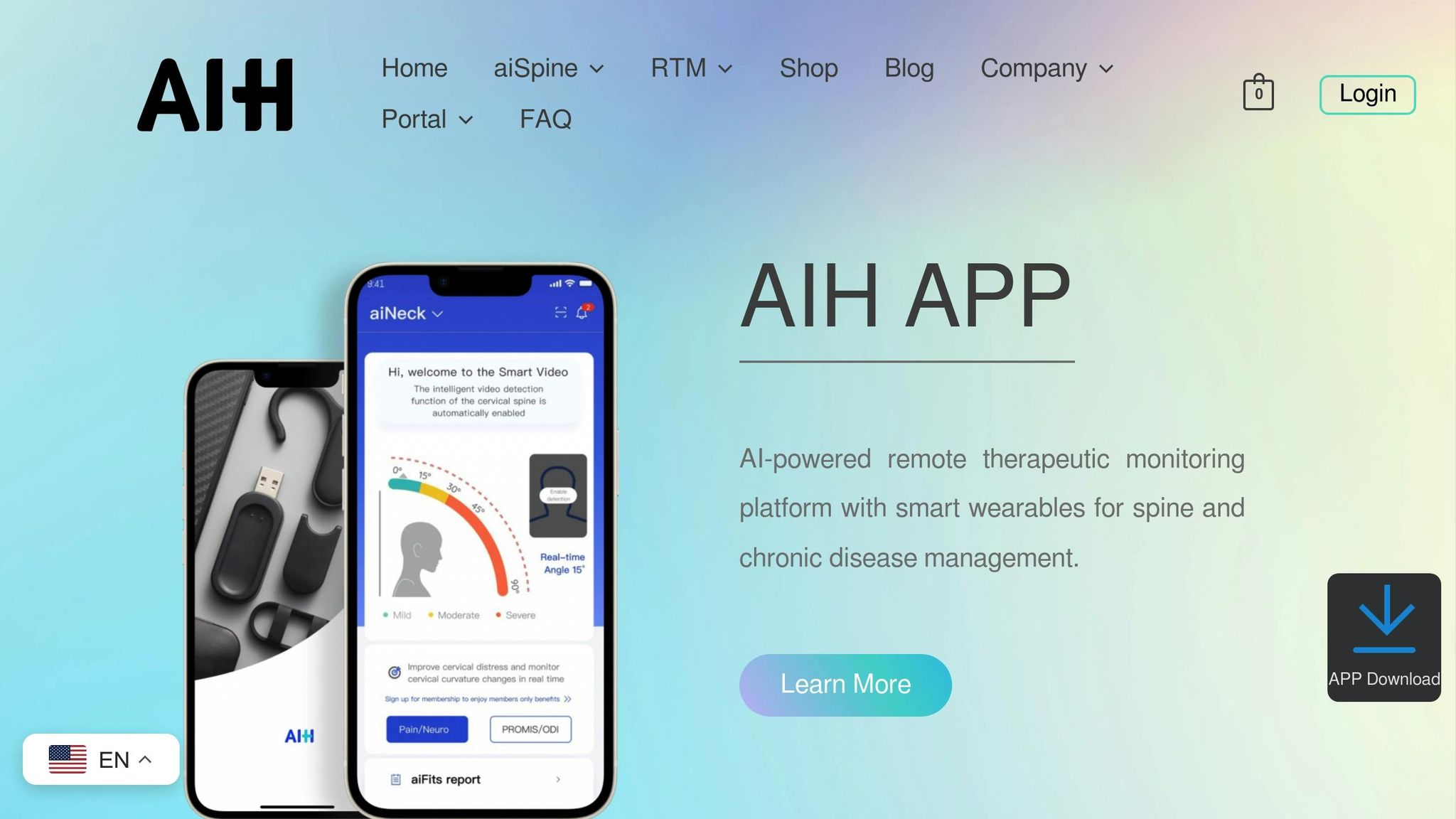
AIH LLC’s aiSpine and aiRing devices integrate autonomous AI to process data locally, reducing reliance on constant cloud connectivity.
Accuracy
The aiSpine uses a 9-axis Inertial Measurement Unit (IMU) to precisely detect angular and curvature changes in the cervical and lumbar spine. Its AI algorithms, developed by experts, provide clinical-grade data and trigger immediate vibration feedback to correct posture when needed .
"aiSpine (Spine Posture Monitor) is an Artificial Intelligence (AI) driven device that prevents, monitors, and records angular and curvature changes in the neck and back." – AIH LLC
The aiRing features advanced precision sensors and ultra-low power Bluetooth chips, enabling constant and intelligent monitoring of vital signs.
Latency
Both devices are designed to minimize delays in processing. The aiRing’s low-power Bluetooth ensures quick synchronization, while local AI processing eliminates the need for frequent cloud communication, speeding up response times . The aiSpine also incorporates Bluetooth 4.0 for connectivity and boasts a 7-day standby battery life, ensuring uninterrupted monitoring.
Scalability
The RTM platform supports large-scale data management across multiple devices. It allows for seamless integration of various wearing modes, enabling personalized spine monitoring solutions . By combining physiological sensor data with user-reported information, the platform connects patients worldwide with medical resources through a fast digital network, facilitating continuous care .
Suitability for Spine/Chronic Disease Monitoring
Both devices leverage rule-based and machine learning methods to provide effective long-term monitoring for spine health and chronic disease management . The aiSpine focuses on tracking angular shifts in neck and back alignment, making it ideal for identifying gradual posture changes. Meanwhile, the aiRing monitors vital signs, supporting chronic disease management by tracking therapy adherence and patient response . Additionally, the RTM platform enhances care by monitoring musculoskeletal and respiratory health alongside therapy outcomes.
"Every product we create is rooted in medical expertise, fortified by global patents, and rigorously tested to meet international compliance." – AIH LLC
Pros and Cons
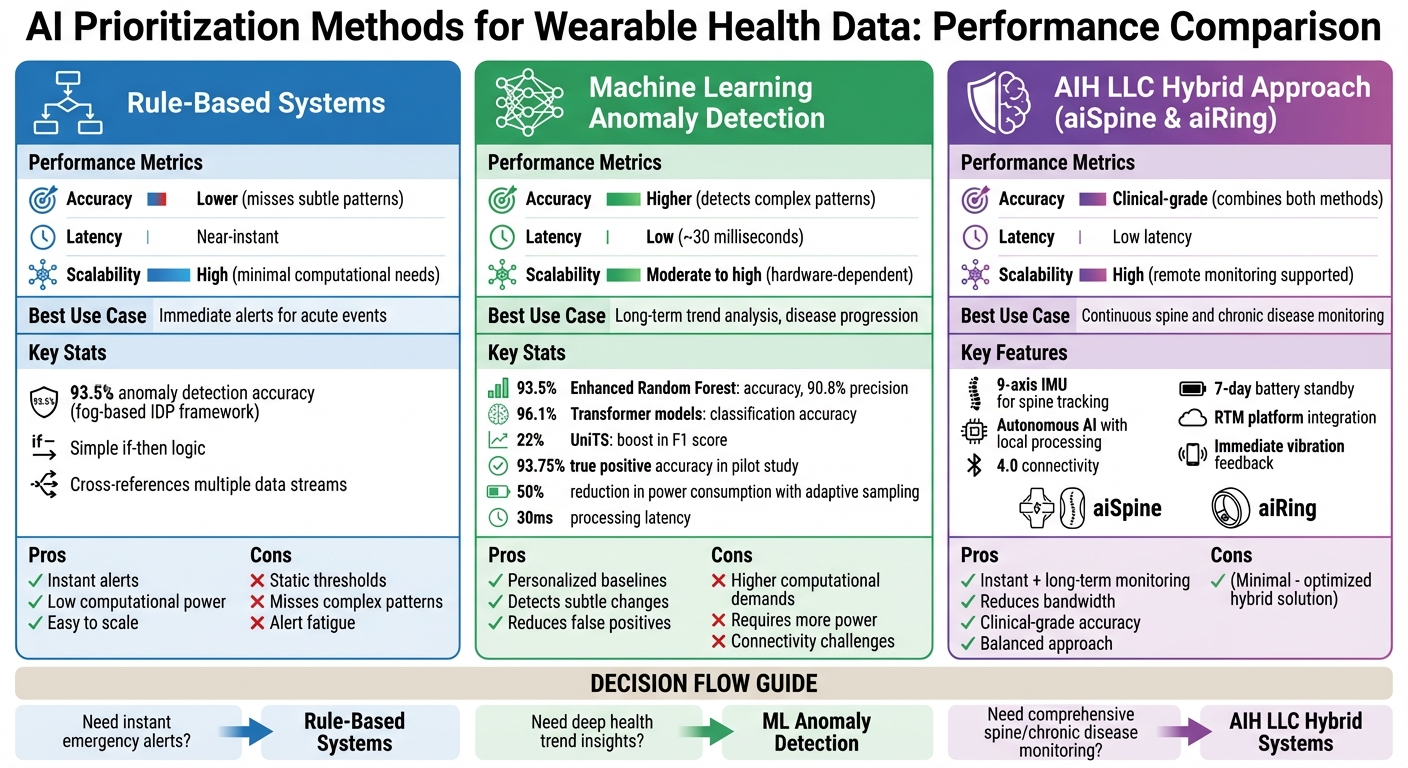
Comparison of AI Prioritization Methods for Wearable Health Data: Rule-Based vs ML vs Hybrid Systems
Here’s a side-by-side look at rule-based systems, machine learning anomaly detection, and AIH LLC’s hybrid approach, summarizing their strengths and limitations for health monitoring.
Rule-based systems are straightforward and deliver instant alerts when predefined thresholds are crossed. They require minimal computational power, making them ideal for devices with limited resources. This simplicity also allows them to scale easily. However, they fall short in detecting nuanced or complex health patterns that don’t fit within their static rules.
Machine learning anomaly detection fills this gap by recognizing non-linear patterns and creating personalized baselines, which static systems may overlook. For instance, Enhanced Random Forest models achieve 93.5% accuracy and 90.8% precision, while Transformer models push accuracy to 96.1% . However, these advanced models come with trade-offs, such as roughly 30 ms latency due to higher computational demands. While this delay is minimal, it’s an important consideration, particularly for real-time applications. That said, these models excel in chronic disease monitoring and long-term trend analysis, where precision outweighs the need for immediate feedback.
AIH LLC’s aiSpine and aiRing combine the best of both worlds through a hybrid approach. These systems integrate rule-based logic for instant alerts – such as posture corrections or vital sign monitoring – with machine learning algorithms that analyze long-term data to identify gradual health changes. This dual-layer framework not only reduces bandwidth consumption but also delivers clinical-grade accuracy, making it particularly effective for spine health and chronic disease management.
| Approach | Accuracy | Latency | Scalability | Best Use Case |
|---|---|---|---|---|
| Rule-Based Systems | Lower; misses subtle patterns | Near-instant | High; minimal computational needs | Immediate alerts for acute events |
| ML Anomaly Detection | Higher; detects complex patterns | Low (~30 ms) | Moderate to high; hardware-dependent | Long-term trend analysis, disease progression |
| AIH LLC Hybrid | Clinical-grade; combines both | Low latency | High; remote monitoring supported | Continuous spine and chronic disease monitoring |
Each method comes with its own trade-offs, making the choice heavily dependent on specific monitoring needs. If you need instant responses, rule-based systems are the way to go. For deeper insights into health trends, machine learning is unmatched. However, for applications like spine health and chronic disease management, AIH LLC’s hybrid systems – like aiSpine and aiRing – offer a balanced solution. They deliver immediate alerts while also capturing long-term patterns, all without overwhelming healthcare providers. This balance between speed and complexity is key to effective health data monitoring.
Conclusion
The best prioritization strategy hinges on specific clinical requirements. Rule-based systems excel in delivering instant alerts during emergencies, while machine learning identifies intricate patterns that static rules might overlook. Advanced models have demonstrated over 93% accuracy with minimal delays. These models establish personalized baselines but demand higher computational power, a challenge effectively addressed by modern fog computing architectures.
For managing spine health and chronic conditions, hybrid systems present a balanced solution. AIH LLC’s aiSpine and aiRing devices integrate immediate rule-based notifications with machine learning for analyzing long-term trends. This combination minimizes bandwidth usage while maintaining clinical-grade precision, making remote monitoring both efficient and reliable.
"AI amplifies the value of wearable data by detecting subtle trends that would otherwise go unnoticed." – John Snow Labs
FAQs
How does AI decide which wearable health data is urgent?
AI systems process wearable health data to pinpoint what’s urgent by evaluating its importance and context. Using methods like federated learning and intelligent alerting systems, they analyze sensor inputs alongside health risk factors. This helps prioritize alerts based on their timing and relevance, ensuring that critical health information gets immediate attention.
Why can machine learning spot issues that rule-based alerts miss?
Machine learning has the ability to spot subtle patterns and uncover complex relationships within health data – something rule-based alerts often miss. By analyzing information in ways that traditional methods simply can’t, it enables more precise and tailored detection of potential issues.
How do aiSpine and aiRing process data without relying on the cloud?
aiSpine and aiRing leverage edge AI technology to handle data processing directly on the device. This approach allows for real-time health monitoring and analysis without relying on cloud connectivity. The result? Faster insights and improved privacy, as sensitive data stays on the device itself.