
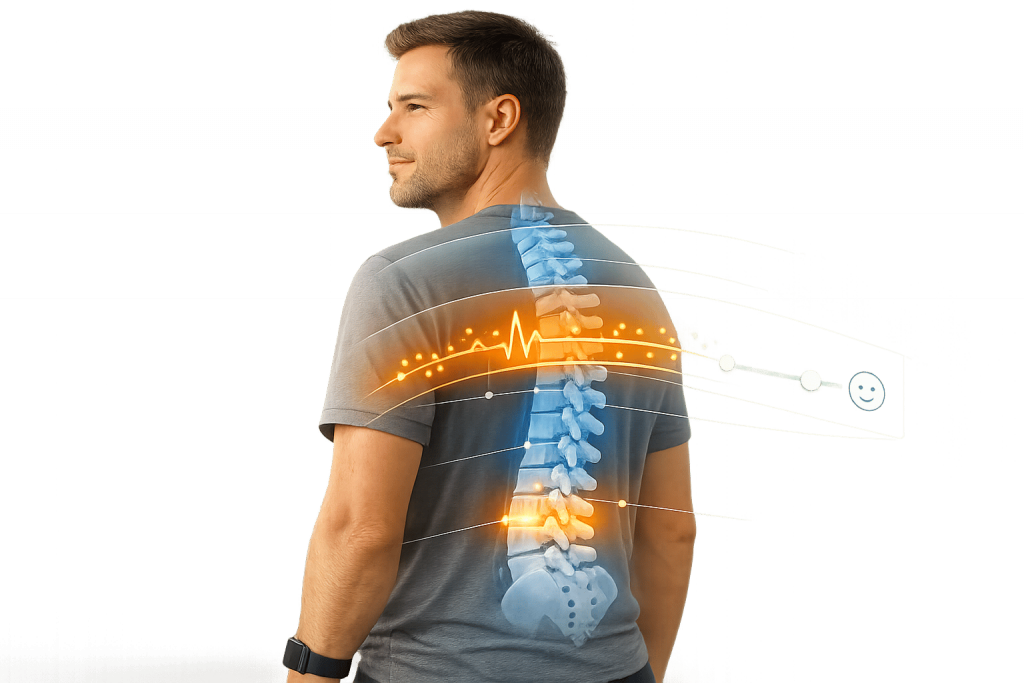
Predictive health algorithms are reshaping spine care by addressing long-standing inconsistencies in diagnosis and treatment. These tools analyze imaging, clinical notes, and patient data to assist doctors in making quicker, more accurate decisions. With low back pain affecting millions globally, these algorithms offer solutions like automated MRI analysis, risk prediction, and tailored treatment recommendations.
Key Takeaways:
- AI Applications: Tools like computer vision and radiomics identify spine issues like herniation or fractures.
- Faster Analysis: MRI scans can now be processed in under a second, saving time and standardizing results.
- Patient Benefits: Care plans are now more personalized, improving outcomes and reducing unnecessary treatments.
- Provider Tools: Devices like aiSpine and aiRing collect posture and health data, helping doctors monitor patients remotely.
By combining imaging, wearable data, and patient-reported outcomes, predictive algorithms streamline care and improve decision-making, paving the way for more consistent and effective spine treatments.
How AI Is Transforming Spine and Scoliosis Treatment | Patient-Specific Treatment Innovations
sbb-itb-44aa802
Building a Predictive Workflow for Spine Care
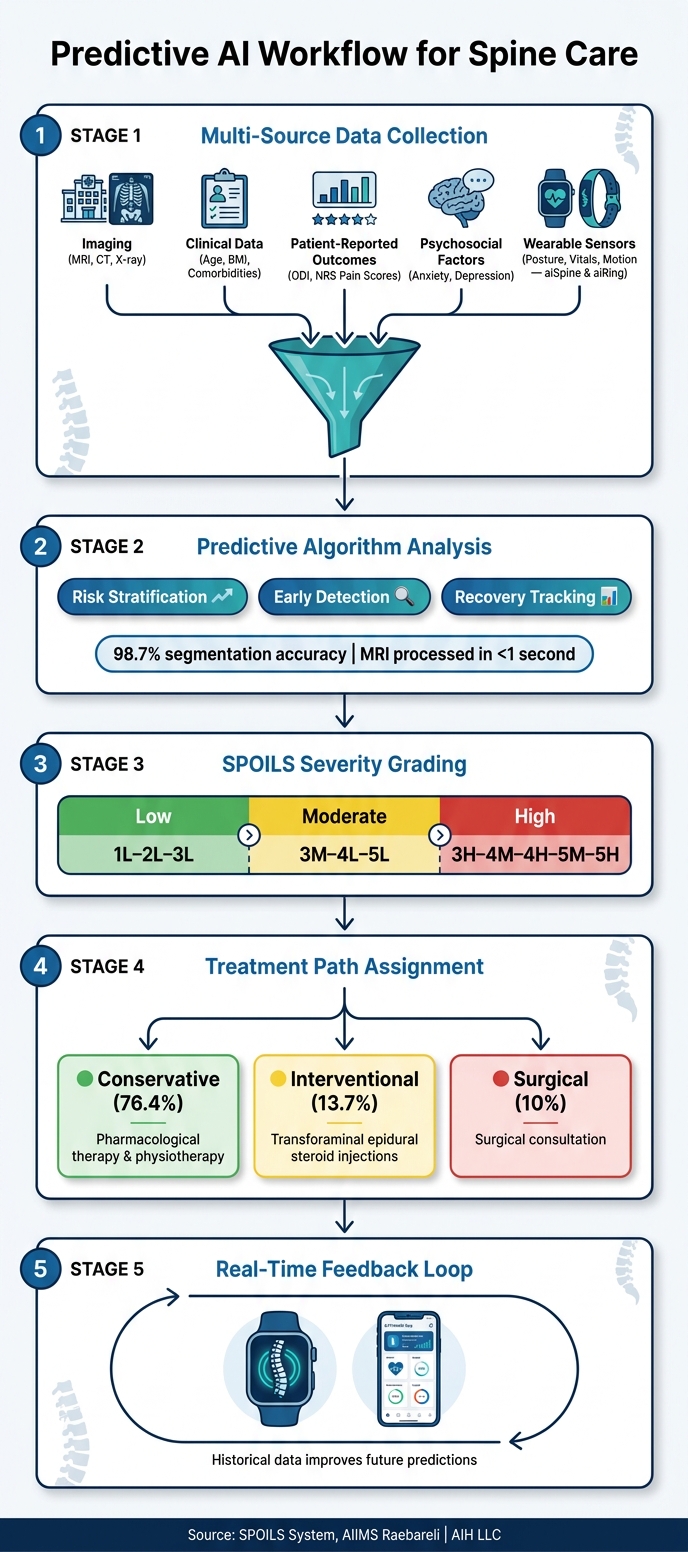
Predictive AI Workflow for Spine Care: From Data to Clinical Decision
Creating an effective predictive workflow for spine care involves several steps: defining the clinical questions, pinpointing reliable data sources, and aligning the outputs with actionable decisions. The goal is to transform predictive insights into consistent and practical patient care.
Core Functions of Predictive Health Algorithms
In spine care, predictive algorithms focus on three main areas: risk stratification, early detection, and recovery tracking. These functions work together to enhance patient management. A great example is the SPOILS (Software to Predict Outcome in Lumbar Spondylosis) system, developed at AIIMS Raebareli under Dr. Suyash Singh. This system combines automated segmentation with a Gradient Boost classifier, analyzing 4,260 disk slices to achieve 98.7% segmentation accuracy and 97.84% accuracy in predicting spondylosis severity. By integrating AI-derived severity grades with tools like the Oswestry Disability Index (ODI) and Numerical Rating Scale (NRS), it helps clinicians decide between surgical and conservative treatments.
"AI–clinical intelligence and radiomics fusion facilitated a more objective, reproducible, and scalable framework for spine care, potentially reducing interobserver variability and optimizing therapeutic strategies." – Suyash Singh, MCh, Department of Neurosurgery, AIIMS Raebareli
These functions depend heavily on diverse and well-integrated data streams, which are explored in detail below.
Data Inputs Required for Predictive Models
The effectiveness of a predictive model rests on the quality and variety of its data inputs. In spine care, the most robust models combine multiple types of data for a well-rounded analysis. Imaging data from MRI, CT, and X-ray forms the structural basis for tasks like segmentation and pathology classification. Clinical tabular data, including patient demographics like age, BMI, and comorbidities, adds depth for risk profiling. Meanwhile, patient-reported outcomes (PROs), such as pain scores and functional assessments, guide recovery predictions and treatment planning.
Psychosocial factors, like anxiety and depression, further refine the classification of chronic low back pain phenotypes. Biomarkers (e.g., C-reactive protein and interleukin-22) and real-time motion data from wearable sensors provide additional layers of insight. The table below outlines key data categories and their clinical applications:
| Data Category | Specific Inputs | Clinical Application |
|---|---|---|
| Imaging | MRI, CT, X-ray | Segmentation, fracture detection, severity grading |
| Clinical Tabular | Age, BMI, comorbidities | Risk stratification, complication prediction |
| Patient-Reported | ODI, NRS pain scores | Outcome prediction, triage decisions |
| Psychosocial | Anxiety, depressive symptoms | Chronic LBP phenotype classification |
| Real-Time Wearable | Posture, vital signs, motion | Recovery tracking, postoperative monitoring |
How AIH LLC Supports Predictive Workflows
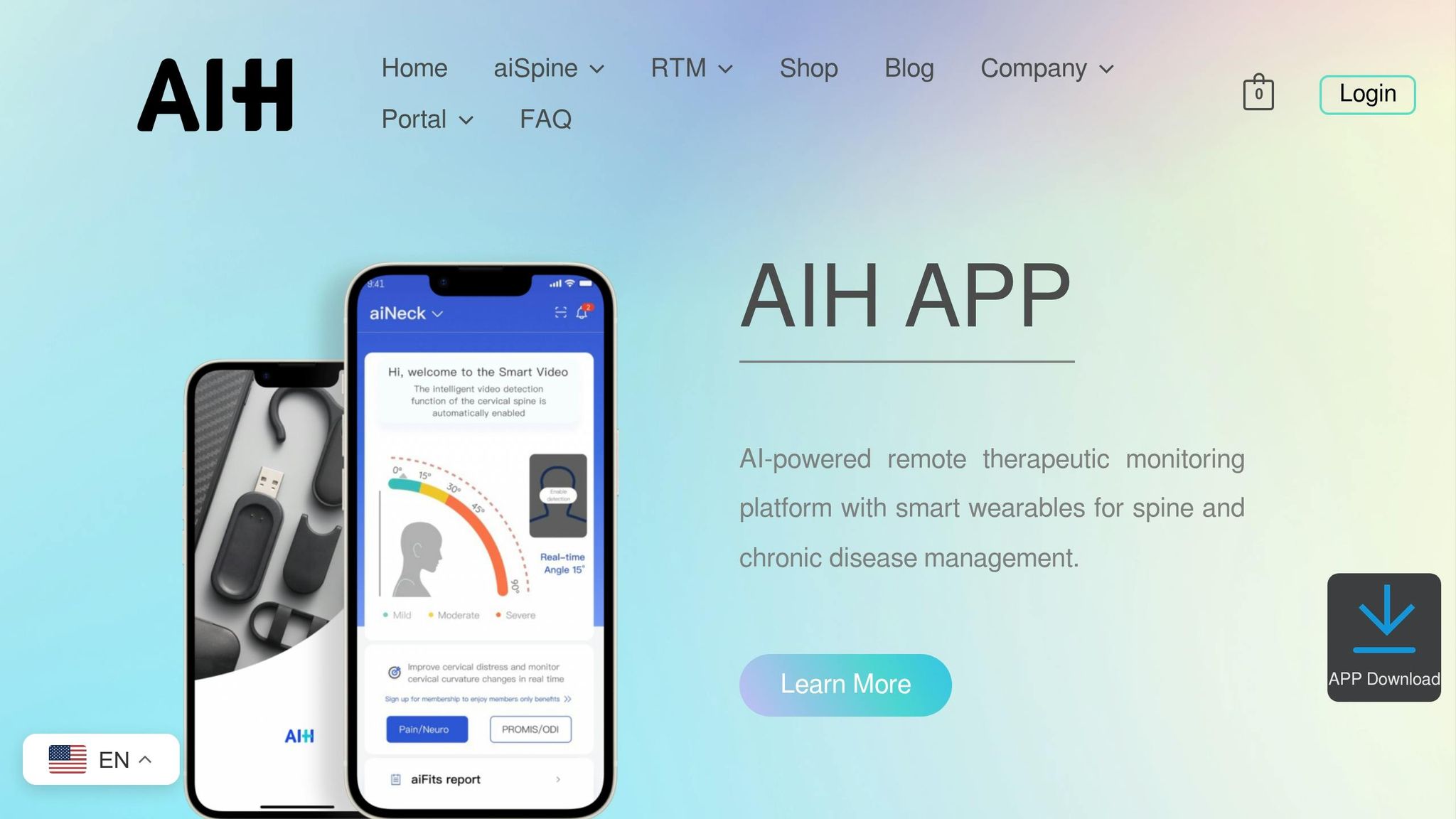
Real-time data collection is a critical component of predictive workflows, and wearable technology plays a key role here. This is where AIH LLC steps in with innovative solutions. Their aiSpine device continuously monitors spinal posture using Bluetooth 4.0 and vibration alerts to ensure proper alignment. Meanwhile, the aiRing tracks vital signs across various scenarios, using advanced sensors and AI algorithms to deliver a consistent stream of health metrics.
Both devices sync seamlessly with the AIH Health App, offering real-time tracking, historical data analysis, and personalized feedback. For healthcare providers, wearable-generated data – such as posture trends, vital sign fluctuations, and activity levels – complements imaging and clinical records. Together, these tools provide a more comprehensive view of a patient’s condition over time, enabling better decision-making and care.
Setting Up Data Capture and Clinical Monitoring
Using Wearables for Real-Time Data Collection
Wearable devices are transforming how spine care is monitored by offering continuous insights into patients’ daily movements, rest patterns, and recovery processes – details that often go unnoticed during standard clinic visits. For instance, AIH LLC’s aiSpine and aiRing devices collect vital posture and physiological data in real time, feeding this information into the AIH Health App for analysis. This approach enables remote monitoring to uncover factors that might not be evident during a brief clinical exam. When wearable data is combined with Electronic Health Records (EHRs) and patient-reported outcomes (PROs), providers gain a more comprehensive understanding of a patient’s condition between appointments. This real-time data is essential for building predictive analysis models that guide better care.
Maintaining Data Quality and Accuracy
For predictive algorithms to perform effectively, the data they rely on needs to be complete and accurate. However, real-world applications often face challenges like missing entries, connectivity issues, or system glitches. Advanced methods, such as Variational Autoencoders (VAEs), can fill these gaps while preserving the overall data patterns. Consistency and standardization are also crucial. Tools like the Record Strength Score (RSS) evaluate data reliability and completeness, helping identify and address gaps before they affect outcomes. Additionally, techniques like histogram matching have been used to maintain Cobb angle prediction errors within 4° (SD 3.12°) across datasets from seven hospitals.
"AI models typically exhibit reduced accuracy and robustness when deployed across multiple medical centers due to variability in imaging protocols and data characteristics." – Teng Zhang, PhD, University of Hong Kong
Wearable devices face their own challenges, particularly when it comes to usability. If a wearable is uncomfortable or its accompanying app is difficult to navigate, patients are less likely to use it consistently, leading to data gaps that can be just as problematic as missing data altogether. Ensuring these devices are easy to use is vital for maintaining the quality of real-time inputs, which, in turn, supports accurate predictions of adverse events.
Using Historical Data to Improve Predictions
Historical data plays a key role in shifting spine care from reactive to predictive. By examining past trends in posture, pain levels, and clinical outcomes, algorithms can detect early warning signs before a condition worsens. For instance, the Hospital Frailty Risk Score (HFRS), derived from historical clinical records, was identified as the most important factor in predicting 30-day unplanned readmissions in a study involving 4,346 spine surgery patients. When structured historical data – like expert-verified Pfirrmann grading scores – is paired with live metrics from wearables, such as posture deviations, activity levels, and vital signs, it provides a richer context. This combination allows current data to be interpreted within the framework of a patient’s complete clinical history, making predictive care more actionable and effective.
Applying Predictive Insights to Clinical Decisions
Once robust data capture is established, the next step is to use predictive insights to guide clinical decisions effectively.
Turning Predictions into Specific Actions
With accurate and continuous data capture in place, predictions must lead to clear, actionable steps. A great example of this is the SPOILS system, implemented at AIIMS Raebareli between March 2023 and February 2024. This system streamlined the spine care workflow by categorizing patients into surgical, interventional, and conservative treatment paths. The results? 10% of patients were routed to surgery, 13.7% received transforaminal nerve blocks, and 76.4% were placed on conservative medical management.
Here’s how the system connects severity scores to clinical actions:
| Decision Stratum | Predicted Severity Class (SPOILS) | Clinical Indicators (ODI/NRS) | Recommended Action |
|---|---|---|---|
| Surgical | 3H, 4M, 4H, 5M, 5H | High scores | Surgical consultation |
| Interventional | 3M, 4L, 5L | Moderate scores | Transforaminal epidural steroid injections |
| Conservative | 1L, 2L, 3L | Mild to moderate scores | Pharmacological therapy & physiotherapy |
This structured approach eliminates uncertainty, offering providers a clear treatment path based on patient categorization.
Managing Alert Volume in Clinical Workflows
One challenge with predictive systems is the overwhelming number of notifications they can generate. When every minor deviation triggers an alert, there’s a real risk of providers becoming desensitized. The solution isn’t fewer predictions – it’s smarter filtering.
For example, in postoperative recovery monitoring, research suggests that only a decline of 0.25 standard deviations in mean daily steps should trigger a clinical review. This avoids unnecessary alerts for smaller dips in activity. Similarly, AI tools integrated into PACS systems can automatically flag incidental vertebral fractures, removing the need for providers to log into separate software.
"The best back surgery is no surgery… AI changes this equation by enabling smarter triage." – Vijay Yanamadala, MD, System Medical Director of Quality, Innovation, and Research, Ayer Neuroscience Institute
The key is designing a system where every alert is tied to a specific, actionable response. This ensures that notifications are meaningful and directly support clinical decisions.
Spine-Specific Use Cases
Predictive monitoring has clear benefits for various spine conditions. Postoperative recovery is one area where it shines. For instance, Random Forest models using smartphone step data have shown 86.7% accuracy in predicting functional decline after lumbar surgery. Patients undergoing fusion procedures tend to experience greater mobility decreases during these declines compared to those undergoing decompression, justifying more intensive real-time follow-up. Devices like AIH LLC’s aiSpine and aiRing track posture and vital signs through the AIH Health App, offering objective data between clinic visits.
In cases of spinal metastases, the Metastatic Spinal Tumor Frailty Index (MSTFI) has proven to be more effective than traditional tools like the Charlson Comorbidity Index (CCI) for predicting nonroutine discharge and 30-day readmission risks. By focusing on frailty scores instead of age or BMI alone, care teams can better plan discharges and preempt readmissions.
For acute trauma, AI tools integrated into PACS systems have identified incidental vertebral fractures in 42.8% of cases, underscoring their role as a critical safety net in emergency spine care.
Training Providers and Validating Predictive Systems
Training Providers to Interpret Algorithm Outputs
Accurate predictions only matter if providers know how to act on them.
Think of AI as an "intelligent co-pilot" rather than the one making final decisions. Training programs must teach providers how to interpret algorithm outputs, when to trust them, when to intervene, and how to connect those outputs to specific treatment paths – whether surgical, interventional, or conservative. For example, spine programs using robotic systems like Mazor X and ExcelsiusGPS have already started integrating AI-driven decision-making into resident training, making it a routine part of how new surgeons are educated.
Providers also need a solid foundation in data literacy. This means understanding how factors like MRI settings or PROMs (Patient-Reported Outcome Measures) influence an algorithm’s results. Without this knowledge, even the most advanced algorithm risks becoming a mysterious "black box."
These steps lay the groundwork for reliable validation and ongoing monitoring of predictive systems.
Measuring Clinical Outcomes and System Performance
Once providers are trained to interpret outputs, the next step is confirming that these algorithms actually improve patient care. Validation isn’t just about proving the algorithm works in a controlled lab setting – it’s about showing real-world improvements in clinical outcomes. The best validation combines hard data, like mobility metrics, with patient-reported outcomes.
Take the SuMO platform as an example. Evaluated in a multicenter study across Paris and Bordeaux (2021–2022), it analyzed data from 119 patients using a deep learning algorithm to predict MCID (Minimal Clinically Important Difference) on the Oswestry Disability Index. With an accuracy of 81.6%, the study demonstrated how longitudinal PROMs collected digitally can effectively validate AI performance in actual spine care.
"AI-based algorithms may help physicians in their future daily practice by addressing personalized patient care." – Arthur André, MD, Ramsay Santé
On a broader scale, the Cleveland Clinic developed a validation framework using data from 55,970 surgical encounters spanning 15 years (2007–2022). Their AI/ML tool optimized three outcomes simultaneously: improving patient-reported outcomes at one year, reducing healthcare utilization (like opioid prescriptions and office visits), and lowering cost per episode. The analysis found a −0.34 correlation between utilization and PROs, showing these metrics provide independent insights into recovery.
Governance and Ongoing System Review
Predictive models can lose accuracy over time as patient populations, medical practices, and data quality evolve. Without proper governance, even a validated algorithm can drift, leading to less reliable outcomes.
Duke Health offers a strong example of how to manage this challenge. Since 2021, their AI governance committee – part of the Duke Institute for Health Innovation – has overseen more than 50 AI systems using a People, Process, Technology, and Operations (PPTO) framework. The committee is divided into specialized subcommittees focused on areas like implementation, statistical evaluation, ethics, and operations. Every algorithm is centrally registered, assigned a risk level, and monitored according to its risk profile.
Two key principles define this approach. First, human-in-the-loop oversight is essential. Licensed clinicians must validate algorithm outputs in real time, not just during periodic reviews. Second, governance requires dedicated funding. Sustainment and operational costs typically account for 10–15% of the total project budget, and cutting corners here often leads to failure.
"Realizing the benefits of AI while minimizing harm requires the establishment of effective AI governance – a system of rules, practices, processes, and technological tools designed to ensure the responsible development, deployment, and use of AI technologies." – Nature npj Digital Medicine
Strong governance builds trust in predictive models over time and ensures they continue enhancing clinical decision-making. By rotating committee members regularly, institutions can keep up with advancing technology and avoid stagnation, ensuring spine care remains precise, reliable, and patient-focused.
Conclusion: What Predictive Algorithms Mean for the Future of Spine Care
Predictive algorithms are transforming spine care by replacing subjective decision-making with an objective, data-driven approach that combines imaging, clinical data, and patient outcomes. With low back pain expected to affect over 800 million people globally by 2050, the demand for efficient predictive tools has never been greater. Advanced algorithms now have the capability to segment lumbar MRIs in under a second, streamline patient triage into surgical or conservative care, and identify high-risk cases before they worsen – key innovations for addressing the growing burden on spine care systems.
The future of spine care builds on these advancements by incorporating diverse data sources to create even more tailored treatment plans. This next step involves integrating imaging, biomechanical data, clinical notes, and patient-reported outcomes to deliver context-aware recommendations. Tools like SPOILS demonstrate the potential for highly accurate, individualized treatment planning, signaling a shift toward making personalized care the norm rather than the exception.
"This AI–clinical intelligence and radiomics fusion facilitated a more objective, reproducible, and scalable framework for spine care, potentially reducing interobserver variability and optimizing therapeutic strategies." – JMIR AI
Achieving these outcomes depends on continuous collection of real-world data. AIH LLC’s aiSpine posture monitoring device and aiRing vital signs monitoring ring, integrated with the AIH Health App, provide the long-term, patient-specific data that predictive models need. These tools enable remote monitoring and real-time feedback, bridging the gap between clinical assessments and the daily habits that influence spine health outcomes. This integration underscores the article’s central theme: predictive care that seamlessly connects technology with individualized patient management.
FAQs
What data does a spine predictive algorithm need to work well?
Predictive algorithms in spine care rely on high-quality data to recognize patterns in patients’ conditions. These systems process a variety of inputs, including electronic health records, imaging scans, lab results, and patient-reported outcomes such as pain levels. They also factor in demographics, medication history, and biomechanical measurements like disc height and Cobb angles.
Adding to this, real-time data from wearable devices – like AIH LLC’s aiSpine and aiRing – offers enhanced monitoring capabilities. This allows for more personalized and proactive care by providing a detailed, ongoing view of the patient’s condition.
How do clinicians turn AI predictions into a treatment plan?
Clinicians are increasingly relying on AI predictions to act as a smart assistant, complementing their expertise. By processing patient data – such as electronic health records, imaging results, vital signs, and self-reported outcomes – AI models uncover patterns that lead to personalized risk scores and forecasts. These insights guide clinicians in deciding the best course of action, whether that’s surgical intervention or more conservative care options. Tools like AIH LLC’s aiSpine and aiRing even offer real-time monitoring, enabling treatments to be adjusted and improved as needed.
How can AIH LLC wearables fit into a spine care workflow?
AIH LLC’s wearables, such as the aiSpine and aiRing, deliver real-time insights into posture and vital signs. These devices sync seamlessly with the AIH Health App, allowing clinicians to merge this data with imaging and lab results. By tracking patient progress over time, healthcare providers can shift from reactive care to a more proactive approach, enabling tailored interventions and better-informed decisions.