
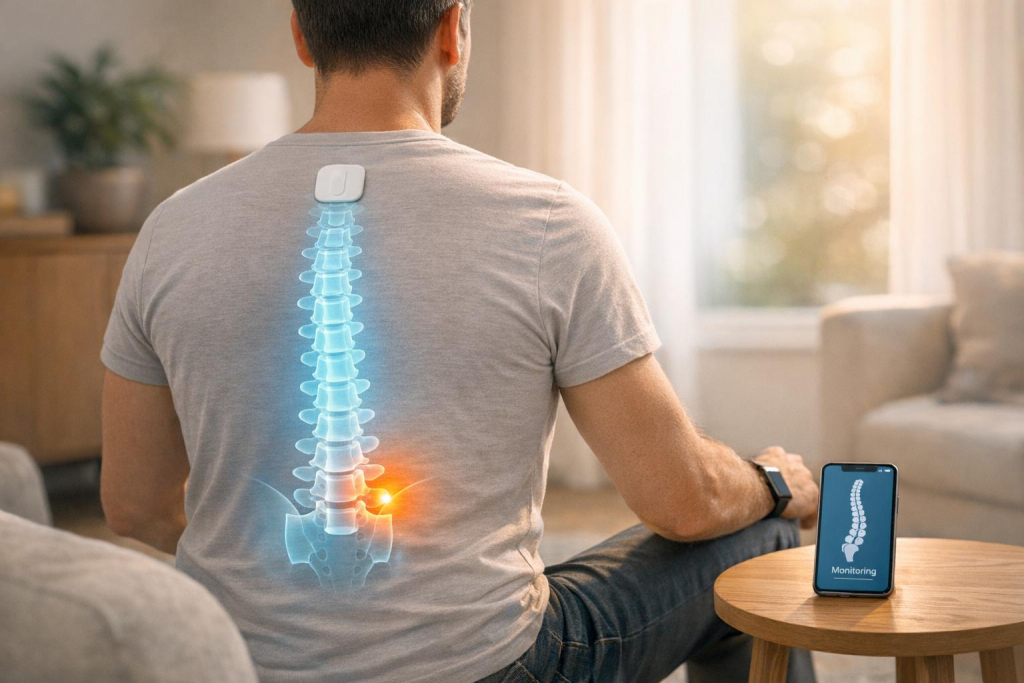
AI is transforming spine health care by enabling remote monitoring through wearable devices, advanced imaging, and machine learning. With tools like smartphone-enabled 3D imaging and AI-powered wearables, clinicians can track posture, movement, and spinal alignment in real-time. These technologies help identify subtle patterns and anomalies that traditional methods often miss, improving early detection and personalized care.
Key highlights:
- Spine health challenges: Low back pain affects 80% of Americans, costing $134 billion annually.
- AI tools: Wearables like aiSpine track posture and movement, offering real-time feedback.
- AI advancements: Systems like 3D-PoseFormer achieve over 94% accuracy in motion analysis.
- Research insights: AI models predict recovery outcomes and guide tailored treatments.
AI-driven monitoring is reshaping how spine health is managed, offering smarter, data-driven solutions for both patients and healthcare providers.
Artificial Intelligence in Spine Care: What You Need to Know
sbb-itb-44aa802
AI Algorithms for Detecting Spine Health Anomalies
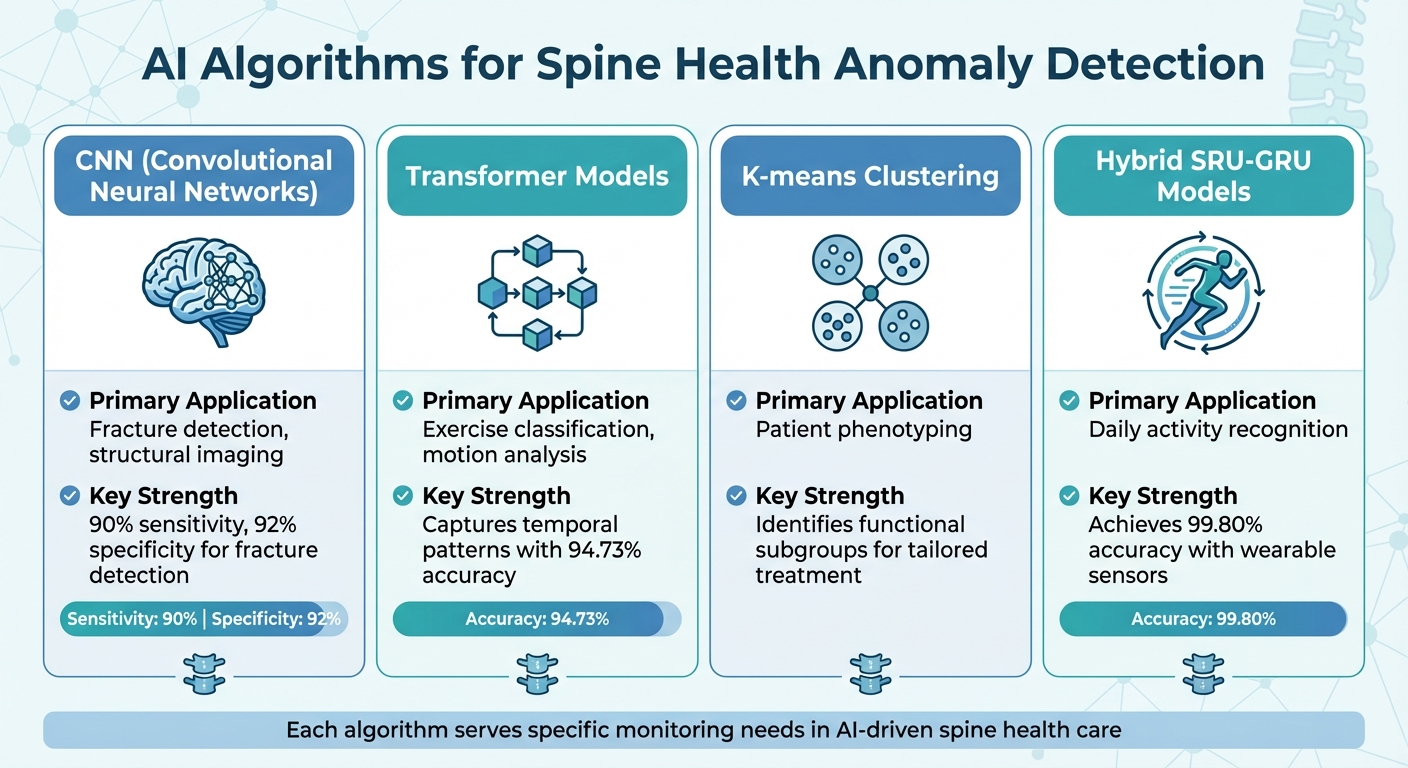
AI Algorithm Comparison for Spine Health Anomaly Detection
Hybrid Deep Learning for Behavioral Anomaly Detection
Hybrid deep learning models are proving invaluable for identifying subtle movement patterns that could signal spinal issues. These systems analyze metrics like range of motion, velocity, and acceleration to create unique motion profiles for each individual.
In February 2026, researchers at The Ohio State University Wexner Medical Center conducted a study involving 607 low back pain patients using the Conity Care™ wearable sensor platform. By combining K-means clustering with Principal Component Analysis, they identified three distinct functional groups: Poor function (Motion Index score of 14.2), Moderate function (35.3), and High function (61.4). Patients in the "Poor function" cluster were found to have a much higher likelihood of experiencing negative outcomes after three months of standard care.
"By capturing how individuals move their spine, it aims to provide insights on how LBP affects spine function, reveal distinct phenotypic patterns and help guide more tailored treatment strategies." – European Spine Journal
One standout application of these models is identifying guarding behaviors, which are protective movement patterns that patients unconsciously adopt to avoid pain. These behaviors often go unnoticed during routine clinical exams but can be detected through continuous AI monitoring. Impressively, these systems achieved an accuracy of over 85% in distinguishing patients with low back pain from healthy individuals.
Such insights are setting the stage for even greater precision through the integration of multiple sensor technologies.
Neuro-Signal Decoding and Multisensor Fusion
Building on the capabilities of deep learning, multisensor fusion takes anomaly detection to the next level. By integrating data from various sensors, AI platforms construct a comprehensive view of spine health. For instance:
- Inertial measurement units (IMUs) capture body movement.
- Surface electromyography (sEMG) tracks muscle activity.
- Depth cameras provide 3D body positioning without requiring physical markers.
A great example of this approach is the 3D-PoseFormer framework, developed in November 2025. This system uses Transformer-based architecture to combine RGB video with depth camera data, analyzing motion patterns during physiotherapy exercises. It achieved an impressive 94.73% accuracy for exercise classification on the KIMORE dataset, far outperforming traditional single-sensor methods.
By integrating IMUs, sEMG, and depth cameras, these systems provide reliable, continuous monitoring – even in the unpredictable conditions of a home environment.
But it’s not just about collecting data. Advanced algorithms are now tailoring evaluations to individual patient needs.
Context-Aware Analysis for Personalized Monitoring
The most advanced AI systems go beyond generalized analysis, adapting their evaluations to each patient’s unique profile. These context-aware algorithms compare patient movements against data from matched healthy controls.
| Algorithm Type | Primary Application | Key Strength |
|---|---|---|
| CNN (Convolutional Neural Networks) | Fracture detection, structural imaging | 90% sensitivity, 92% specificity for fracture detection |
| Transformer Models | Exercise classification, motion analysis | Captures temporal patterns with 94.73% accuracy |
| K-means Clustering | Patient phenotyping | Identifies functional subgroups for tailored treatment |
| Hybrid SRU-GRU Models | Daily activity recognition | Achieves 99.80% accuracy with wearable sensors |
These systems don’t just focus on biomechanics. They also incorporate psychological factors, such as pain interference and self-efficacy scores, alongside physical movement data. This combination allows for more accurate predictions about recovery outcomes and helps clinicians prioritize interventions. For example, they can determine which patients might benefit from more intensive care rather than relying solely on raw measurements. This holistic approach is transforming how remote spine health monitoring is managed.
Wearable Devices and AI Integration for Spine Monitoring
Real-Time Spine Posture and Movement Tracking
Today’s wearable devices, equipped with Inertial Measurement Units (IMUs), can track spine movement in three dimensions, capturing rotational range of motion, velocity, and acceleration during everyday activities. This kind of continuous monitoring goes beyond the occasional clinic visit, allowing AI algorithms to spot early irregularities and strengthen the role of wearables in proactive spine care. Building on earlier research, similar sensor systems now provide ongoing assessments of spinal performance through motion tracking.
Take the aiSpine posture monitoring device from AIH LLC, for example. It continuously tracks posture with flexible wear options. When it detects poor alignment – like slouching or forward head posture – it vibrates to remind users to correct their stance. With Bluetooth 4.0 connectivity and a 7-day standby battery, it’s designed for daily use without being a hassle.
Integration with AI-Powered Health Platforms
Once the data is collected, AI-powered platforms convert it into actionable insights, enabling smarter clinical decisions. These platforms take raw sensor data and transform it into meaningful metrics, creating a seamless connection between wearables and continuous spine health monitoring.
For instance, the AIH Health App connects devices like aiSpine and aiRing into a single ecosystem for spine health. It provides real-time tracking, historical data analysis, and personalized feedback. Users get instant alerts when their movement deviates from healthy patterns, creating a feedback loop that encourages better habits. Some advanced platforms even combine spine movement tracking with other wellness metrics, such as stress levels and sleep quality, offering a broader perspective on overall health. This interconnected approach has shown measurable improvements in patient outcomes.
Benefits of AI-Driven Wearables for Spine Health
The combination of AI and wearable tech brings clear advantages for both patients and healthcare providers. For patients, these devices deliver immediate reminders to adjust posture through haptic feedback, which responds within 80–150 milliseconds of detecting an issue. This quick feedback helps reduce postural deviations and the frequency of related symptoms.
"Wearables close the loop between intention and execution – but only if paired with deliberate neuromuscular retraining. A vibration is a reminder, not a reset."
– Dr. Lena Torres, Physical Therapist and Co-Director of the Posture & Movement Lab, UCSF
For healthcare providers, wearables offer objective data that goes beyond what patients might self-report. By analyzing movement patterns, clinicians can predict recovery outcomes, identify patients at risk, and customize treatment plans. With over 540 million people worldwide suffering from low back pain and annual U.S. healthcare costs exceeding $134 billion, these predictive tools are incredibly valuable. Remote monitoring also supports telehealth by providing continuous, real-world data. Through real-time corrective feedback, AI-driven wearables are reshaping remote therapeutic monitoring. AIH LLC’s remote therapeutic monitoring services leverage this technology to deliver consistent care without requiring frequent in-person visits.
Research Findings: AI in Spine and Neurological Applications
AI for Detecting Range of Motion Anomalies
AI is proving to be a powerful tool for identifying subtle motion anomalies that traditional methods often miss. For example, the Conity Care™ platform’s study of 607 patients refined the "Motion Index", which categorizes functional clusters. Results showed that patients with lower scores faced worse recovery outcomes.
A significant development in this field is the SpineSighter AI model. By analyzing spine movement during forward flexion tests through standard video recordings and computer vision, this model achieved an impressive 95.13% accuracy in classifying patients by functional levels, with a sensitivity of 93.81%.
"This innovative use of AI highlights the importance of velocity as a critical indicator of spinal functional differences, opening new avenues for personalised clinical management, self-care and recovery strategies".
The SpineSighter Research Team emphasized that velocity is just as crucial as the range of motion when evaluating spinal health.
Early Warning Systems for Spine Health Complications
AI’s ability to detect motion anomalies has also paved the way for early warning systems designed to prevent spine health complications. One example is the PostureGuard system, deployed in 15 Indonesian public schools between July and September 2024 as part of the country’s Digital Wellness Mandate. It screened 200 students and achieved a mean absolute error below 2.3° for forward head angle estimation, matching the precision of radiographic methods. The system also revealed a concerning trend: each additional daily hour of screen time was linked to a 2.1° increase in forward head angle. Since every centimeter of forward head displacement adds roughly 10 pounds of extra load to the spine, these insights could help mitigate long-term health risks.
In surgical planning, the SpinePose AI tool from the University of Michigan analyzed 761 sagittal whole-spine X-rays to predict spinopelvic parameters. When tested on 40 X-rays, it delivered median errors of just 2.2 mm for the sagittal vertical axis and 1.3° for pelvic tilt, matching the precision of fellowship-trained surgeons. Such accuracy helps surgeons ensure proper alignment, which is key to better clinical outcomes.
Impact on Recovery and Rehabilitation Outcomes
AI is also revolutionizing recovery and rehabilitation strategies for spine-related conditions. At the University of Pennsylvania and University of Miami, researchers tracked 75 spine surgery patients over four years, collecting over 109,000 step-count data points via smartphones. Using a Random Forest machine learning model, they predicted secondary post-operative functional decline with 86.7% accuracy (80% sensitivity, 90% specificity). Patients who took longer to regain baseline activity levels were more likely to experience future declines, giving clinicians a valuable early warning system.
For pediatric patients, researchers at Shriners Children’s Hospitals studied 455 children undergoing spinal fusion for adolescent idiopathic scoliosis between 2010 and 2024. By analyzing 171 pre-operative clinical features, their AI system predicted post-operative quality-of-life outcomes with an area under the receiver operating curve of 0.86. This helps families set realistic expectations and allows clinicians to tailor rehabilitation plans. Meanwhile, the 3D-PoseFormer framework enables markerless telerehabilitation for lower back pain. Using standard RGB and depth video, it achieved 94.73% accuracy in classifying physiotherapy exercises, making home-based recovery programs more effective.
These advancements highlight how AI is reshaping remote spine monitoring and creating more personalized recovery strategies.
Challenges and Future Directions in AI-Driven Spine Monitoring
Data Privacy and Security Concerns
One of the biggest hurdles in AI-driven spine monitoring is protecting patient privacy. Sensitive data, such as CT scans, sensor logs, and even GPS information, often needs to be centralized for analysis. Unfortunately, this increases the risk of data breaches, as it creates a single point of vulnerability. Remote monitoring systems add another layer of risk by tracking patients’ movements and communication patterns to assess social participation, which can inadvertently expose personal details.
Another issue is the "black box" nature of deep learning models. These systems often lack transparency, making it hard for clinicians to trust AI-driven recommendations when the reasoning behind them isn’t clear. Bias is another concern – many AI models are trained on data from single hospitals or specific demographic groups, which can lead to results that don’t apply well to diverse populations.
A promising development in this area came in February 2026, when researchers Pavihaa Lakshmi B and Vidhya S from the Vellore Institute of Technology introduced a privacy-aware Federated Learning framework. By using the Federated Averaging algorithm across seven local models, they achieved an impressive 96.03% accuracy, reduced validation loss from 0.910 to 0.061, and maintained differential privacy with an epsilon of ~1.24 – all without centralizing patient data. Tackling these privacy challenges is critical as we move toward integrating real-time data from multiple sources for spine monitoring.
Improving Multimodal Data Integration
AI systems in spine monitoring need to combine data from a variety of sources – wearable sensors, medical imaging, electronic health records, and even patient-reported pain levels. Successfully integrating these data streams is key to improving anomaly detection and ensuring a more comprehensive view of a patient’s spine health.
Platforms like MONAI are helping to streamline this process. As an open-source tool, MONAI supports the creation of reproducible data pipelines that integrate structural imaging, clinical records, and even genomic profiles. Techniques such as spatial normalization and intensity harmonization are used to minimize variability caused by different scanning equipment or patient positioning, making the data more consistent and easier to analyze.
Future of Adaptive AI Frameworks
Solving integration and privacy challenges lays the groundwork for adaptive AI systems that can continuously learn from new patient data. These next-generation models are designed to evolve in real time, updating risk predictions as new information becomes available. The FDA’s 2021 "Predetermined Change Control Plan" allows for post-clearance updates to AI models, although the full regulatory framework is still being finalized.
Adaptive frameworks will play a critical role in personalized spine monitoring. As Rahul Kumar et al. point out, "Decisions involving spines are often sensitive to small variations in expected risk, thus outputs should be supported by information on data limits, confidence intervals, and calibration data". This means future systems must not only provide predictions but also explain the underlying factors – like comorbidities, spinal alignment, or patient age – that influence those predictions.
Explainable AI tools such as SHAP and Grad-CAM are already making strides in this direction. By translating complex model outputs into narratives that clinicians can easily interpret, these tools help bridge the gap between AI and human expertise. Additionally, active learning models that refine themselves using longitudinal data will enable truly personalized care, tailoring recommendations to each patient’s recovery journey instead of relying on generalized algorithms.
Conclusion
Key Takeaways
AI-driven remote monitoring is reshaping the way spine health care is delivered. What once seemed theoretical is now producing real-world results. For example, the PostureGuard system, implemented in 15 Indonesian schools between July and September 2024, demonstrated a mean absolute error of less than 2.3° for estimating forward head angle. This proves that AI can achieve clinical-grade accuracy, even in low-resource environments, with devices costing under $200.
Calibration tailored to Southeast Asian populations reduced joint localization error from 4.7 cm to just 1.1 cm – a 75% reduction. This level of accuracy is crucial because even small forward head displacements can drastically increase spinal load. For adolescents spending up to 8 hours daily on devices, the resulting disc compression forces can equate to carrying 20–25 kg on the cervical spine every day.
"AI’s unique capacity to integrate vast and complex data, learn from patterns, and generate predictive insights, positions it as an invaluable tool for optimizing clinical workflows and supporting personalized treatment strategies".
Victoria A. Bensel, DC, MS, MPH, highlights how the shift from reactive to predictive care – enabled by continuous monitoring, digital biomarkers, and real-time feedback – allows for earlier interventions and more tailored treatment plans. These advancements emphasize AI’s growing impact on spine care and its potential to drive innovative solutions.
AIH LLC‘s Contribution to Spine Health
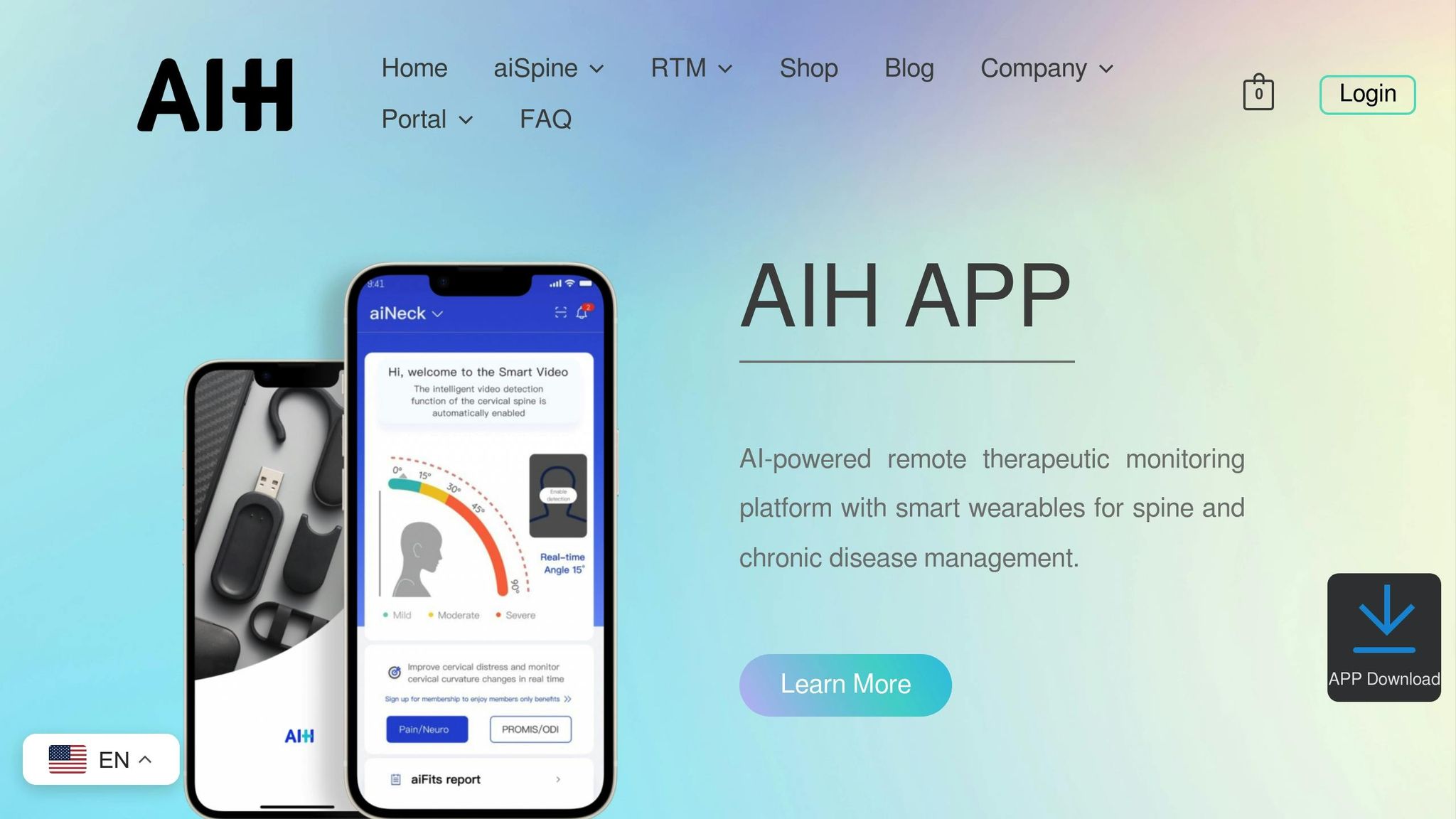
AIH LLC is at the forefront of this transformation with its aiSpine posture monitoring device and aiRing vital signs monitoring ring, both of which integrate seamlessly with the AIH Health App for comprehensive spine health management. These devices offer real-time posture tracking, vibration reminders, and historical data analysis, making continuous monitoring more accessible outside traditional clinical settings.
The company’s strategy reflects the industry’s move toward decentralized care and value-driven health solutions. By combining precise sensors with autonomous AI algorithms, AIH LLC’s devices provide objective measurements and personalized feedback. Research shows this approach can enhance motor learning, improve treatment adherence, and support better long-term outcomes. With the aiNeuro device on the horizon – designed for preemptive stroke monitoring and posture correction – AIH LLC continues to push the boundaries of advanced spine health technology, making it accessible to a broader audience.
FAQs
How does AI detect spine issues from everyday movement data?
AI can analyze motion data – like angular displacement, velocity, and acceleration – to identify spine issues. By using machine learning models trained on sensor data, it evaluates spinal behavior in real time and pinpoints potential abnormalities. This method allows for continuous monitoring and helps catch spine health concerns early.
What sensors do wearables use to monitor posture and spinal motion at home?
Wearable devices often rely on inertial measurement units (IMUs) and magnetic sensors to monitor posture and spinal motion from the comfort of home. These sensors gather detailed data on movement and alignment, making remote tracking more accurate and efficient.
How is my privacy protected when my spine data is monitored remotely?
Your privacy is protected through rigorous data management practices, giving you control over your personal information and ensuring compliance with privacy regulations. These steps guarantee that any spine health data is collected, handled, and secured with care, as detailed in the relevant privacy policies.