
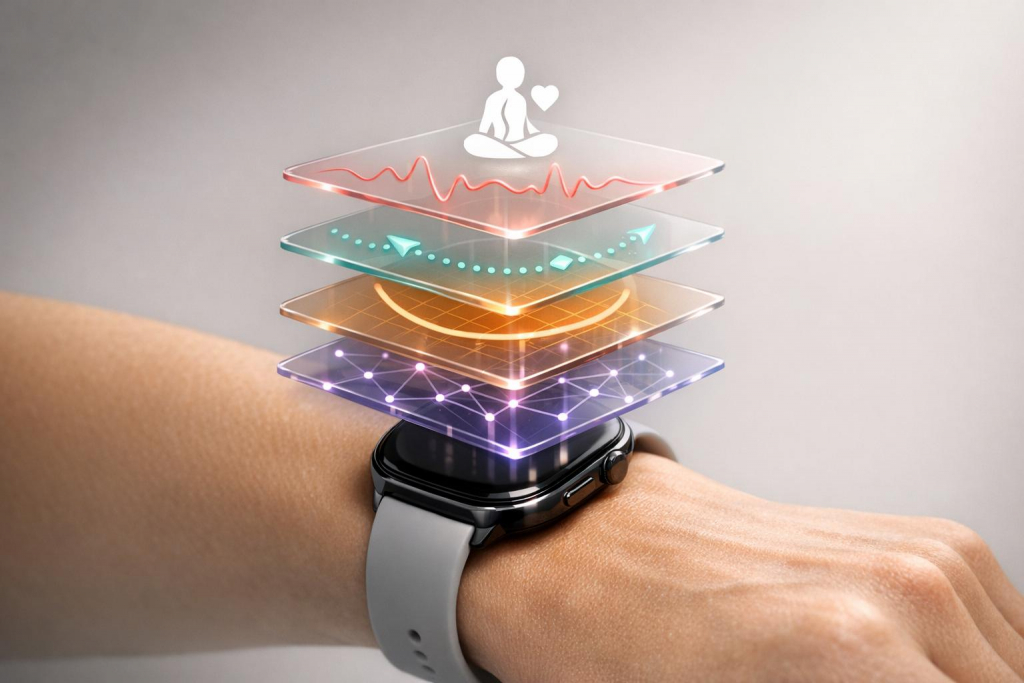
Multi-sensor wearables combine multiple sensors like accelerometers, gyroscopes, PPG, and skin temperature sensors into a single device to provide a more accurate and detailed view of health. These devices rely on data integration – or merging data from different sensors – to improve reliability, reduce errors, and offer actionable health insights.
Key points:
- Data fusion aligns and combines inputs from various sensors to detect patterns like irregular heart rhythms or stress levels, which single sensors might miss.
- AI and preprocessing help clean and synchronize raw data, ensuring accuracy even with noise or motion artifacts.
- Companies like AIH LLC use this technology in devices like the aiSpine (posture tracking) and aiRing (vital signs monitoring), paired with the AIH Health App for real-time feedback and long-term trends.
Despite challenges like signal quality and hardware limitations, advancements in AI are pushing wearables toward more personalized health monitoring. Future devices, like AIH’s upcoming aiNeuro, aim to address issues like preemptive stroke monitoring and energy efficiency.
Why it matters: Multi-sensor wearables enable better chronic disease management, posture correction, and overall health monitoring by integrating data into actionable insights.
Sensor Fusion in Advanced Multimodal Interfaces for Human Health and Well-Being (Di Luzio, Spoke 3)
sbb-itb-44aa802
Core Steps in Multi-Sensor Data Integration
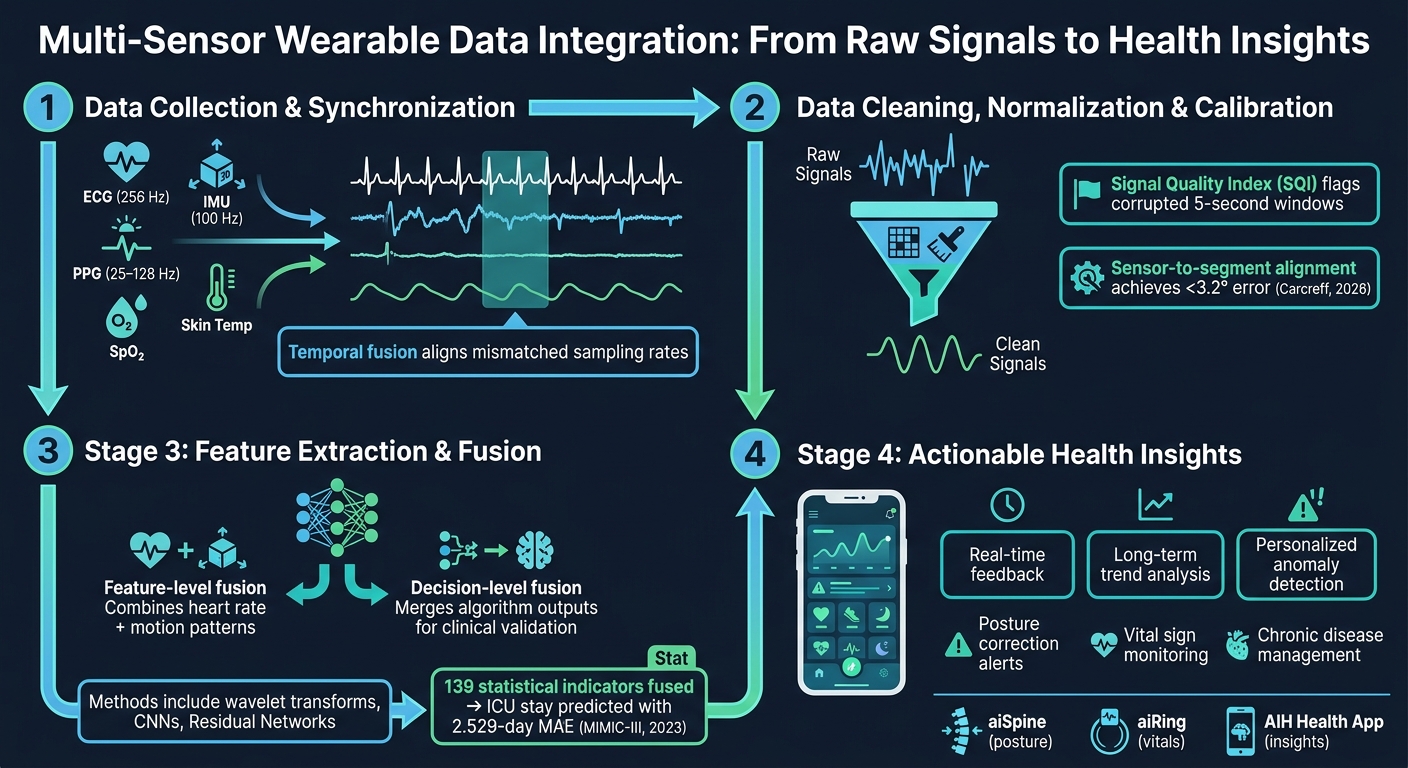
Multi-Sensor Wearable Data Integration: From Raw Signals to Health Insights
Turning raw sensor data into actionable insights is the backbone of effective health monitoring systems.
Data Collection and Synchronization
Multi-sensor wearables rely on input from various devices like ECG, PPG, IMUs, SpO₂, and skin temperature sensors. Each sensor type operates at a unique sampling frequency – ECG sensors commonly run at 256 Hz, IMUs at around 100 Hz, and PPG sensors range between 25 to 128 Hz.
These differences in sampling rates create a major challenge: aligning data streams in time. Without time-stamping and synchronization, comparing or merging these streams becomes unreliable. Temporal fusion techniques step in here, using time-based correlations to fix alignment errors and ensure data streams are synchronized.
Once the data is synchronized, the next step is to refine the raw signals through cleaning and calibration.
Data Cleaning, Normalization, and Calibration
Raw sensor data is often cluttered with noise from factors like motion, electrical interference, or improper sensor placement. Preprocessing filters out these artifacts, ensuring the data is ready for meaningful analysis.
A commonly used tool for this is the Signal Quality Index (SQI), which evaluates the reliability of data in short intervals (e.g., 5-second windows). This process flags corrupted data segments before they enter the fusion process. Instead of discarding bad data outright, systems often adjust the weighting of each sensor’s input:
"Corrupted signals can cause significant fluctuations in measured or derived parameters, resulting in false alarms… Data fusion has emerged as a solution that provides improved accuracy and more precise inferences compared to those derived from a single sensor source." – Arlene John, University of Twente
For wearables that rely on motion data, sensor-to-segment alignment is a critical calibration step. This ensures the sensor’s coordinate system aligns with the body part it’s attached to. For example, a 2026 study by L. Carcreff at the University of Nottingham Ningbo China validated a system using seven IMUs placed on different body segments. After applying alignment algorithms, the system achieved errors below 3.2° compared to a reference motion capture system.
Once the data is cleaned and calibrated, the system is ready to extract meaningful features.
Feature Extraction and Fusion
With clean, synchronized data, the system can now extract features that provide critical health insights. Methods like wavelet transforms are used to extract precise heartbeat data from ECG and PPG signals, while time-frequency analysis creates 2D spectrograms that reveal how health metrics evolve over time.
The extracted features are then combined using fusion techniques. These methods can range from simple weighted summation to advanced deep learning models like CNNs and Residual Networks. The level at which data is fused also plays a role:
- Feature-level fusion: Combines metrics like heart rate and motion patterns, offering better resilience against signal corruption.
- Decision-level fusion: Merges outputs from separate algorithms, making it easier to validate in clinical settings.
For example, a 2023 study utilizing the MIMIC-III database fused 139 statistical indicators from vital signs and lab results. This approach successfully predicted ICU length of stay with a mean absolute error of 2.529 days.
These steps lay the foundation for extracting reliable, actionable insights from multi-sensor data.
How Multi-Sensor Wearables Are Used in Health Monitoring
The true power of multi-sensor wearables shines when applied to specific health challenges, like improving spine health and managing chronic diseases. By combining data from various sensors, these devices provide a more accurate and actionable picture of a user’s health.
Spine Health and Posture Monitoring
Maintaining proper posture requires constant monitoring of how the body moves and aligns. Multi-sensor wearables tackle this challenge by combining gyroscopes and accelerometers to track even the smallest deviations in spinal alignment.
For example, a 2024 study conducted at Baylor College of Medicine used wearable sensors to monitor 10 neurosurgeons during live surgeries. The study found that these surgeons spent over half of their operating time in static postures, increasing their risk of musculoskeletal strain.
"Wearable technology can identify those periods when neglected postures are more prevalent, enabling prompt correction." – Dr. Alejandro Zulbaran-Rojas, Research Associate, Baylor College of Medicine
Devices like AIH LLC’s aiSpine provide real-time feedback to users. Through subtle vibrations, these wearables prompt users to correct their posture immediately. The AIH Health App pairs with the device to track spinal alignment trends over time, offering insights into long-term posture habits. This same level of precision and data accuracy is crucial for managing chronic diseases.
Chronic Disease Monitoring
When it comes to chronic conditions like cardiovascular disease or metabolic disorders, a single sensor can’t tell the whole story. Multi-sensor wearables combine inputs – such as data from a smart ring, skin temperature readings, and SpO₂ sensors – to deliver a more complete view of the user’s health. This fusion of data ensures greater accuracy by filtering out motion artifacts and focusing on meaningful health events.
Take AIH LLC’s aiRing, for instance. This wearable integrates advanced sensors and AI algorithms to provide 24/7 monitoring of vital signs. Its waterproof design ensures continuous tracking, even in challenging conditions, making it a reliable tool for long-term health management.
Personalized Insights Through the AIH Health App
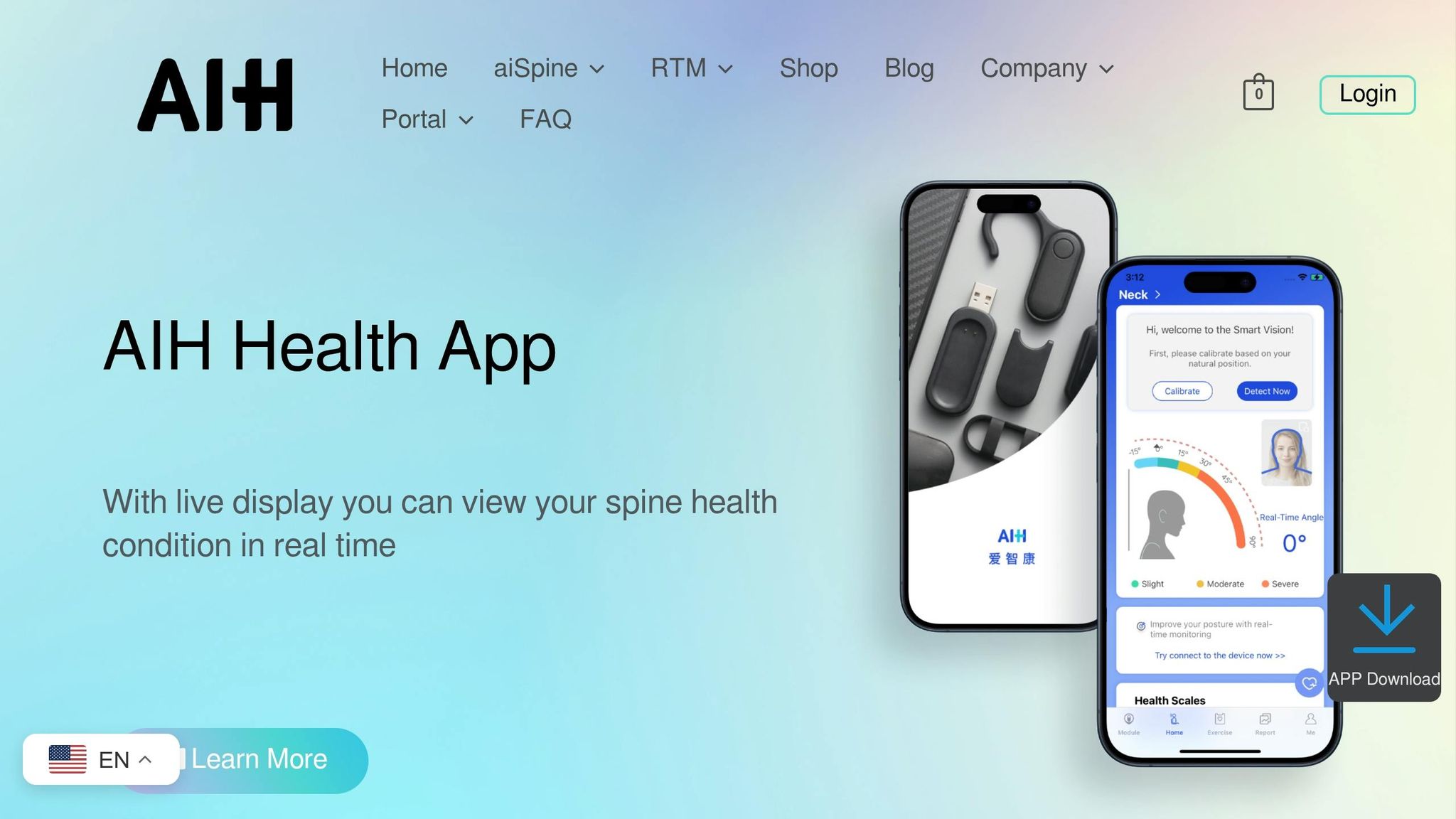
The AIH Health App takes all the raw data from devices like the aiSpine and aiRing and transforms it into actionable insights. It processes this data in real time to highlight critical trends and detect anomalies. On-device analytics provide immediate feedback, while cloud-based processing offers a deeper look at long-term patterns. Unlike generic solutions, the app tailors its insights to reflect each user’s unique health profile, going beyond population averages to deliver a truly personalized experience.
Challenges and Future Directions in Multi-Sensor Data Integration
Current Technical and Practical Challenges
Even with significant progress, multi-sensor systems still face hurdles that researchers and engineers are working to overcome.
One major issue is signal quality. Problems like motion artifacts and synchronization mismatches – caused by sensors running at different frequencies or temporary failures – can compromise data accuracy. Arlene John from the University of Twente highlights the impact:
"Corrupted signals can cause significant fluctuations in measured or derived parameters, resulting in false alarms in ambulatory health monitoring devices. This can lead to alarm fatigue and delay responses to critical events."
Another challenge lies in physiological variability. Algorithms often struggle to perform consistently across diverse users, as individual differences make it hard to create a universal solution. Additionally, wearable devices face power and hardware limitations. Running complex data fusion models continuously drains battery life and requires highly efficient chip designs, which is no small feat for compact devices.
These obstacles underscore the need for advanced AI approaches to improve personalized health monitoring.
AI and Personalized Health Monitoring
AI is proving to be a powerful tool for addressing these challenges. Modern machine learning models are capable of adapting to individual physiological patterns, making them ideal for personalized applications. For example, transformer-based architectures can manage asynchronous data streams, enabling them to process health data even when sensors report at irregular intervals. Techniques like Kalman filters help correct for sensor drift in real time, while unsupervised learning methods can identify unusual health events without relying on large labeled datasets.
A 2023 study using the MIMIC-III database, which included data from 33,847 ICU stays, showcased the potential of these AI methods. By combining vital signs, lab results, and patient demographics with tools like XGBoost and GPU-accelerated Bayesian optimization, researchers accurately predicted patient length of stay with a mean absolute error of 2.529 days. This approach also cut processing time by about 85% compared to traditional CPU methods.
"The magic lies in how machine learning (ML) algorithms intelligently combine this sensor information to extract deeper insights than any single sensor could achieve on its own." – Amit Yadav, Machine Learning Researcher
Despite these advancements, challenges remain. Boon Giin Lee from the University of Nottingham Ningbo China points out the key issues:
"The main challenges remain, including ensuring data quality, addressing class imbalance, achieving hardware efficiency for wearable platforms, and maintaining the clinical interpretability of complex models."
AIH LLC‘s Direction for Future Development
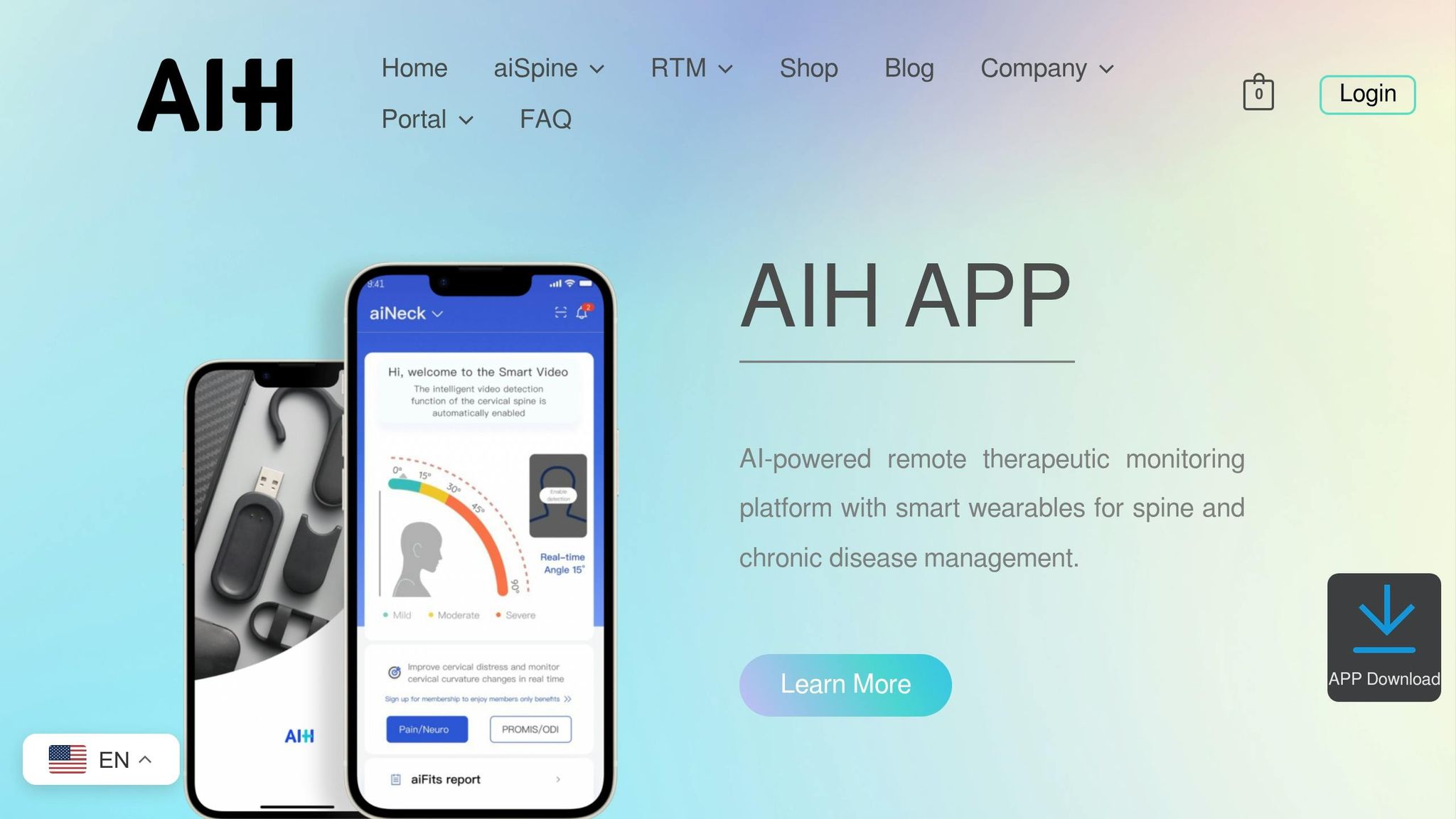
Building on these AI-driven advancements, AIH LLC is expanding its offerings to meet evolving health monitoring needs. Its current lineup – including the aiSpine, aiRing, and AIH Health App – illustrates how layered sensor data and AI analysis can work together in user-friendly devices.
Looking ahead, the company plans to launch the aiNeuro device, designed for preemptive stroke monitoring and posture correction. This upcoming product aims to address persistent challenges like signal quality, synchronization, and energy efficiency. By focusing on context-aware, adaptive systems that model each user’s health over time, AIH LLC is pushing the boundaries of what multi-sensor wearables can achieve. These innovations signal a shift from merely collecting data to creating tools that provide actionable, personalized insights.
Conclusion: Why Multi-Sensor Data Integration Matters
Key Takeaways
Multi-sensor data integration takes wearable technology to the next level by combining signals to create a more complete picture of health. This method improves reliability, accuracy, and the overall quality of insights by addressing the shortcomings of individual sensors. Arlene John highlights that integrating data from multiple sources strengthens both system reliability and resilience. By shifting the focus from raw data to actionable health insights, this approach supports early detection of health issues, better management of chronic conditions, and more tailored care.
AIH LLC’s Role in Integrated Health Solutions
These advancements come to life through practical applications. AIH LLC has implemented these principles with a connected ecosystem of devices. For example, the aiSpine monitors posture and spinal health throughout the day, while the aiRing continuously tracks vital signs like heart rate, SpO2, and skin temperature. Together, these devices sync via the AIH Health App, delivering personalized feedback that a single sensor simply couldn’t provide. This multi-wearable approach ensures consistent data collection, even when individual sensors face noise or interruptions.
Looking ahead, AIH LLC plans to expand its ecosystem with the aiNeuro, a device aimed at preemptive stroke monitoring. This next step underscores their mission: to transform health data into actionable guidance that people can use in their daily lives. By moving beyond simple data collection, AIH LLC is shaping the future of wearable technology and personalized health solutions.
FAQs
How do wearables sync sensors that sample at different rates?
Wearable devices rely on data fusion techniques to handle sensors that sample at varying rates. These methods work by integrating data in a hierarchical way, giving priority to measurements based on factors like accuracy, relevance, and precision. This approach ensures that different data streams come together seamlessly, enabling a more thorough and reliable analysis.
What is an SQI, and why does it matter for accuracy?
The Signal Quality Index (SQI) is a metric used to evaluate how accurate and reliable sensor data is. By detecting and filtering out noise or unwanted artifacts, it ensures that health monitoring data remains precise. This process allows wearable devices to deliver more dependable insights for tracking health metrics effectively.
What’s the difference between feature-level and decision-level fusion?
Feature-level fusion brings together data from multiple sensors into a single, unified set of features before classification. This approach allows for a deeper and more integrated analysis of the sensor data. In contrast, decision-level fusion works by combining the final outputs or decisions from each sensor after they’ve been processed separately. This is often achieved using logical operations like AND or OR. While feature-level fusion focuses on creating a richer and more cohesive dataset, decision-level fusion emphasizes modularity and the independence of each sensor’s processing.