

Predictive analytics is changing how chronic diseases are managed by shifting healthcare from reactive treatment to proactive prevention. Using historical data, machine learning, and wearable technology, these tools help predict health events like hospitalizations or flare-ups before they occur, enabling earlier interventions.
Key takeaways:
- Machine learning models predict chronic disease events with accuracy rates up to 95%.
- Wearables and biosensors provide real-time health data, improving predictions.
- Transformers and AI tools like the "Disease Atlas" map patient health trajectories for tailored care.
- Integration with Electronic Health Records (EHRs) ensures clinicians can act on data effectively.
Challenges include addressing bias in data, ensuring privacy, and meeting regulatory standards. Despite hurdles, predictive analytics is driving more precise care and better outcomes for chronic disease patients.
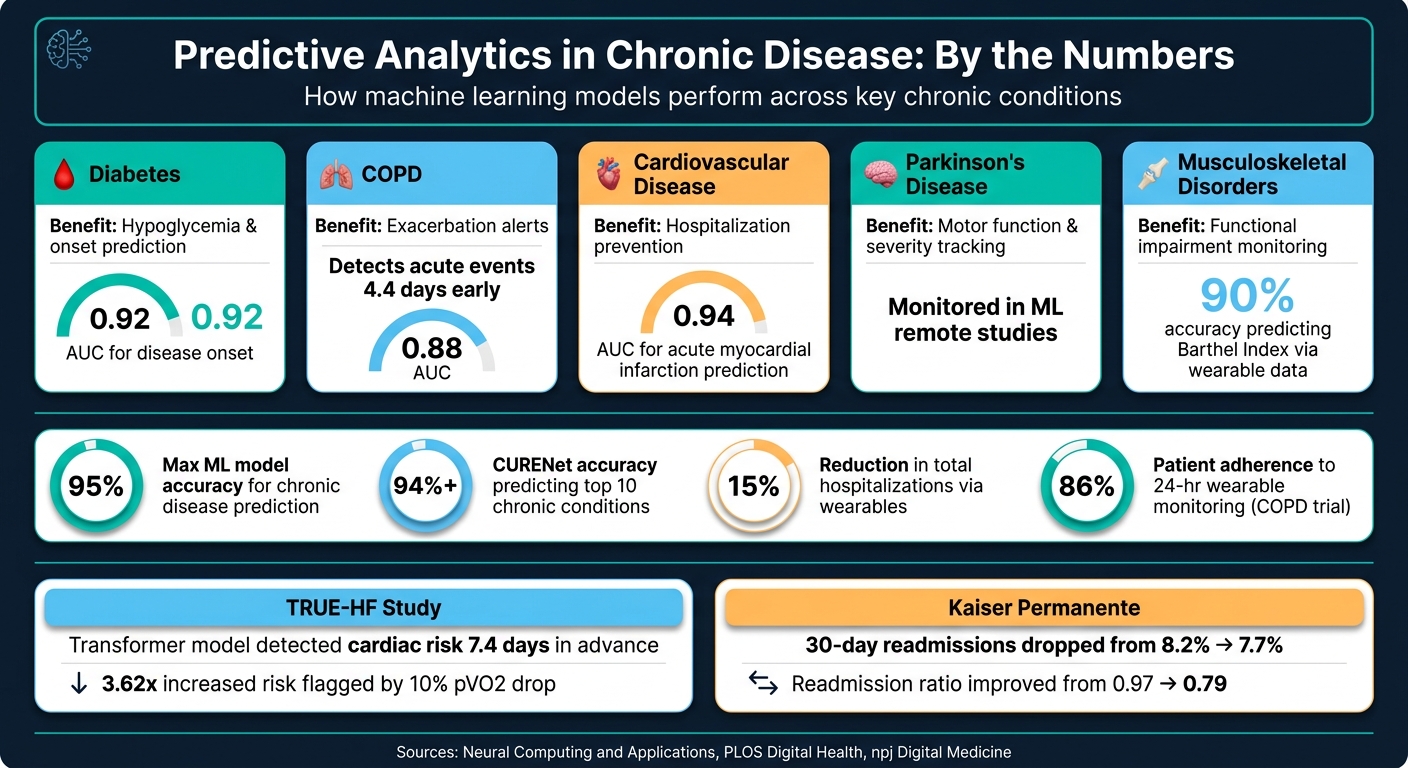
Predictive Analytics in Chronic Disease Care: Key Stats & Performance Data
From Data to Diagnosis -Power of Predictive Analysis | Dr.Lalin L. Laudis | TEDxKanniyakumari

What Predictive Analytics Means for Chronic Disease Care
Predictive analytics uses a mix of historical records and real-time data to anticipate a patient’s next health event. In the context of chronic disease care, this could mean predicting the likelihood of a flare-up, hospitalization, or functional decline – before it happens. The purpose? To give healthcare providers enough time to take preventative action, rather than responding after the damage is already done.
How Predictive Analytics Works in Healthcare
Predictive analytics is all about recognizing patterns in patient data to drive early interventions. Using machine learning algorithms, it processes vast amounts of complex data to uncover trends. These algorithms range from tree-based models like Random Forest to more advanced deep learning systems such as Recurrent Neural Networks (RNNs) and Transformer models. Transformers, in particular, have become a standout option for chronic disease data. Thanks to their self-attention mechanisms, they can analyze intricate relationships across years of patient history, something RNNs often struggle to manage.
One of the practical tools born from these models is the "Disease Atlas" – a visual representation of a patient’s likely health trajectory. Instead of simply labeling someone as "high risk", these maps outline the potential sequence of clinical events, enabling more tailored care plans.
"The effective integration of artificial intelligence into clinical workflows requires models that go beyond simple prediction to generate comprehensive, explainable, and actionable disease trajectories." – Sequential Pattern Transformer (SPT) Research Team, Neural Computing and Applications
Chronic Conditions Where Predictive Models Have the Most Impact
Chronic conditions are particularly well-suited for predictive analytics because they progress gradually and often present subtle signs before major health events occur. Here are some examples where predictive models have delivered strong results:
| Condition | Key Predictive Benefit | Notable Performance |
|---|---|---|
| Diabetes | Hypoglycemia and onset prediction | AUC of 0.92 for disease onset prediction |
| COPD | Exacerbation alerts | Detects acute events an average of 4.4 days early |
| Cardiovascular Disease | Hospitalization prevention | AUC of 0.94 for acute myocardial infarction prediction |
| Parkinson’s Disease | Motor function and severity tracking | Commonly monitored in ML remote monitoring studies |
| Musculoskeletal Disorders | Functional impairment monitoring | 90% accuracy predicting Barthel Index via wearable activity data |
Data Sources That Power Predictive Analytics
The success of predictive analytics depends on pulling insights from multiple data sources. No single input tells the whole story, so the most effective models combine several types of information to create a more complete view of each patient:
- Electronic health records (EHRs): These provide a long-term view of a patient’s health, including lab results, visit histories, and diagnoses.
- Wearable devices: Tools like fitness trackers contribute real-world data on heart rate, oxygen saturation (SpO2), and physical activity levels between clinical appointments.
- Biosensors: Devices such as continuous glucose monitors (CGMs) offer real-time physiological data, which is especially crucial for managing conditions like diabetes and hypertension.
- Patient-reported outcomes (PROs): Self-reported symptoms and assessments add a subjective layer that complements clinical data.
The trend toward multimodal data fusion – blending these diverse data sources – is transforming the field. For example, the CURENet model combined unstructured clinical notes with structured lab data, achieving over 94% accuracy in predicting the top 10 chronic conditions. This level of precision simply isn’t possible with a single data stream. These integrated insights are now paving the way for cutting-edge research and practical applications in healthcare.
What Recent Research Shows About Predictive Analytics
Recent studies reveal that predictive analytics often surpasses traditional clinical tools in performance. However, they also bring attention to certain limitations that healthcare professionals must address.
How Predictive Models Are Measured for Accuracy
To evaluate the clinical reliability of predictive models, researchers rely on several key metrics:
| Metric | What It Measures | Why It Matters |
|---|---|---|
| AUROC | A model’s ability to differentiate between at-risk and stable patients | Scores above 0.80 are considered strong indicators for clinical decision-making |
| Sensitivity (Recall) | The accuracy in identifying true positive cases | High sensitivity helps reduce missed events, which is critical for preventing hospitalizations |
| Specificity | The ability to avoid false positives | High specificity minimizes alert fatigue for healthcare staff |
| F1 Score | The balance between precision and recall | Particularly useful when stable patients outnumber high-risk ones in datasets |
A 2025 systematic review of 76 studies revealed that 73.7% of them had a high risk of bias, often due to gaps in study methodology. While this doesn’t discredit the models themselves, it highlights the need for stronger validation to ensure findings can be applied across different healthcare systems. These metrics remain critical for assessing how predictive models perform in practical settings.
How Predictive Analytics Is Used in Clinical Settings
Real-world clinical trials provide further evidence of the effectiveness of predictive analytics. For instance, the TRUE-HF study conducted by the Ted Rogers Centre for Heart Research tracked 217 heart failure patients using Apple Watch Series 6 devices from December 2019 to April 2024. A transformer model predicted pVO2 levels, achieving a Pearson correlation of 0.85. A 10% drop in wearable-derived pVO2 was linked to a 3.62-fold increase in the risk of unplanned events, which the model detected 7.4 days in advance. This highlights how predictive analytics can enable early and proactive healthcare interventions.
In another example, Kaiser Permanente Northern California implemented a randomized study from May to December 2022 involving 9,959 patients across 19 hospitals. The study used the causal ML-based Predicted Benefit Intervention (PBI) score to identify patients more likely to benefit from a Transitions Program that included medication reconciliation and weekly follow-ups. The results were promising: 30-day readmissions decreased from 8.2% to 7.7%, and the observed-to-expected readmission ratio improved from 0.97 to 0.79.
"Predictive analytics was seen as a potentially effective approach to support decision-making, calculate risks, and improve resource utilization, especially in the context of complex chronic care." – International Journal of Medical Informatics
One of the most intriguing advancements in predictive analytics is the shift from risk-based to benefit-based targeting. Traditional models often focus on the highest-risk patients, but these patients may not always respond to interventions. Causal ML takes a different approach by prioritizing patients who are most likely to benefit from clinical action. This shift, combined with the integration of AI-powered wearables, is paving the way for more precise and impactful healthcare solutions.
How AI-Powered Wearables Support Predictive Analytics
AI-powered wearables bring predictive analytics to life by delivering accurate, continuous updates to predictive models. Unlike traditional health evaluations that provide isolated snapshots, these devices supply a steady stream of data, which is critical for understanding the dynamic nature of chronic diseases. Conditions like heart disease or respiratory issues often progress unpredictably, with subtle changes in metrics like heart rate, oxygen saturation, or breathing patterns signaling potential crises. Wearables capture these signals effortlessly, feeding them into predictive algorithms that can identify risks early. Devices such as aiSpine and aiRing exemplify how this ongoing data flow translates into actionable insights.
AIH LLC Wearables: Monitoring Spine Health and Chronic Conditions
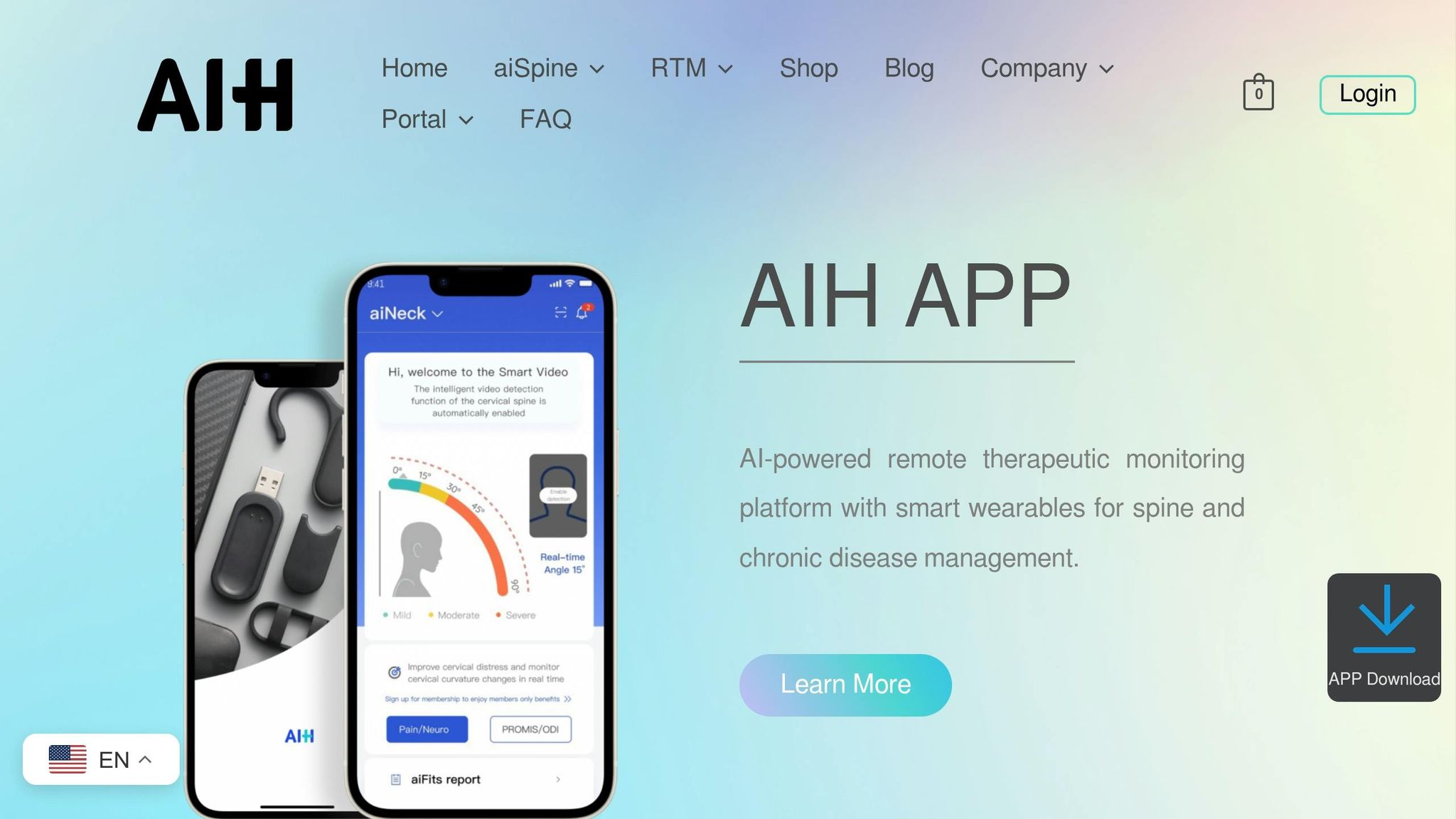
AIH LLC has leveraged this technology to address two key areas: spinal health and vital signs monitoring. The aiSpine device focuses on real-time posture tracking. By using vibration reminders and analyzing historical data, it helps patients and clinicians spot patterns linked to musculoskeletal issues. Meanwhile, the aiRing continuously monitors vital signs like heart rate and respiratory metrics through advanced sensors and AI algorithms, all housed in a lightweight, waterproof ring. Both devices integrate seamlessly with the AIH Health App, which consolidates data for real-time feedback and remote monitoring. This constant data stream is the backbone of predictive analytics, enabling proactive care. Backed by clinical research, these wearables highlight how technology can transform chronic disease management.
Research on Wearables in Chronic Disease Management
The evidence supporting wearable technology in healthcare continues to grow. For example, the eMEUSE‑SANTÉ clinical trial, published in PLOS Digital Health in May 2026, tracked 220 COPD patients over six months using wristbands that monitored heart rate, breathing rate, and SpO₂. The data generated a BVS3 risk score that predicted moderate and severe exacerbations with 84.8% accuracy and an AUC of 0.88, detecting events an average of 4.4 days before clinical confirmation. Impressively, patient adherence to 24-hour monitoring remained high, reaching 86% over the study period.
"By enabling earlier intervention, this end‑to‑end digital solution could significantly improve patient outcomes through proactive disease management." – PLOS Digital Health
Another study conducted in 2024 at Virgen del Rocío University Hospital in Seville, Spain, involved 90 patients with complex chronic conditions. Researchers found that maximum step counts during morning and evening – captured passively by wearable activity trackers – could predict functional status with 90% accuracy using the Barthel Index, without requiring any lab-based clinical parameters.
Across various conditions, wearables have proven to be effective for remote patient monitoring, contributing to a 15% reduction in total hospitalizations. This is particularly impactful when considering that chronic diseases account for approximately 90% of total U.S. healthcare expenditures.
sbb-itb-44aa802
Adding Predictive Analytics to Clinical Workflows
Wearable data becomes truly impactful when it integrates smoothly into clinicians’ workflows, enabling timely and informed actions.
EHR Integration and Remote Monitoring
Technologies like SMART on FHIR and Apple’s HealthKit have made it possible to connect wearable devices and remote monitoring platforms directly with Electronic Health Records (EHRs). This integration allows real-world metrics – such as sleep patterns, activity levels, and vital signs – to appear within a clinician’s existing tools. The result? A more comprehensive view of a patient’s health between visits.
But integration isn’t just about moving data from one place to another. It’s about combining different types of data for better insights. Predictive models now merge unstructured notes, structured lab results, and continuous remote monitoring data to create more accurate forecasts. This approach not only enriches patient profiles but also contributes to measurable improvements in care.
"The integration of Artificial Intelligence, Electronic Health Records (EHRs), and wearable technologies holds substantial potential for transforming healthcare from a reactive, disease-focused model to a proactive, patient-centered paradigm." – MDPI Healthcare
The design of alert systems also plays a critical role in adoption. Immediate alerts, like pop-up notifications, ensure visibility but contribute to alert fatigue, which is reported in 31.8% of implementation studies. Non-intrusive dashboards reduce this burden but risk being overlooked. The most effective systems match the type of alert to the urgency of the situation, avoiding a one-size-fits-all approach. By streamlining data integration and tailoring alerts, healthcare providers can see real gains in both clinical performance and patient outcomes.
Effects on Clinical Efficiency and Patient Outcomes
Evidence of the impact of predictive analytics is growing. For example, a prospective study showed that remote patient monitoring reduced the 6-month mortality rate in patients with CHF and COPD from 17% to 6.4%. This significant improvement was largely due to earlier detection and timely interventions.
Resource allocation has also seen improvement, shifting from risk-based to benefit-based models. Traditional methods often focus on the highest-risk patients, but high risk doesn’t always equate to the highest benefit from interventions. For instance, Kaiser Permanente Northern California implemented a causal machine learning model in May 2022, leading to a drop in the observed-to-expected readmission ratio from 0.97 to 0.79. This improvement, which was statistically significant, persisted through June 2023.
"Variation in the effectiveness of readmission prevention interventions may partly stem from how patients are identified… causal machine learning has emerged as an alternative for generating more targeted predictions." – npj Digital Medicine
Another key factor in adoption is model interpretability. Clinicians are more likely to trust and act on recommendations when they understand the reasoning behind them. Transparent methods, like SHAP values or decision trees – often referred to as "white-box" models – make the decision-making process clear and address concerns about algorithm reliability. This transparency reduces what researchers call algorithm aversion and strengthens clinical decision-making, which is essential for proactive care in chronic disease management.
"Model interpretability as achieved by, e.g., white-box models, feature importance, or decision trees is essential for establishing ML in a clinical decision support system (CDSS) as it addresses safety concerns." – BMC Medical Informatics and Decision Making
Challenges and Ethical Issues in Predictive Analytics
Predictive analytics offers significant potential for improving chronic disease management, but using these tools responsibly comes with its fair share of challenges. From addressing data inconsistencies to navigating complex regulations, the road to effective implementation is anything but straightforward.
Handling Bias and Equity in Predictive Models
One of the biggest hurdles in predictive analytics is dealing with incomplete or unbalanced data. For instance, missing values in electronic health record (EHR) lab measurements can range from 5% to 40%, depending on the variable. Models built on limited or single-center datasets often fall short when applied to larger, more varied populations.
But bias isn’t just about missing data. Social determinants of health (SDOH) – factors like income, housing, and geography – can inadvertently serve as stand-ins for race or ethnicity, embedding systemic inequities into healthcare decisions. Even pharmacy claims data can be misleading; for example, 20% of patients fail to start newly prescribed therapies, skewing adherence metrics.
"Responsible AI deployment requires participatory governance, health equity prioritization, and maintenance of clinician oversight throughout implementation." – Frontiers in Digital Health
To tackle these issues, proactive measures are essential. Regular fairness audits can help pinpoint demographic disparities before they influence care. Tools like the Prediction Model Risk of Bias Assessment Tool (PROBAST) are invaluable during development, helping identify weaknesses early on. Testing models on independent patient datasets, rather than just the ones used for development, is another critical step to ensure reliability in real-world scenarios.
Confronting bias head-on is especially important as regulatory and privacy standards continue to evolve.
Regulatory and Privacy Requirements
Beyond addressing bias, predictive analytics must adhere to strict regulatory and privacy standards. In the U.S., these tools are governed by HIPAA and FDA guidelines for Software as a Medical Device (SaMD). A key development came in December 2024, when the FDA released updated guidance on "Predetermined Change Control Plans" (PCCPs). This framework allows manufacturers to pre-approve future updates to AI algorithms, enabling continuous improvements without requiring a new 510(k) submission for every tweak.
"The FDA’s December 2024 guidance on ‘Predetermined Change Control Plans’ for continuously learning AI devices marks an important milestone… facilitating adaptive AI algorithms by allowing pre-approved modifications while ensuring safety and efficacy." – Frontiers in Public Health
Privacy concerns are another major consideration. Cyberattacks on healthcare systems have skyrocketed, with data breaches increasing by 239% since 2018. Even when datasets are de-identified, the risk of re-identification remains a serious issue. Techniques like federated learning are gaining traction as a solution. These methods allow models to train on distributed datasets without exposing raw patient information, enhancing both privacy and model performance.
Ultimately, building trust is key. Transparency in how data is used and ensuring patients provide meaningful, informed consent are essential steps toward integrating predictive analytics safely into healthcare workflows.
Conclusion: Where Predictive Analytics in Chronic Disease Care Is Headed
Predictive analytics is reshaping how chronic diseases are managed. Care is shifting away from reactive treatments toward continuous, proactive monitoring. For example, models like CURENet have achieved over 94% accuracy in predicting the top 10 chronic conditions, while the Sequential Pattern Transformer (SPT) reached an 85.78% Top-5 accuracy in forecasting future disease trajectories for type 2 diabetes patients. These advancements signal a major evolution in healthcare. With stronger data integration and innovations in wearable technology, the future of chronic disease care is becoming increasingly precise and tailored to individual needs.
"The transformation of chronic disease management is increasingly driven by the integration of AI and multimodal data analytics, enabling precise, individualized, and scalable healthcare interventions." – Zhujin Song, Department of Pharmacy, Zhejiang University
Emerging research and real-world applications highlight these changes. The next step involves combining electronic health records (EHR), real-time wearable data, genomic insights, and clinical notes with explainable AI frameworks. This approach ensures that clinicians can interpret high-risk signals effectively. Tools that prioritize trust, transparency, and actionable insights will ultimately succeed in clinical settings.
Wearable devices are central to this progress. By continuously tracking vital signs, mobility, posture, and other health metrics between clinic visits, wearables provide the real-time data streams that enhance the accuracy and timeliness of predictive models. Devices like AIH LLC’s aiRing and aiSpine, paired with the AIH Health App, are designed specifically for this purpose. They gather ongoing health data for spine health and chronic condition management, feeding it into platforms optimized for remote therapeutic monitoring and personalized care.
Although the potential of these technologies is validated by current research, integrating them into everyday clinical workflows remains a challenge. Issues like data bias, interoperability hurdles, and shifting regulatory requirements still need to be addressed. However, the path forward is clear. As human-in-the-loop systems continue to evolve, the foundation for truly personalized chronic disease care is steadily being built – one data point at a time.
FAQs
How do predictive models actually reduce hospitalizations?
Predictive models play a key role in cutting down hospitalizations by making proactive care possible. By examining data from clinical records, demographic details, and even real-time inputs like electronic health records or wearable devices, these models pinpoint patients who are at higher risk. Armed with this information, healthcare providers – such as those using AIH LLC’s digital health platforms – can step in early with personalized strategies. This might include targeted outreach, remote monitoring, or adjusting treatments promptly. The result? Stabilized conditions that help avoid emergency room visits or hospital stays.
What data do wearables need to collect for reliable predictions?
Wearable devices gather a wide range of biometric and physiological data to support accurate predictions in managing chronic diseases. Some of the key metrics tracked include physical activity (measured through acceleration), vital signs like heart rate, breathing rate, body temperature, blood pressure, and oxygen saturation. More advanced sensors can even monitor ECG readings and sleep patterns. When this data is paired with contextual information – like environmental conditions and patient-reported outcomes – it provides a more complete picture of an individual’s health.
How are bias and privacy handled in predictive analytics?
Protecting patient privacy and minimizing bias are key to ensuring reliable predictive analytics in chronic disease management.
Privacy is maintained using advanced methods such as federated learning, differential privacy, and homomorphic encryption. These techniques ensure that patient data remains secure, even during model updates, by limiting data exposure and enhancing security measures.
On the other hand, tackling bias involves thoroughly evaluating models for fairness and accuracy across varied population groups. This ensures that predictive tools work effectively for everyone, regardless of demographic differences.
AIH LLC contributes to these efforts by offering smart wearables and a secure digital health platform. These tools enable personalized, private monitoring, combining innovation with a strong commitment to patient confidentiality and equitable care.