
What Is a Pulse Oximeter and What Does It Estimate?
A pulse oximeter is a device that is usually clipped on a fingertip and uses light beams to estimate a person's blood oxygen level (oxygen saturation) and their pulse rate. It estimates the amount of oxygen in the blood without having to draw a blood sample. Most pulse oximeters show two or three numbers: oxygen saturation (SpO2) as a percentage, pulse rate (PR), and sometimes a third number for signal strength. Oxygen saturation values are between 95% and 100% for most healthy individuals, but they can be lower in people with lung and heart problems, and they are generally slightly lower for those living at higher altitudes.[source]
A pulse oximeter estimates rather than diagnoses. Only a health care provider can diagnose a medical condition such as hypoxia (low oxygen levels). Pulse oximeter readings should be considered in context with other information, including signs and symptoms of low oxygen, rather than in isolation.[source]
aiOxy at a Glance: Confirmed Features and Specifications
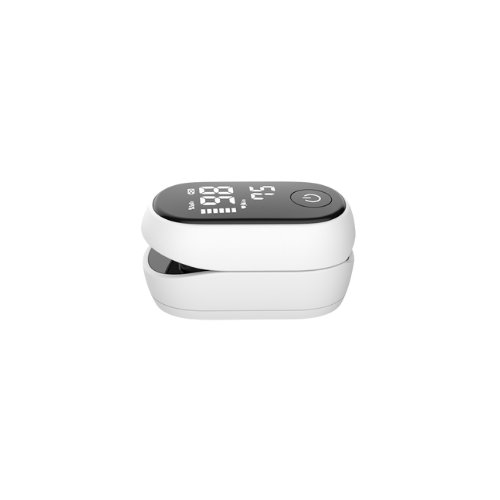
The confirmed AIHNET product name is aiOxy, and it maps to manufacturer model AOJ-70B. It is a fingertip pulse oximeter with an OLED reading view that includes pulse waveform or bar-graph signal information. It spot-checks SpO2 and pulse rate and displays perfusion index. The manufacturer-stated ranges and accuracy values below are quoted exactly and are not guarantees of universal clinical accuracy. aiOxy has no physiological alarm and is intended for spot checking, not continuous monitoring.
| Feature | Confirmed detail |
|---|---|
| Product name | aiOxy |
| Manufacturer model | AOJ-70B |
| Form factor | Fingertip |
| Reading view | OLED with pulse waveform or bar-graph signal information |
| Measurement type | Spot-check SpO2 and pulse rate; perfusion index display |
| SpO2 measurement range | 0-100%; display 35-100% |
| SpO2 stated accuracy | +/-2% at 70-100%; below 70% unspecified |
| Pulse-rate range | 25-250 bpm |
| Pulse-rate stated accuracy | +/-2 bpm |
| Perfusion-index range | 0-50% |
| Connectivity | Bluetooth 4.2 (as stated in the supplied manual) |
| Power | Two AAA batteries |
Taking a Reading at Home: Step-by-Step
To take a reading, follow your health care provider's advice about when and how often to check your oxygen levels, and follow the manufacturer's instructions for use. The steps below describe a general spot-check routine; they are not individualized medical instructions, and they do not tell you what action to take based on a result. aiOxy is intended for spot checking, not continuous monitoring, and it has no physiological alarm.[source]
General at-home spot-check routine
- Follow your provider's advice Follow your health care provider's advice about when and how often to check your oxygen levels.
- Follow the manufacturer's instructions Use the device according to the manufacturer's instructions for use.
- Warm, relaxed hand below heart level When placing the pulse oximeter on your finger, make sure your hand is warm, relaxed, and held below the level of the heart.
- Remove fingernail polish Remove any fingernail polish on that finger.
- Sit still Sit still and do not move the part of your body where the pulse oximeter is located.
- Wait for a steady number Wait a few seconds until the reading stops changing and displays one steady number.
Recording and Tracking Your Readings Over Time
A simple record-keeping habit can help you track changes over time. Write down your oxygen level and the date and time of the reading so you can track any changes and report these to your health care provider.[source]
aiOxy belongs to the aiCare ecosystem and connects with aiCare through Bluetooth for supported SpO2 and pulse-data workflows, as stated in the supplied manual (Bluetooth 4.2). aiCare is AIHNET's connected-health software platform that receives, organizes, and presents connected health data from supported AIHNET devices, and supported data domains include blood oxygen and heart rate. aiCare helps users organize and view supported health information over time. Automatic or background synchronization, reconnection behavior, and exact operating-system compatibility are not confirmed.
What Can Affect a Pulse Oximeter Reading?
As with any device, there is always a risk of an inaccurate reading. Multiple factors can affect the accuracy of a pulse oximeter reading, such as poor circulation, skin pigmentation, skin thickness, skin temperature, current tobacco use, and use of fingernail polish. Current scientific evidence suggests there are some accuracy differences in pulse oximeter performance between individuals with lighter and darker skin pigmentation. Readings should be considered in context with other information, including signs and symptoms of low oxygen.[source]
Signs and Symptoms to Be Aware Of
Be familiar with signs or symptoms of low oxygen levels: bluish coloring in the face, lips, or nails; shortness of breath, difficulty breathing, or a cough that gets worse; restlessness and discomfort; chest pain or tightness; and fast or racing pulse rate. Be aware that some people with low oxygen levels may not show any or all of these symptoms. Only a health care provider can diagnose a medical condition such as hypoxia. Contact a health care provider if you are concerned about the pulse oximeter reading, or if your symptoms are serious or get worse.[source]
Where aiOxy Fits in the aiCare Ecosystem
aiOxy belongs to the aiCare ecosystem and connects with aiCare through the confirmed product workflow, using Bluetooth 4.2 as stated in the supplied manual. aiCare receives, organizes, and presents connected health data from supported AIHNET devices, and supported data domains include blood oxygen and heart rate. aiCare is AIHNET's connected-health software platform that brings supported AIHNET device data together into one health-data experience. Automatic or background synchronization, reconnection behavior, universal phone support, exact operating-system compatibility, Wi-Fi protocol, encryption details, security certification, and guaranteed privacy are not confirmed.
You can learn more about the aiOxy pulse oximeter on the aiOxy product page.
Frequently Asked Questions
What is a pulse oximeter used for at home?
A pulse oximeter estimates blood oxygen saturation (SpO2) and pulse rate using light beams, without drawing blood. It is one way to monitor oxygen levels, and readings should be considered alongside symptoms and other information. It does not diagnose a condition or replace a health care provider.
How do I know if my pulse oximeter reading is accurate?
There is always a risk of an inaccurate reading. Factors such as poor circulation, skin pigmentation, skin thickness, skin temperature, current tobacco use, and fingernail polish can affect accuracy. Manufacturer-stated accuracy values are quoted exactly and are not guarantees of universal clinical accuracy; not every reading is correct for every user.
What do the numbers on a pulse oximeter mean?
Most pulse oximeters show oxygen saturation (SpO2) as a percentage and pulse rate (PR), and some show a third number for signal strength. Oxygen saturation values are between 95% and 100% for most healthy individuals but can be lower in people with lung and heart problems or at higher altitudes. This article does not interpret a specific reading or advise an action based on it.
Can aiOxy send my readings to my phone?
aiOxy connects with aiCare through Bluetooth for supported SpO2 and pulse-data workflows, as stated in the supplied manual (Bluetooth 4.2). aiCare receives, organizes, and presents supported connected health data from compatible AIH devices. Automatic or background synchronization, reconnection behavior, and exact operating-system compatibility are not confirmed.
Is aiOxy a medical device?
The supplied product information does not establish medical-device classification. This article does not answer yes or no and does not substitute the absence of diagnosis or treatment capability for classification.
When should I contact a health care provider about a reading?
Contact a health care provider if you are concerned about the pulse oximeter reading, or if your symptoms are serious or get worse. Only a health care provider can diagnose a medical condition such as hypoxia. This article does not provide emergency triage or individualized medical advice.
References
- Pulse Oximeter Basics | FDA — www.fda.gov