
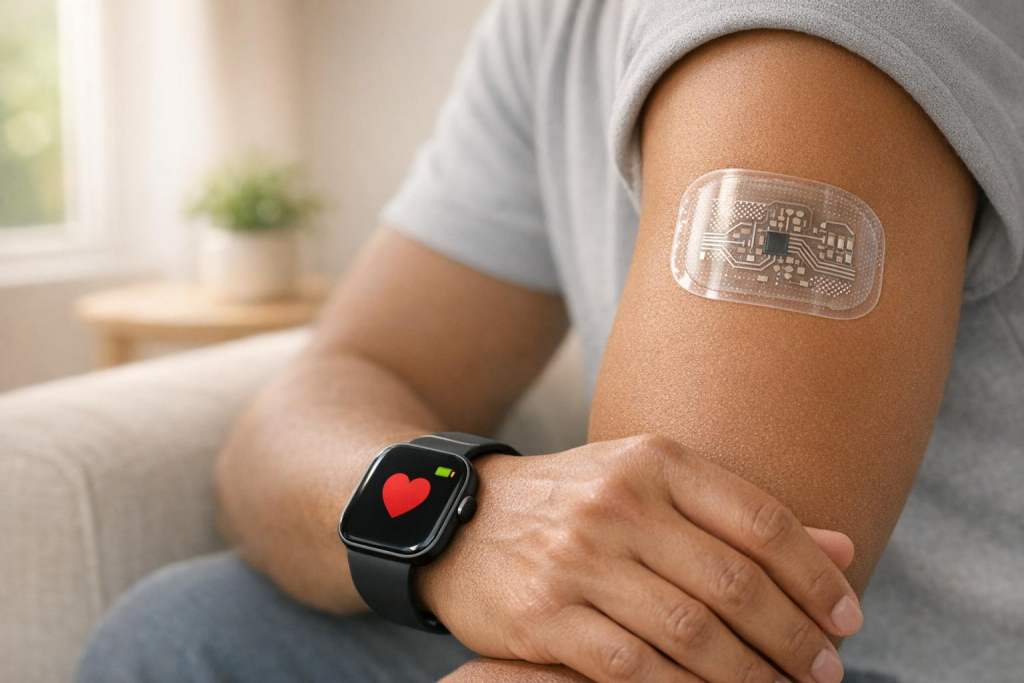
Energy-efficient sensors are solving the biggest problem with wearable health monitors: short battery life. By using less power and even harvesting energy from sources like body heat or light, these sensors enable continuous tracking without frequent recharging. This is critical for managing chronic conditions and detecting health issues early.
Key Highlights:
- Battery Life: Reduced energy usage and energy harvesting methods extend operation times.
- On-Device Processing: Sensors process data locally, cutting wireless transmission needs by up to 100x.
- Comfort: Smaller, lighter designs improve wearability without sacrificing functionality.
- AI Integration: Local AI processing ensures real-time insights while maintaining data privacy.
- Applications: From posture correction to chronic disease management, these sensors support better health outcomes.
Devices like AIH LLC‘s aiSpine and aiRing showcase this technology, offering continuous monitoring with minimal energy use. These advancements are reshaping health monitoring into a more efficient and user-friendly experience.
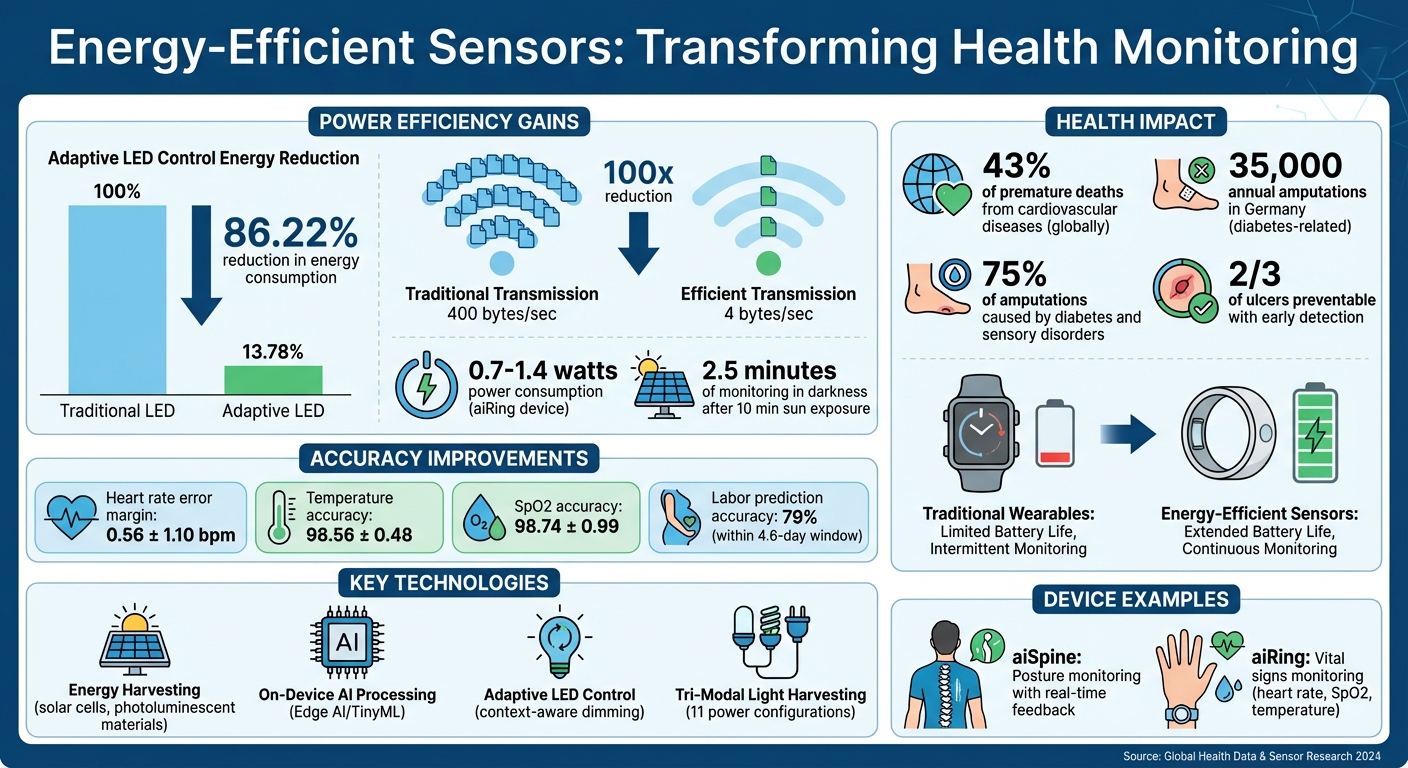
Energy-Efficient Sensors: Key Performance Metrics and Benefits for Health Monitoring
Designing a Hybrid Energy-Efficient Harvesting System for Head- or Wrist-Worn Healthcare Wearables
sbb-itb-44aa802
Problems with Wearable Health Monitoring Devices
Wearable health monitoring devices face several hurdles that make them less reliable as tools for continuous medical use. Let’s dig into some of the key challenges, starting with battery limitations.
Short Battery Life Limits Continuous Monitoring
One major issue is the limited battery life of these devices, which interrupts 24/7 health tracking. Most wearables need recharging every two to three days, creating gaps in the data they collect. These interruptions can delay critical clinical insights when timely data is essential. The problem is worsened by the energy demands of optical sensors, which measure metrics like heart rate and blood oxygen levels. Add to that the power needed for continuous wireless data transmission – up to 400 bytes per second – and you’ve got a recipe for rapid battery depletion. This makes wearables less practical for individuals with busy schedules or those managing chronic health conditions.
Balancing Small Size with Accurate Data Collection
Another challenge lies in creating devices that are both compact and capable of delivering precise data. High-capacity batteries, which are necessary for continuous monitoring, often take up significant space, adding weight and stiffness to the device. Shrinking the battery to improve comfort usually means sacrificing power, which limits the device’s functionality. Plus, miniaturization efforts face technical constraints in areas like material engineering and power management. Smaller devices also struggle with heat dissipation. For example, during charging or heavy use, the internal temperature of a compact wearable can climb to around 99°F. While this is safely below the 111°F threshold that could cause skin burns, it still highlights the difficulties of packing advanced features into a small, wearable form.
Comfort and Long-Term Performance Requirements
No matter how advanced a wearable is, it’s useless if people don’t want to wear it. Studies show that reducing stiffness, size, and weight is crucial for ensuring users stick with these devices – they should ideally feel almost invisible. But the high-capacity batteries needed for longer operation make wearables bulkier and heavier, which can reduce comfort. This added weight also means more frequent charging, increasing both costs and environmental waste. If users feel tied to charging cables or constantly aware of the device, they’re less likely to wear it consistently, even when the health benefits are clear.
How Energy-Efficient Sensors Solve These Problems
Energy-efficient sensors tackle challenges like battery drain, size limitations, and user comfort by optimizing power usage and processing data directly on the device.
Low-Power Design Extends Battery Life
Smart power management is key. Features like adaptive LED control dim or shut off LEDs in bright conditions, reducing energy consumption by up to 86.22%. On-sensor data processing also plays a big role, cutting wireless transmission needs from 400 bytes per second down to just 4 bytes per second – a staggering 100-fold reduction. Some wearables even go a step further by using energy harvesting methods, like multijunction solar cells, to stretch battery life even further.
In August 2025, researchers from KAIST and Northwestern University, led by Professor Kyeongha Kwon and Dr. Chanho Park, showcased an adaptive wearable platform that combines these techniques. Their device monitored heart rate, blood oxygen levels, and sweat metrics under a range of lighting conditions, including total darkness, by using a photoluminescent layer.
Some experimental platforms are exploring "battery-free" designs. These rely solely on ambient light and photoluminescent materials, such as strontium aluminate microparticles, which store light during the day and emit it in darkness. These innovations open the door to uninterrupted, 24/7 data collection.
Continuous Data Collection Without Interruptions
By cutting energy demands, these sensors enable uninterrupted monitoring, eliminating the frequent recharging breaks that plague traditional wearables. For example, in January 2026, researchers developed a skin-interfaced wireless sensor that measured heart rate with an error margin of just 0.56 ± 1.10 bpm. Remarkably, this device operated without LEDs in ambient light, using a tri-modal light harvesting system that could switch between 11 power configurations based on environmental conditions.
Continuous monitoring is especially important for detecting long-term health patterns. For instance, AI models analyzing temperature data from smart rings can predict labor onset with 79% accuracy within a 4.6-day window. Additionally, photoluminescent encapsulation allows up to 2.5 minutes of heart rate monitoring in complete darkness after just 10 minutes of sun exposure.
Working with AI-Powered Health Platforms
By overcoming power constraints, these sensors integrate seamlessly with AI-driven platforms to deliver real-time insights. Using Edge AI or TinyML, they process data locally, cutting down on energy use, reducing latency, and keeping sensitive information secure since the data doesn’t need to be sent to the cloud.
"What AI has allowed us to do is create optimized and efficient models for it to start learning on its own and coming up with different inferences for us."
– Shravan Aras, PhD, Associate Director of Sensor Analysis, University of Arizona
A great example of this integration is the AIH Health App, which pairs with devices like aiSpine and aiRing for real-time health tracking and personalized feedback. AI algorithms also improve accuracy by filtering out errors, such as motion artifacts in heart rate data. These systems use pattern recognition to isolate specific signals in complex sensing environments, shifting healthcare from reactive treatment to proactive prevention. Professor Kyeongha Kwon highlights how this technology supports "24-hour continuous health monitoring, shifting the medical paradigm from treatment-centered to prevention-centered".
Where Energy-Efficient Sensors Are Used in Health Monitoring
Energy-efficient sensors are already transforming healthcare by addressing a range of needs, from monitoring daily posture to detecting critical health conditions before they escalate.
Tracking Posture and Musculoskeletal Health
Wearable devices designed for musculoskeletal health rely on low-power sensors to monitor physical activities like stride patterns, movement quality, and energy use. Many of these devices use energy harvesting to ensure continuous operation. A standout example is the aiSpine posture monitoring device, which uses energy-efficient technology to track spinal alignment in real time. Paired with the AIH Health App, it provides instant feedback to users, helping them correct poor posture and potentially avoid chronic back issues. This technology hints at even broader health applications in the future.
Monitoring Vital Signs for Chronic Conditions
Energy-efficient sensors are also making strides in the management of chronic diseases. These sensors can track vital signs – such as blood pressure, heart rate, and glucose levels – over long periods without frequent battery replacements [3,6]. The aiRing vital signs monitoring ring is a prime example, integrating low-power modules to measure heart rate, SpO2, and temperature in a single device. Despite its compact design, the aiRing achieves clinical-grade accuracy – 98.56 ± 0.48 for temperature and 98.74 ± 0.99 for SpO2 – while consuming just 0.7–1.4 watts of power. Considering that cardiovascular diseases cause 43% of premature deaths globally, these wearables offer a vital early warning system, enabling timely interventions.
Future Uses in Preventive Healthcare
Energy-efficient sensors are also reshaping preventive healthcare by overcoming traditional power limitations. These advancements allow for early detection of health issues, even before symptoms emerge. For example, in September 2024, researchers at the University Clinic of Magdeburg, led by Professor Peter R. Mertens, unveiled smart sensor insoles equipped with temperature sensors. Designed for diabetic patients, these insoles detect localized heat increases, signaling potential inflammation. This innovation aims to reduce the 35,000 annual amputations in Germany, many of which stem from undetected diabetic complications.
"If we can prevent two thirds of ulcers, we will have a major impact. There are around 35,000 amputations per year in Germany, 75 percent of which are caused by diabetes and sensory disorders."
– Prof. Peter R. Mertens, University Clinic for Renal and Hypertensive Diseases, Otto von Guericke University of Magdeburg
Another leap forward comes from the EU-funded ThrombUS+ Project, which developed a portable AI-powered wearable. This device combines ultrasound, electrical impedance plethysmography, and light reflection rheography to continuously monitor post-operative patients for early signs of deep vein thrombosis (DVT). Designed for use both in hospitals and at home, it represents a shift toward proactive health management. These advancements highlight how energy-efficient sensors enable continuous operation, paving the way for a more preventive approach to healthcare.
AIH LLC‘s Energy-Efficient Wearable Devices
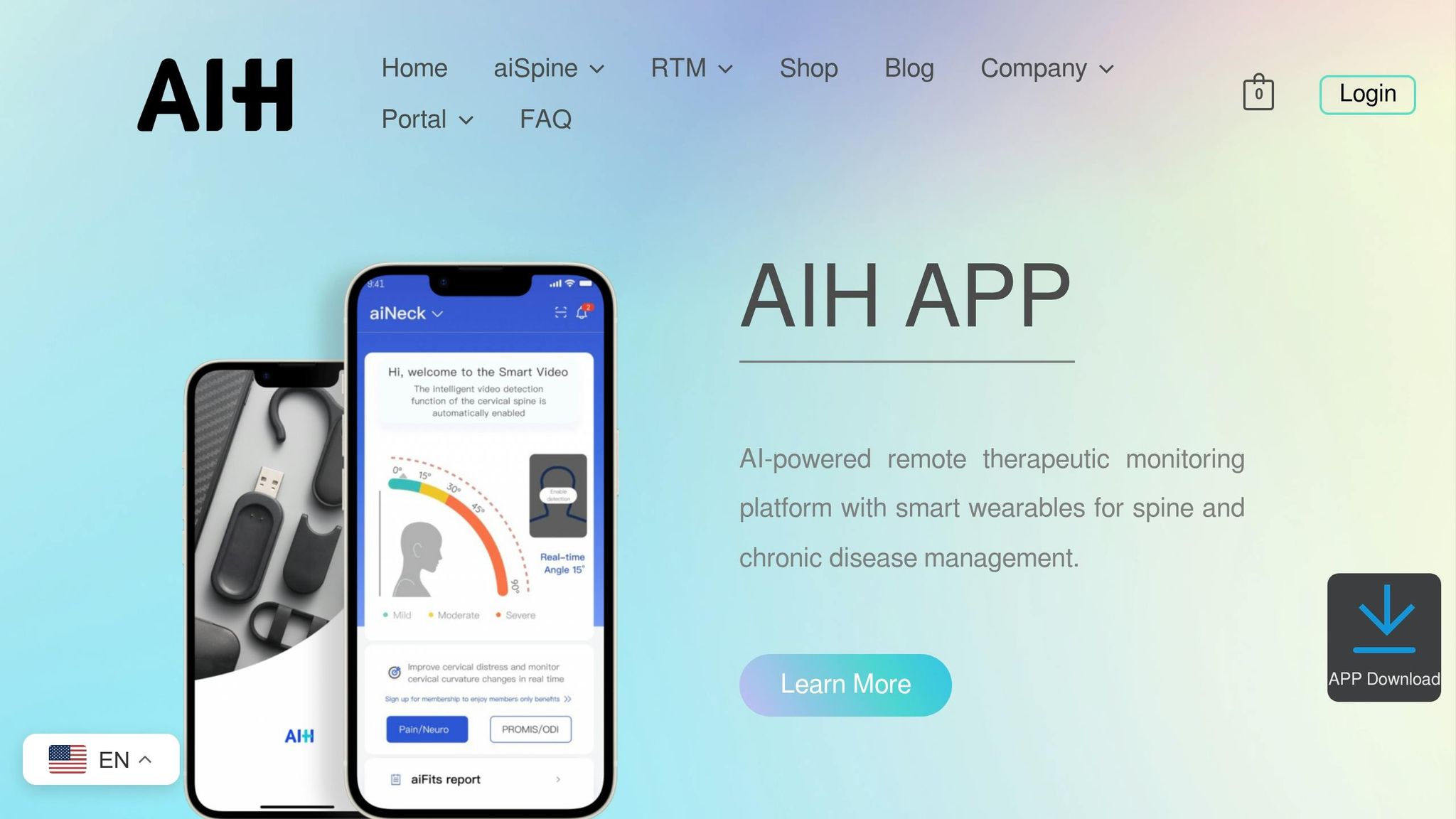
AIH LLC has raised the bar in wearable health technology by combining energy-efficient sensors with advanced health monitoring capabilities.
aiSpine and aiRing: Smart Wearable Technology
AIH LLC offers two standout devices: the aiSpine and aiRing, both designed for continuous health tracking with minimal energy consumption.
- aiSpine: This device uses AI-powered sensors to monitor neck and back movements, tracking angular and curvature changes while also recording physical activity and calorie expenditure. Its compact design allows for versatile use, whether clipped onto glasses, worn over the ear, or attached to clothing.
- aiRing: This smart ring is equipped with ultra-low power Bluetooth chips and precision sensors, enabling it to monitor vital signs seamlessly. Its waterproof build, intuitive touch controls, and ability to link with multiple devices make it adaptable to various scenarios without disrupting continuous tracking.
AI-Powered Personalized Health Insights
AIH LLC’s devices leverage energy-efficient sensors to gather a constant stream of health data, which is then processed by AI algorithms. These algorithms provide detailed insights into musculoskeletal and respiratory health, as well as evaluate therapy adherence and effectiveness through Remote Therapeutic Monitoring (RTM). This ongoing data analysis supports a more personalized and proactive approach to health management.
Complete Health Monitoring System
AIH LLC has created a unified health management platform by combining wearable technology, AI analytics, and remote monitoring. This digital platform consolidates data from the devices with user-provided information to build a comprehensive health profile. It also connects users to healthcare professionals across the United States for consultations and medical resources. As the company emphasizes:
"Every product we create is rooted in medical expertise, fortified by global patents, and rigorously tested to meet international compliance".
Conclusion
Energy-efficient sensors are transforming health monitoring by enabling continuous and accurate tracking. Thanks to advancements in low-power designs and energy harvesting, operating times have effectively doubled, making battery life less of a concern for uninterrupted monitoring.
On-device AI processing is another game-changer. It not only reduces power consumption but also enhances data security. Researchers from Soochow University highlight this by stating:
"The energy consumption of wireless transmission often exceeds that of data collection and processing itself"
– Soochow University
These breakthroughs are paving the way for preventive and continuous care. Devices like AIH LLC’s aiSpine and aiRing showcase this progress by integrating ultra-low power sensors with AI-driven analytics. These tools provide personalized health insights while enabling large-scale, maintenance-free monitoring – critical for managing and preventing chronic illnesses. With the ability to harvest energy from the environment and process data locally, wearable technology is stepping into a new era of continuous and accessible health monitoring.
FAQs
How do energy-efficient sensors extend wearable battery life?
Energy-efficient sensors are designed to make wearable devices last longer by using components that consume less power or by harnessing ambient light. This approach allows for continuous monitoring without relying on large, heavy batteries. For instance, sensors powered by light can run around the clock, making them ideal for consistent health tracking while minimizing energy use.
What is on-device AI, and why does it save power?
On-device AI handles data processing directly on the wearable device itself, eliminating the need to rely on cloud-based systems. This approach conserves energy by cutting down on data transmission and reducing dependence on continuous internet connectivity, making it a great fit for power-efficient health monitoring.
Are ‘battery-free’ wearables realistic for 24/7 monitoring?
Yes, battery-free wearables are now a reality. Thanks to nano-sensors that can generate energy from small, everyday movements – like breathing or walking – these devices no longer rely on traditional batteries. This breakthrough means wearables can provide continuous health monitoring without the challenges and limitations associated with batteries.