
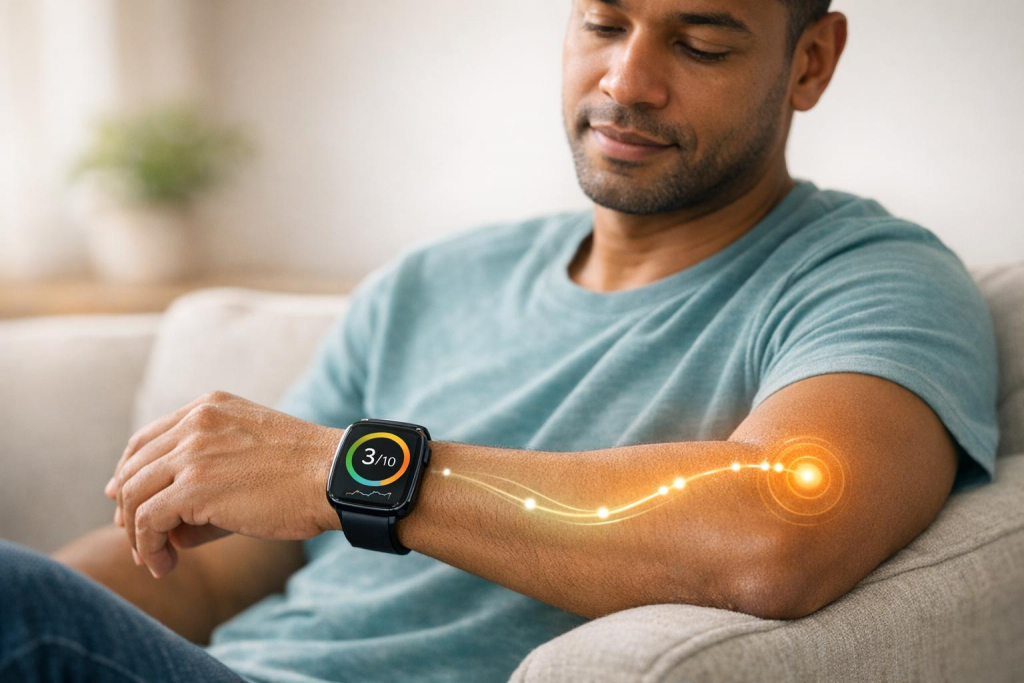
AI wearables are transforming how pain is monitored and managed. These devices collect round-the-clock data on key physiological signals like heart rate, movement patterns, and skin temperature. Using AI algorithms, they analyze this data to detect pain levels and even predict pain flares. This approach helps bridge the gap between patients’ daily experiences and clinicians’ understanding, offering more precise care.
Key Takeaways:
- Continuous Monitoring: AI wearables track pain-related markers 24/7, providing a detailed pain profile.
- Personalized Feedback: Devices learn individual baselines and suggest actions like breathing exercises or contacting a doctor.
- Advanced Sensors: Tools like sEMG, PPG, and IMUs measure muscle tension, blood flow, and movement changes related to pain.
- AI Algorithms: Machine learning models classify pain levels and adapt treatments in real time.
- Proven Results: Studies show up to 92% of users report improvement, with many experiencing reduced pain scores.
By combining real-time data with actionable insights, AI wearables are helping users manage pain more effectively, while clinicians gain access to objective, timely information for better decision-making.
AI Wearable Pain Monitoring: Key Technologies, Clinical Results, and User Outcomes
Core Technologies in AI Wearables
Sensors for Pain Detection
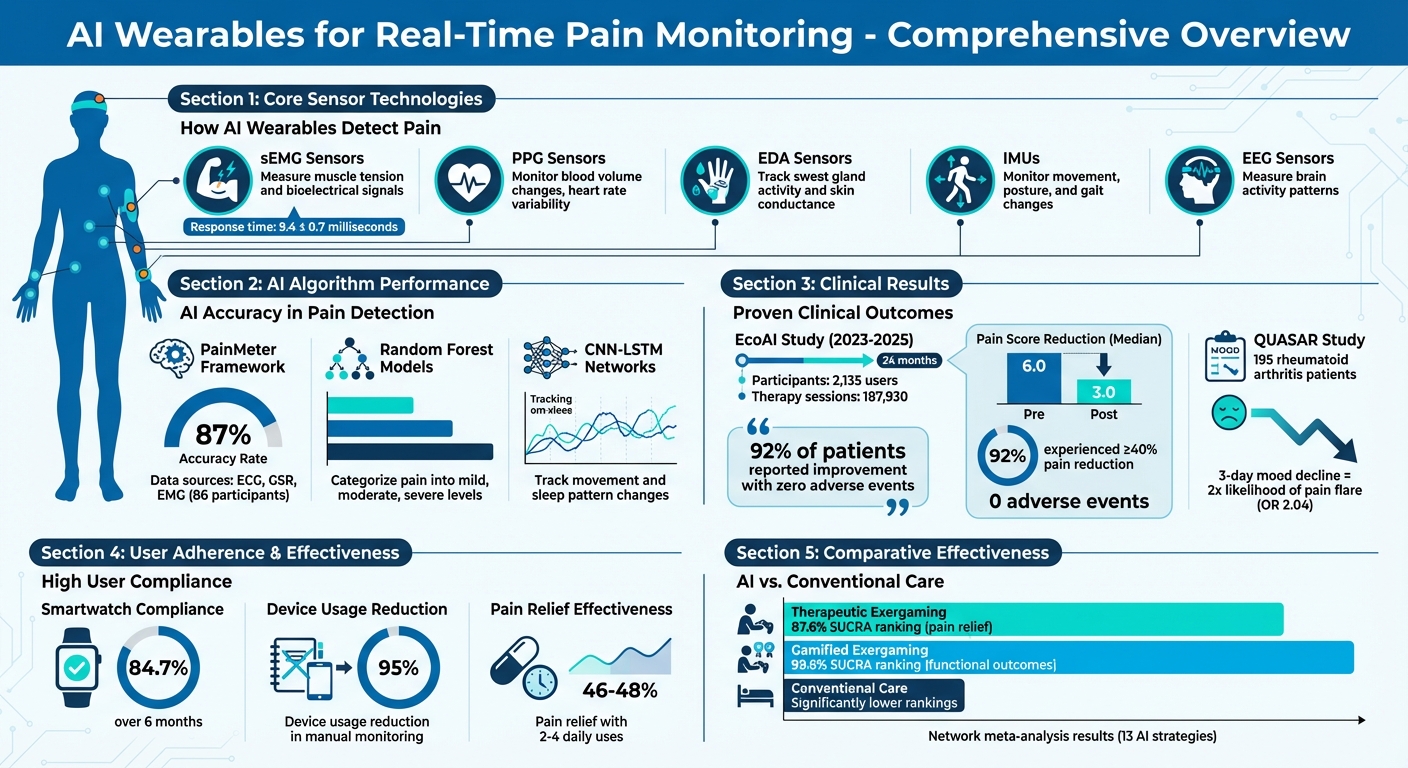
AI wearables rely on a mix of sensors to measure physiological signals that can indicate pain. One key technology is surface electromyography (sEMG) sensors, which pick up bioelectrical signals from muscle activity. These signals can reveal muscle tension or strain, often linked to pain. For example, in August 2025, researchers at the University of Shanghai for Science and Technology introduced a wearable closed-loop TENS platform. This device used sEMG sensors to trigger pain relief with an impressive response time of 9.4 ± 0.7 milliseconds. It delivered ±22 mA biphasic pulses and could operate for 4.2 hours on a 400 mAh battery.
Another important tool is photoplethysmography (PPG) sensors, which use optical methods to monitor blood volume changes under the skin. These sensors can measure heart rate, heart rate variability, and oxygen saturation – metrics that often shift in response to pain. Similarly, electrodermal activity (EDA) sensors track sweat gland activity and skin conductance, which increase when the body experiences pain or stress.
Inertial measurement units (IMUs), combining accelerometers and gyroscopes, help monitor movement, posture, and gait changes. Since pain can alter how someone moves or holds their body, these sensors provide useful insights into physical limitations and discomfort. Some advanced devices also incorporate electroencephalogram (EEG) sensors, which measure brain activity to identify neural patterns associated with pain. Together, these sensors work as a cohesive system, collecting the raw data that AI algorithms analyze to predict and manage pain in real time.
AI Algorithms for Pain Prediction
The raw data from sensors are processed by AI to uncover patterns that reveal pain levels. First, algorithms clean the data using filters like Savitzky-Golay and standardize the sensor readings. From there, they extract "digital biomarkers", such as RMSSD and SDNN values from heart rate variability, to create a detailed profile of the individual’s pain experience.
Random Forest models are particularly effective at categorizing pain into levels such as mild, moderate, or severe. In April 2024, researchers Da’ad Albahdal and colleagues introduced the PainMeter framework, which used the BioVid Heat Pain dataset from 86 participants. Their Random Forest algorithm analyzed ECG, GSR, and EMG data, achieving an 87% accuracy rate in detecting pain without relying on facial expressions. For tracking movement changes over time, CNN-LSTM networks are used to process sequential data, identifying patterns like reduced activity or disrupted sleep that often signal pain.
"By leveraging data-driven models and advanced algorithms, ML can automatically and objectively assess pain levels across diverse populations and contexts." – IEEE Access
Some systems go a step further with closed-loop designs. These systems not only predict pain but also adjust treatments in real time. For instance, between January 2023 and March 2025, the EcoAI platform analyzed 187,930 therapy sessions from 2,135 users. It dynamically adjusted stimulation intensity and waveforms based on user feedback, reducing median pain scores from 6.0 to 3.0 over two years.
These advancements are turning AI wearables into practical tools for managing pain. Companies like AIH LLC (https://aihnet.com) are already combining sensor technologies with machine learning to deliver real-time, personalized pain monitoring and actionable recommendations.
sbb-itb-44aa802
Research Studies on AI Wearables for Pain Management
Usability and Adherence Results
Getting patients to consistently use wearable devices can be tricky, but when the benefits are clear, adherence rates tend to be high. For example, a study involving spinal cord stimulation patients found that participants wore smartwatches for six months with an impressive compliance rate of 84.7%. This highlights how ease of use and meaningful feedback can encourage regular use.
Another example is the QUASAR study, conducted by the University of Manchester between May 2017 and July 2018. Led by Dr. John McBeth, the study tracked 195 rheumatoid arthritis patients using the uMotif smartphone app and MotionWatch 8 accelerometers to monitor pain flares. The findings were striking: a three-day decline in mood doubled the likelihood of a pain flare the next day (OR 2.04). These insights emphasize the importance of adherence when validating clinical outcomes.
Clinical Validation of Pain Relief
AI-powered wearables have shown they can deliver long-term pain relief. A retrospective study conducted between January 2023 and March 2025 analyzed data from 2,135 EcoAI™ users across the U.S., covering 187,930 therapy sessions. Results showed that median pain scores dropped from 6.0 to 3.0 over 24 months. Notably, 92% of patients reported improvement, and 66% experienced at least a 40% reduction in pain scores, all without any adverse events. Patients who used the device two to four times daily reported pain relief ranging from 46% to 48%. Dr. Prachi Patel, one of the study’s investigators, remarked:
"This is the first large real-world demonstration of using the EcoAI AIML technology combined with remote patient monitoring (RPM) to show durable outcomes".
These findings reinforce the safety and reliability of AI-guided therapies, offering real-world proof of their effectiveness.
Meta-Analyses of Digital Health Tools
Beyond individual studies, larger reviews also support the effectiveness of AI wearables in managing pain. A 2025 network meta-analysis examined 13 AI-assisted strategies for musculoskeletal disorders. It found that Therapeutic Exergaming achieved an 87.6% SUCRA ranking for pain relief, while Gamified Exergaming scored 99.6% for improving functional outcomes. In contrast, conventional care lagged behind, highlighting the advantages of AI-driven methods.
In another pilot study, consumer wearables like Fitbit demonstrated the ability to detect moderate pain (NRS ≥ 4) through metrics like pulse rate (p = 0.02) and motion frequency (p < 0.001). This suggests that even widely available devices can generate clinically useful pain data. However, meta-analyses also point to challenges. For instance, some reviews noted high variability in study designs, with heterogeneity levels reaching I² = 91%, signaling the need for more standardized research approaches.
Real-Time Feedback and Activity Recommendations
Cloud-Based Platforms for Personalized Care
AI wearables work hand-in-hand with cloud platforms to turn raw sensor data into practical insights. Take devices like the aiSpine posture monitor and aiRing vital signs tracker – they sync effortlessly with the AIH Health App to create a feedback system tailored to each user’s specific pain patterns. By combining real-time physiological data like heart rate, muscle activity, and spinal alignment with historical trends, these tools offer a personalized approach to pain management.
Clinical studies show impressive results, with up to 95% of users sticking with these devices and a noticeable reduction in the need for manual monitoring. This system doesn’t just track pain – it actively helps users adjust their daily activities to manage it better.
Activity Recommendations Based on Pain Data
Once the data is processed in the cloud, AI algorithms step in to provide tailored activity recommendations. Sensors keep a close eye on posture and gait, delivering instant haptic or visual alerts when movements that might cause pain are detected. Smart insoles even monitor weight distribution and spinal alignment, offering real-time feedback to correct issues as they happen.
In clinical environments, systems designed to correct exercise movements have shown remarkable success. By comparing patient movements to ideal models, these systems have reduced pain by 60% in chronic desk-related cases within just four weeks. This approach shifts the focus from treating pain after it occurs to preventing it through proactive, personalized care.
Conclusion
Key Takeaways
AI wearables are changing the game in chronic pain management by providing objective, real-time data that replaces guesswork with personalized care. These devices track signals like heart rate variability, skin temperature, and movement patterns to detect and even predict pain levels, making them especially valuable for patients who can’t express their discomfort. Moving away from the traditional "0–10" pain scale to data-driven pain profiles allows clinicians to craft treatments tailored to each patient, rather than relying on subjective descriptions.
The results speak volumes. Clinical studies show these devices lead to noticeable pain relief, consistent usage, and better overall outcomes. With 67% to 88% of chronic pain patients also facing sleep issues, wearables that monitor both pain and sleep offer insights into their interaction, enabling solutions that are truly individualized. As Kreshnik Hoti from PainChek explains:
"Initially, we thought AI should automate everything, but now we see [that] hybrid use – AI plus human input – is our major strength".
This emerging approach is laying the groundwork for more precise and effective pain management strategies.
Future Directions in AI Wearable Technology
The next wave of AI wearables is poised to deliver even more transformative benefits. Devices are evolving into closed-loop systems that adjust treatments automatically based on real-time feedback, preventing therapy tolerance. At the same time, Explainable AI (XAI) will provide transparent insights into algorithmic decisions, fostering trust and improving clinical choices.
These advancements are already extending care beyond hospitals. AI wearables are enabling "hospital-at-home" setups, where patients use apps and remote monitoring to manage their conditions, with healthcare teams intervening only when flagged by the data. The technology is also empowering those who can’t communicate their pain – like dementia patients or newborns in NICUs – by analyzing facial expressions and vocal cues to detect discomfort that might otherwise go unnoticed.
The real challenge lies in ensuring these tools work equitably for all. Developers must tackle issues like algorithmic bias, particularly in facial analysis for varying skin tones, and rigorously validate models across diverse populations to ensure fair access to care. As these barriers are addressed, AI wearables will continue to evolve, shifting from reactive tools to proactive health solutions that aim to prevent pain before it begins.
The Future of AI Analytics on Chronic Pain and Neurological DHTs in Clinical Research
FAQs
How accurate are AI wearables at detecting pain?
AI wearables show great potential in identifying pain, achieving accuracy rates between 75% and 85%. These devices rely on biomarkers such as heart rate, activity patterns, and step count to monitor pain levels in real time. Although their precision may differ depending on the device and specific condition, advancements in research are steadily improving their reliability, offering better tools for personalized pain management and continuous tracking.
What data do pain-tracking wearables collect?
Pain-tracking wearables collect physiological data like heart rate, heart rate variability, step count, and activity levels. By analyzing these metrics, they provide real-time insights into pain levels, paving the way for more tailored health assessments.
Who benefits most from real-time pain monitoring?
Real-time pain monitoring offers significant benefits for individuals dealing with chronic pain, including those relying on spinal cord stimulation systems or undergoing extended pain management treatments. By providing a way to predict and track pain levels more accurately, it allows for better management strategies, ultimately enhancing the overall quality of life for these individuals.