
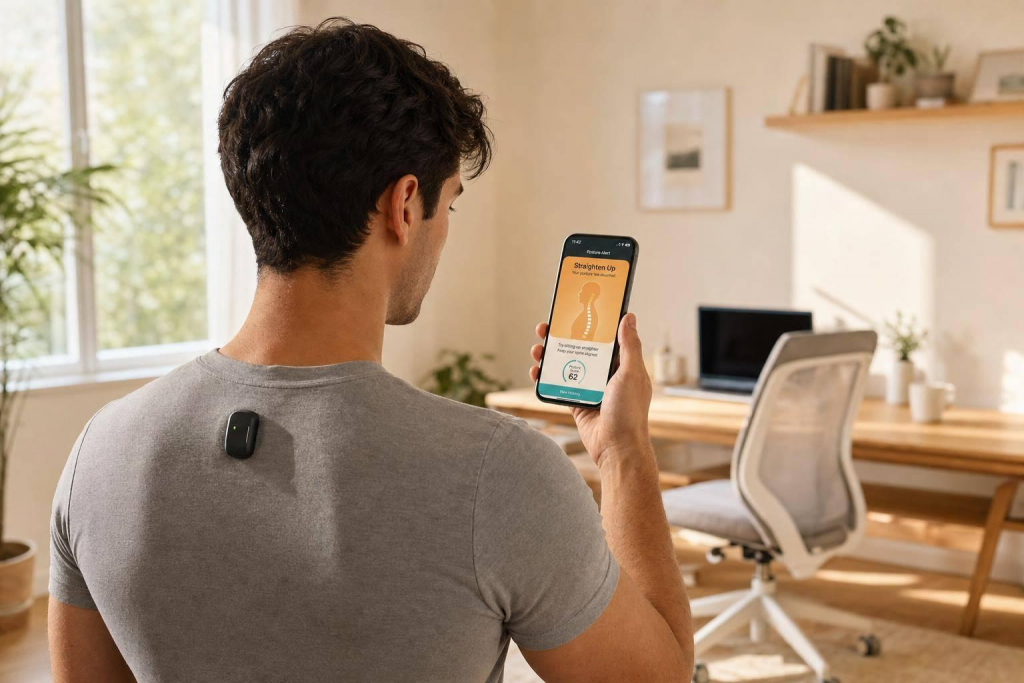
If I had to sum it up in one line: real-time spine alerts help you catch daily posture and symptom changes early, while office visits and imaging mostly show single-point snapshots.
Here’s the short version:
- Wearables track posture and movement during daily life
- Alerts can prompt fast correction when posture slips
- Imaging and clinic exams still matter for structural diagnosis
- The best use is often both together, not one or the other
A few numbers stand out:
- IMU-based wearables stayed within 5° of error in 85%+ of readings
- One pilot study improved posture classification from 47% to 89% with added sensor input
- Advanced systems reported motion error of less than 1.5°
- Imaging equipment can cost about $500,000 to $2,000,000
What this means for you is simple: if care only checks your spine at appointments, a lot can happen between visits. Pain, posture, sleep, and movement can shift day by day. Real-time alerts help fill that gap by logging data, sending feedback, and showing trends before a problem grows.
Quick Comparison
| Area | Real-time alert monitoring | Office visits and imaging |
|---|---|---|
| Main job | Track day-to-day change | Check structure and baseline status |
| Feedback timing | Immediate or near-immediate | At scheduled visits |
| Data source | Sensors, app logs, wearables | Exams, imaging, patient memory |
| Strength | Daily behavior tracking and biofeedback | Structural detail |
| Limits | Alert fatigue, setup, battery, system connection issues | Snapshot-only view, recall bias, high scan costs |
My takeaway: real-time alerts are best for day-to-day follow-up, habit correction, and remote review. Imaging and in-person care are still the main tools for diagnosis, trauma, and surgery follow-up.
So this article is less about choosing a winner and more about knowing what each method does well.
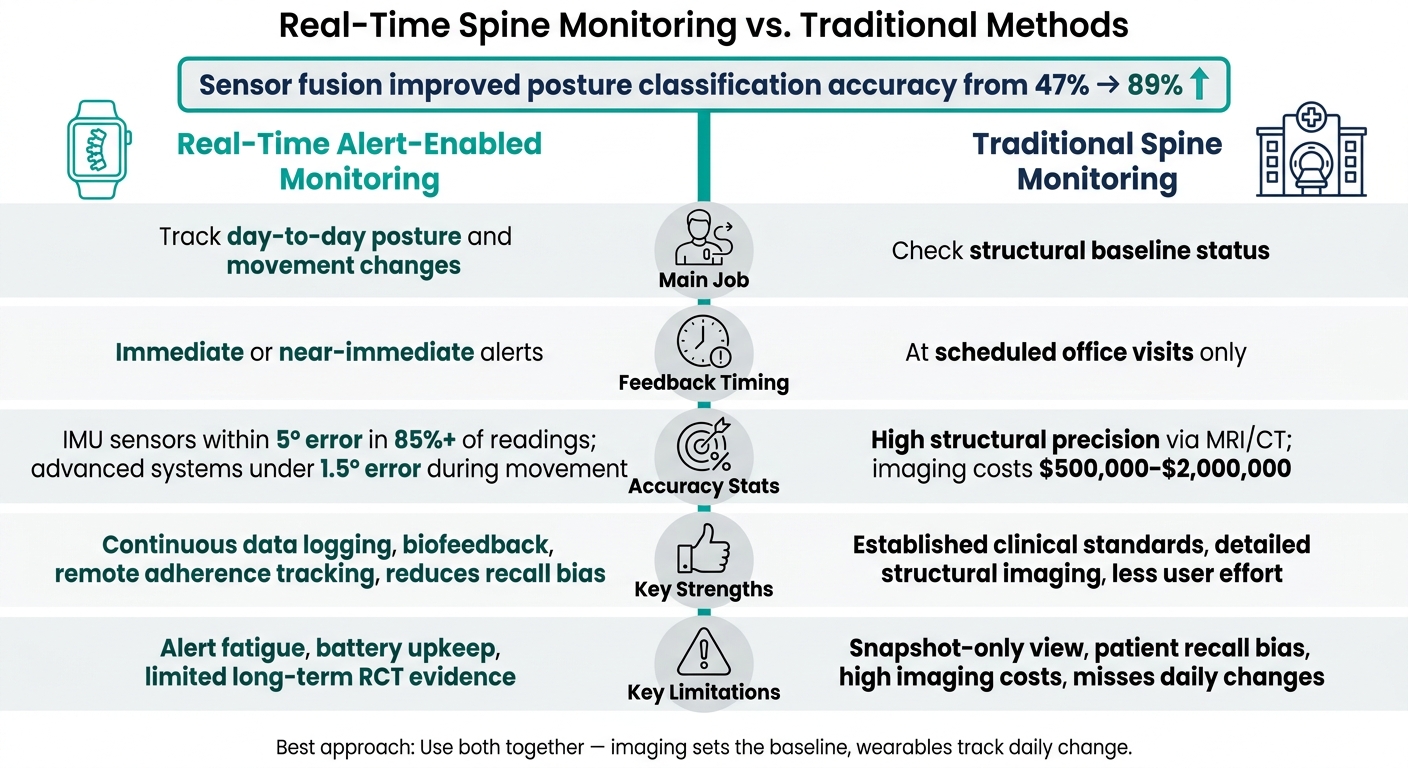
Real-Time Spine Monitoring vs. Traditional Methods: Key Differences at a Glance
1. Real-Time Alert-Enabled Spine Monitoring Platforms and Wearables
These systems matter only when they do two things well: measure posture with enough precision and alert users fast enough to do something about it. That link between accurate sensing and fast feedback is what sets continuous alerting apart from episodic care.
Measurement Accuracy
Modern spine wearables use IMUs to track body position and movement. When set up the right way, these sensors stay within a 5-degree error margin in more than 85% of readings.
Sensor fusion plays a big role here. In one pilot trial, accelerometer data alone produced a posture classification accuracy of 47%. When researchers added a magnetometer alongside permanent magnets, accuracy rose to 89%.
aiSpine delivers posture tracking and vibration reminders through the AIH Health App.
Alert Timeliness
A spine wearable helps only if it reacts fast. Real-time spine wearables monitor posture continuously and send immediate feedback through a mobile app. That speed turns posture data into an in-the-moment correction instead of a delayed note in a chart. Users can adjust right away, not wait until the next visit.
There’s a catch, though: too many alerts start to blend into the background. At that point, people tune them out. Alert thresholds should be personalized.
User Outcomes
The clearest pattern in the evidence is that wearables work best when they support care instead of trying to replace it. Real-time alerts help because they reinforce posture correction between visits, where habits are actually built. A scheduled appointment can point out a problem, but it can’t nudge someone all day.
Wearable sleep data can also flag next-day low back pain flare risk.
Clinical Integration
The AIH Health App connects aiSpine and aiRing data to a cloud-based platform, which lets clinicians review monitored data remotely through Remote Therapeutic Monitoring (RTM).
The biggest roadblock is interoperability. Poor EHR compatibility and inconsistent data processing still slow adoption. Individual calibration also remains key. Systems need to establish a personalized region of confidence for each user before alerts carry meaningful clinical weight. That’s where real-time alerts start to look less like simple tracking and more like day-to-day management, rather than office-only monitoring.
sbb-itb-44aa802
2. Traditional Spine Monitoring Methods
In the U.S., spine monitoring still leans on scheduled office visits, hands-on exams, and static imaging. Those tools can show what’s happening at a given moment. What they don’t show is how a patient changes from one day to the next.
That gap matters. A person’s posture, pain, and movement can shift a lot between appointments, yet standard care often only sees a few isolated snapshots.
Measurement Accuracy
In this setting, accuracy is about more than taking a precise measurement. It’s about spotting structural problems that matter in daily life. Imaging does a good job showing anatomy, but anatomy and symptoms don’t always line up. Research shows that imaging severity has only a modest correlation with day-to-day pain and disability.
Visual observation has its own problem: it depends heavily on the person doing the assessment. Two clinicians may judge the same posture differently, and even the same clinician may not rate it the same way every time. Manual measurements also take time and often miss the postural habits and movement patterns people fall into during normal life.
"Visual observation is inherently subjective and suffers from low inter- and intra-rater reliability." – Journal of Orthopaedic Surgery and Research
Alert Timeliness
Traditional care does not give clinicians real-time alerts. If a patient starts slipping into poor posture habits or has a pain flare between visits, that change may not be noticed until the next appointment.
Standard care depends on episodic visits and static imaging, so symptom changes between appointments can stay off the radar. In plain terms, the problem may worsen before anyone has a chance to step in.
User Outcomes
Traditional care often leaves patients in a passive role. Clinicians depend on patient recall of pain, posture, and activity, and that recall is prone to bias.
When decisions rest on partial or imperfect information, care can turn into a trial-and-error process. That can slow recovery and leave patients frustrated.
Clinical Integration
These methods are well known in clinical settings, but they come with hard limits. The cost alone is a major hurdle:
- MRI systems run about $2,000,000
- CT scanners cost around $1,000,000
- EOS imaging systems cost roughly $500,000
Radiation exposure also limits how often imaging can be repeated. And lab-based tools such as optoelectric systems have mostly not made it into routine care because they are expensive and impractical for day-to-day use.
So while this model can support diagnosis, it does far less for continuous management. That shifts the issue from simply seeing spine problems to tracking them soon enough to affect outcomes.
Accuracy, Outcomes, and Care Implications
Building on the platform comparison above, the big question is simple: can monitoring spot change before symptoms get worse? That’s where timing matters most. Real-time alerts respond during the day, while older methods step in after the fact.
IMU-based wearables usually measure spinal angles with error rates under 5 degrees in more than 85% of measurements, and some advanced systems cut that error to less than 1.5 degrees during movement. By contrast, radiographic imaging remains highly precise for static anatomy.
There’s also a practical gap in how data gets collected. Older care models depend on patient recall. Real-time systems don’t. They log posture and activity automatically, which gives clinicians a steadier picture of what’s happening between visits. Wearable biofeedback also cuts down the time people spend in poor lumbar posture.
In day-to-day care, that means real-time wearables can spot issues sooner, reduce recall bias, and help users correct posture faster. Older monitoring is still episodic and reactive. In practice, AIH LLC’s aiSpine and AIH Health App turn continuous posture data into real-time feedback. Broader use still depends on better system integration.
Pros and Cons
The tradeoff is pretty simple: daily function versus structural detail.
Real-time alerts are built to track what happens day to day. They can flag changes fast and prompt immediate biofeedback. Traditional monitoring is still the stronger option when the goal is structural diagnosis. So this isn’t a straight winner-loser comparison. Each method does a different job, and the table below shows that split.
The biggest risk with real-time systems is alert overload. If people get too many alerts, they start tuning them out, and response rates drop over time. That’s why alert thresholds need to stay personalized. Traditional monitoring runs into a different problem: it leans on patient memory and scheduled office visits. On top of that, people may act one way in a clinic and another way at home, a pattern often called the Hawthorne effect.
| Real-Time Alert-Enabled Monitoring | Traditional Spine Monitoring | |
|---|---|---|
| Major Benefits | Continuous day-to-day data; immediate biofeedback; remote adherence tracking | Established clinical standards; high structural precision (MRI/CT); less user effort |
| Major Limitations | Alert fatigue; battery and sensor upkeep; limited long-term RCT evidence | Static snapshots; recall bias; high imaging costs; misses day-to-day changes |
| Best Use | Postoperative recovery; occupational health; adolescent scoliosis/kyphosis treatment | Initial structural diagnosis; acute trauma; periodic surgical follow-ups |
"Wearable sensors would lie at the core of analysis of the factors that could explain the fluctuation of the condition, and that are potentially modifiable by treatments." – Journal of Spine Surgery
Imaging sets the baseline. Wearables show what changes between visits.
Conclusion
The main difference comes down to timing.
Traditional monitoring gives you snapshots. Real-time alerts show daily change. In plain terms, traditional monitoring sets the baseline, while real-time alerts track what happens from one day to the next.
That gap matters because recovery is rarely linear. Standard spine care can miss a lot between office visits, while real-time monitoring follows posture and activity during daily life.
The strongest approach is to use both together. Clinicians rely on structural data to diagnose and map out care, while real-time alerts act as an ongoing feedback loop. They flag deviations, reinforce good habits, and give providers timely data so they can respond sooner.
In practice, AIH LLC’s aiSpine and aiRing, connected through the AIH Health App, extend spine monitoring with real-time posture tracking, vital-sign data, and personalized feedback.
FAQs
How do real-time spine alerts work?
Real-time spine alerts rely on wearable sensors like accelerometers and gyroscopes to track spinal position and movement nonstop. Devices such as AIH LLC’s aiSpine measure angles between points on the spine to spot misalignment.
When posture slips outside preset ergonomic thresholds, the device or a connected smartphone flags it in under 200 milliseconds. From there, it sends instant feedback through vibration, app notifications, or audio cues.
Can wearables replace imaging or office visits?
Wearables are a complement to standard care, not a full substitute for imaging or in-person visits.
Tools like the AIH LLC aiSpine can track movement in real time between appointments. But they serve a different role than diagnostic imaging. Imaging and physical exams are still needed for a firm diagnosis, while wearables are most useful for steady, objective monitoring and more active health management.
Who benefits most from daily spine monitoring?
Daily spine monitoring is most helpful for people dealing with chronic low back pain, healing after surgery, or trying to build better posture habits.
It can make a big difference for office workers, manual laborers, and people in rural areas or with packed schedules who can’t make frequent in-person visits. Tools like AIH LLC aiSpine give immediate feedback, which can help people stay on track with treatment, support pain outcomes, and keep their movement more consistent.