
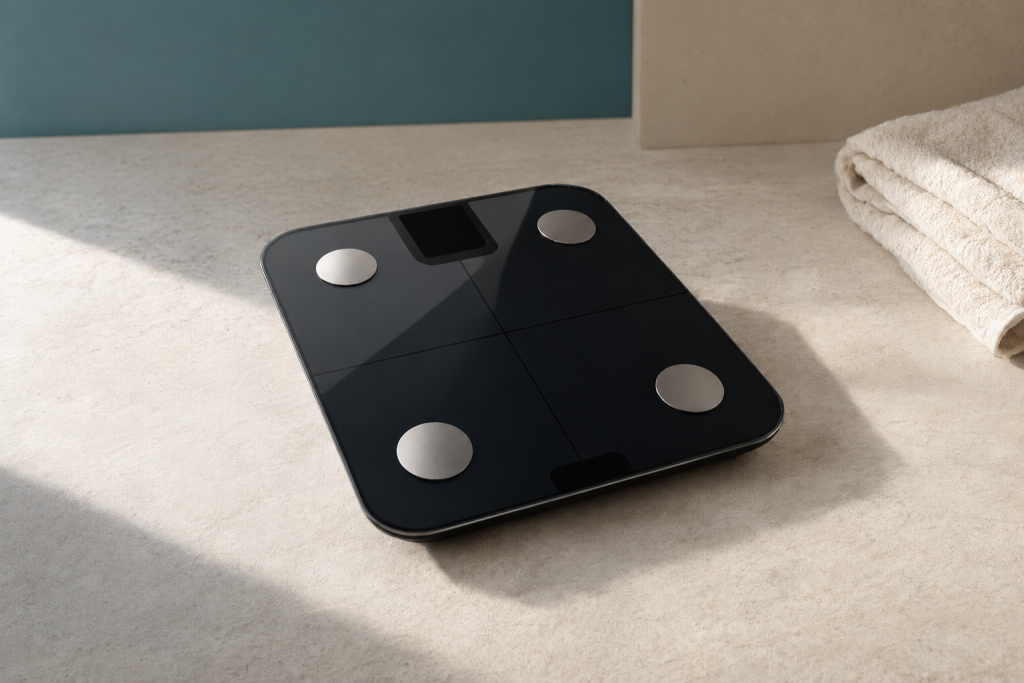
What a Body Fat Scale Can and Cannot Tell You
Body fat scale accuracy is not one question. A scale measures body weight; body-fat and muscle readouts are estimates, and a clinical assessment is a broader professional evaluation. Bioelectrical impedance analysis (BIA) is the estimation approach discussed here. Displayed decimal places and connected records do not by themselves establish the clinical accuracy or medical value of an estimate. Use the comparison below to decide which question you need answered.[source]
Four Ways to Assess Weight and Body Composition
Compare measured body weight, consumer BIA estimates, BMI and waist context, and clinical assessment. These are different kinds of information; the table does not validate any AIH model.[source][source]
| Information | How it is obtained | Useful decision question | What it cannot establish |
|---|---|---|---|
| Body weight | A scale measures body weight under its documented operating conditions. | Do I need a body-weight record? | A weight reading does not directly measure body fat or muscle, or explain why weight changed. |
| BIA composition estimates | Impedance-based estimation produces body-composition outputs using the device method and inputs. | Which outputs are estimates, and what evidence supports this exact model? | Displayed decimal places do not establish clinical accuracy or reliable fat-loss tracking. |
| BMI and waist assessment context | Body size and waist measurements are interpreted in the relevant assessment guidance. | Which assessment measures are relevant to the question I want to discuss? | They are not direct body-fat measurements or a complete clinical assessment by themselves. |
| Clinical assessment | A qualified professional interprets appropriate measurements in a wider health context. | What information is needed to assess my concern? | A consumer scale cannot replace this assessment; connectivity does not validate a measurement. |
What the 2021 Smart Scale Study Did and Did Not Test
Evidence example: a 2021 cross-sectional observational study compared three commercially available smart scales with DXA in a French tertiary-hospital physiology unit. The analyzed groups contained 53, 52 and 48 patients. These were three non-AIH models. Reported weight errors were smaller than the fat- and muscle-mass errors in these groups. The authors cautioned against replacing DXA with the tested scales for body composition in patient care. This does not validate aiScale Lite or Max. A one-time comparison cannot establish reliable longitudinal fat-loss tracking. This summary uses the PubMed abstract and does not claim that the full methods were reviewed.[source]
How UK Guidance Separates Assessment Tools
NICE NG246 is UK guidance, published in January 2025 and updated in January 2026. Recommendation 1.9.9 says not to use bioimpedance as a substitute for BMI as a measure of general adiposity in adults. Recommendation 1.9.7 treats BMI as a practical measure that requires cautious interpretation; recommendation 1.9.8 adds waist-to-height ratio for adults with BMI below 35 when assessing central adiposity. BMI alone is not an entire clinical assessment.[source]
These are attributed UK assessment recommendations, not a validation study of an AIH product or universal US rules. A January 2026 page update does not mean every recommendation was newly issued in 2026: NICE labels recommendation 1.9.9 as 2006, amended in 2014.[source]
Can You Reliably Track Fat Loss With a Consumer Scale?
The cross-sectional study does not establish reliable longitudinal fat-loss tracking. A change between readings does not by itself show how much fat or muscle changed or why. Consistent circumstances may help compare recorded readings, but do not validate a fat-loss estimate. A body-composition percentage is an estimate, not an individual diagnosis or a treatment target.[source]
Follow the exact model documentation for measurement conditions and exclusions. For a question about your own weight or body composition, ask a qualified professional which assessment is relevant. This guide does not set a weighing schedule or recommend treatment, diet or medication changes.
Five Questions to Ask Before Buying
1. Intended use: do I need a body-weight record, a body-composition estimate, or a clinical assessment?
2. Exact model: which model number and manual apply to the product I am considering?
3. Measurement conditions: what conditions and exclusions does that model manufacturer document?
4. Access to records: how are records accessed, and which steps must I complete to save or transfer them?
5. Evidence: what published evidence supports the specific accuracy or clinical claim, and did it test this exact product?
Where aiScale Max Fits: Connected Records
The confirmed aiScale Max documentation describes Bluetooth for initial discovery and Wi-Fi provisioning, followed by direct measurement upload over the configured home Wi-Fi connection. After setup, the confirmed workflow supports uploading measurements without an active phone Bluetooth connection or an open aiCare app for each measurement. Setup requires a 2.4 GHz or mixed 2.4/5 GHz network; a pure 5 GHz network is not supported.
These are record-handling and connection features, not evidence of measurement accuracy or medical benefit. Check the exact model manual rather than assuming Lite and Max use the same connection or record workflow. For current model details, see aiScale Max.
Related Reading and Next Steps
For a practical way to organize body-weight records and questions for a follow-up discussion, read the aiScale Lite body-weight monitoring guide. Its record-keeping examples do not validate body-fat estimates or imply that Lite and Max have identical workflows.
Before choosing a scale, use the five questions above to distinguish a body-weight record from a body-composition estimate. For an individual health concern, ask a qualified professional which assessment is appropriate.
Frequently Asked Questions
Does a body-fat percentage directly measure my body fat?
Consumer body-composition readouts are estimates. A displayed decimal place does not prove clinical accuracy or replace a broader assessment.
Does the cited study validate aiScale Lite or Max?
No. It compared three non-AIH smart scales with DXA in a cross-sectional study. These were three non-AIH models. This does not validate aiScale Lite or Max. A one-time comparison cannot establish reliable longitudinal fat-loss tracking.
Does Wi-Fi make body-composition readings more accurate?
The confirmed aiScale Max Wi-Fi workflow concerns transferring supported records to aiCare after setup. That connection capability does not establish measurement accuracy or medical benefit.