

Telemedicine has transformed healthcare access, but protecting patient data remains a major challenge. Centralized systems are prone to breaches, with over 88 million records compromised in the U.S. in 2023, costing an average of $10.1 million per breach. Blockchain offers a decentralized, secure alternative, ensuring data integrity, patient-controlled access, and compliance with regulations like HIPAA.
Key Takeaways:
- Decentralized Security: Blockchain removes single points of failure, reducing breach risks.
- Smart Contracts: Automate patient consent and access control.
- Immutable Audit Trails: Every action is permanently recorded for transparency.
- Real-World Results: Blockchain systems like BioWallet reduced medical image access time by 67% and prevented data breaches.
- Wearables & Chronic Care: Blockchain secures real-time data from devices and supports personalized, long-term care.
Despite its potential, blockchain faces hurdles like scalability, high costs, and regulatory conflicts. However, advancements like Layer-2 solutions and decentralized identity systems are paving the way for secure, patient-focused telemedicine.
Bottom Line: Blockchain is reshaping telemedicine by enhancing data security, empowering patients, and streamlining healthcare processes.
Blockchain in Healthcare: How It Transforms Medical Records & Patient Data Security
Research Insights: Blockchain for Telemedicine Security
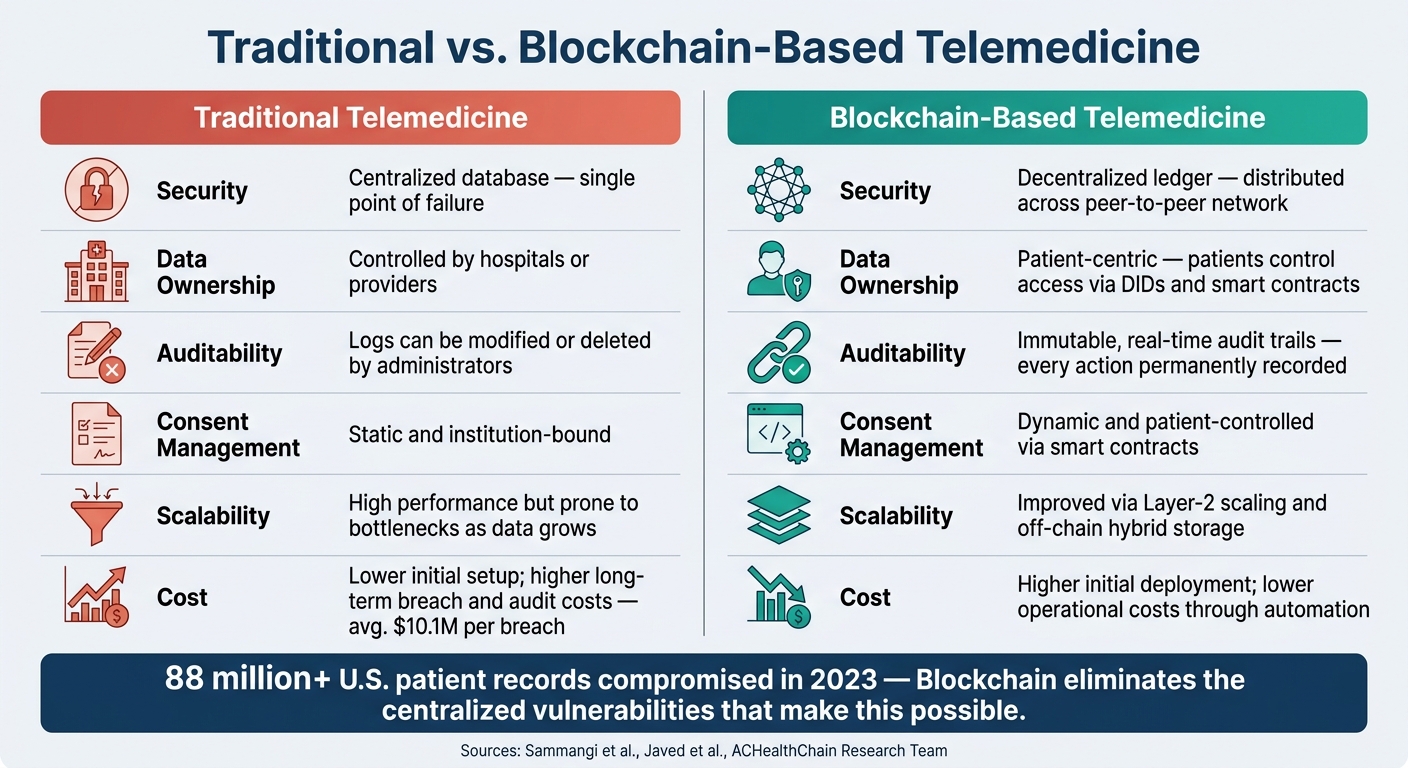
Traditional vs. Blockchain-Based Telemedicine: Security & Data Control
Core Security Features of Blockchain
Blockchain technology secures patient data through a combination of powerful features. Decentralization ensures that records are distributed across a peer-to-peer network, eliminating the vulnerability of a single data repository. Meanwhile, immutability guarantees that once data is recorded, any alteration changes its cryptographic hash, making tampering immediately obvious to the entire network.
Additionally, blockchain enables Decentralized Identifiers (DIDs), allowing patients to control their credentials without relying on hospital-managed identity systems. This approach not only safeguards data but also empowers patients, aligning with modern healthcare goals. For collaborative research, techniques like homomorphic encryption enable computations on encrypted data, ensuring insights can be extracted without exposing sensitive information. Combined with immutable logs, these features create a robust framework for advanced telemedicine applications.
"Blockchain technology provides an innovative paradigm to rethink how health data is stored and accessed. Its distributed nature eliminates the dependence on a single centralized server, significantly reducing the risk of systemic data breaches." – Harsha Sammangi, Aditya Jagatha, and Jun Liu
What Studies Show About Blockchain in Telemedicine
Recent studies highlight blockchain’s potential to transform clinical environments with measurable outcomes. For instance, in March 2026, researchers tested the BioWallet system using data from 110 ARDS-COVID-19 ICU patients. This system combined FHIR-compliant imaging data with Ethereum smart contracts and DIDs, resulting in a 67% reduction in medical image access time for clinicians and a 100% success rate in preventing unauthorized access during simulated emergencies.
Another study from February 2026, conducted by the Vellore Institute of Technology, introduced TeleZK-L2, a framework employing zk-SNARKs (zero-knowledge proofs) on the Polygon zkEVM network. Tested on a 16-node cluster, the system achieved a peak throughput of 260 transactions per second and reduced on-chain verification costs by approximately 52% compared to standard Ethereum execution.
"Blockchain technology addresses these gaps by providing immutable audit logs for HIPAA compliance… enabling patient-centric data control via smart contracts, and ensuring tamper-evident sharing through zero-knowledge proofs." – Muhammad Saeed Javed et al.
Traditional vs. Blockchain-Based Telemedicine Architectures
A side-by-side comparison of traditional and blockchain-based telemedicine systems reveals the distinct advantages blockchain brings to security, data ownership, and auditability.
| Feature | Traditional Telemedicine | Blockchain-Based Telemedicine |
|---|---|---|
| Security | Centralized database | Decentralized ledger |
| Data Ownership | Controlled by hospitals or providers | Patient-centric; patients control access via DIDs and smart contracts |
| Auditability | Logs can be modified or deleted by administrators | Immutable, real-time audit trails; every action permanently recorded |
| Consent Management | Static and institution-bound | Dynamic and patient-controlled via smart contracts |
| Scalability | High performance but prone to bottlenecks as data grows | Improved via Layer-2 scaling and off-chain hybrid storage |
| Cost | Lower initial setup; higher long-term breach and audit costs | Higher initial deployment; lower operational costs through automation |
For healthcare organizations considering blockchain, permissioned networks like Hyperledger Fabric or Quorum often provide the best fit. These networks combine blockchain’s transparency with the strict privacy controls required by HIPAA. Integrating HL7 FHIR standards ensures seamless communication between the blockchain system and existing EHR platforms, preventing operational silos.
Managing Patient Consent and Data Access with Blockchain
Smart Contracts and Patient-Controlled Access
Blockchain’s security features are further enhanced by smart contracts, which give patients direct control over who can access their medical records. By embedding access permissions directly into the blockchain, smart contracts enforce these rules automatically, removing the need for intermediaries. For example, when a patient allows a doctor to view their records, the smart contract ensures that access is granted and managed seamlessly.
Frameworks like ACHealthChain and WiraChain demonstrate how this works in real-world applications. WiraChain, launched in February 2026 by researchers at Universidad Peruana de Ciencias Aplicadas, integrates Hyperledger Besu with the HL7 FHIR standard. This setup allows patients to grant or revoke access to clinical data in real time, enabling smooth data sharing across healthcare providers. Similarly, ACHealthChain, built on Hyperledger Fabric, introduces a "PolicyChain" for detailed access control. This system improves throughput by 19.7% and reduces latency by 87%, specifically in workflows related to patient consent.
"Smart contracts automate fine-grained access control, ensuring only authorized individuals can access or modify healthcare data." – ACHealthChain Research Team
Advanced models like Usage Control (UCON) add another layer of flexibility by enforcing time-limited permissions. For instance, access might expire after a single consultation or once a specific treatment is completed.
By automating permissions and creating immutable audit trails, blockchain ensures both accountability and transparency in managing patient data.
On-Chain Consent Logs and Audit Trails
Blockchain records every action related to patient consent – whether it’s granting, modifying, or withdrawing access – as a transaction. This creates a tamper-proof audit trail that goes beyond traditional modifiable logs.
For healthcare providers in the U.S., this feature aligns directly with HIPAA compliance. Blockchain’s immutable logs serve as verifiable proof that access controls were properly enforced and that only authorized individuals accessed sensitive data. As noted by one research team:
"The blockchain layer is used strictly for accountability: it records consent commitments, access requests/grants, and hashes of the selected policy and decision trace." – FiB-MOBA-EAFG Researchers
To maintain scalability and comply with privacy regulations, Protected Health Information (PHI) is typically stored off-chain – in systems like IPFS or private hospital clouds. Only cryptographic hashes and metadata related to consent are stored on the blockchain. This hybrid approach ensures that data can be effectively "erased" by severing links to off-chain records when necessary.
Access Control Models in Blockchain Systems
Different blockchain-based access models cater to the varied needs of telemedicine and healthcare environments.
| Model | How It Works | Best For |
|---|---|---|
| Role-Based (RBAC) | Access is granted based on the user’s role | Standard clinical workflows |
| Attribute-Based (ABAC) | Access depends on attributes like specialty, location, or time | Complex, multi-provider setups |
| Token-Based | Patients issue cryptographic tokens to grant access, which can be revoked | High-security or research data sharing |
In telemedicine, permissioned blockchains like Hyperledger Fabric or Besu are particularly effective. They combine detailed access control with the privacy protections required under HIPAA. For example, a study from November 2023 demonstrated the feasibility of a consent self-management system for U.S. Health Information Exchanges (HIEs) using a permissioned Ethereum blockchain. This approach proved both cost-efficient and compliant with HIPAA, empowering patients to manage their own consent without relying on a centralized authority.
"Blockchain technology should be at the core of a standardized mechanism for consent self-management that facilitates both patient trust and better interoperability." – Arthur Carvalho, Associate Professor
These access control models highlight how blockchain can enable secure, patient-focused data management while ensuring transparency and accountability.
sbb-itb-44aa802
Blockchain in Wearable Devices and Chronic Care
Securing Real-Time Data from Wearable Devices
Wearable devices constantly transmit sensitive health data, making security during transmission and storage a top priority. The challenge lies in ensuring that this data remains reliable and tamper-proof throughout the process.
Blockchain helps tackle this issue by creating a ledger where data, once recorded, cannot be altered. A study in Scientific Reports highlighted that integrating blockchain with wearable health technology improved data integrity and protection by 99.33% compared to centralized systems. The system works by storing raw sensor data off-chain while maintaining encrypted hashes on the blockchain, ensuring scalability without compromising security.
One example is the Metasave framework, developed in March 2026 by Cochin University. Designed for elderly patients with chronic conditions, it combines IoT sensors with deep learning to detect falls in real time. By employing Zero-Knowledge Proofs (ZKPs) and Merkle Trees, it verifies data integrity without exposing sensitive patient information, achieving 98% sensitivity in detecting falls within home settings.
"Blockchain Technology (BT), in particular Zero-Knowledge Proofs (ZKPs) and smart contracts, present a viable way to enhance the privacy, provenance, and integrity of wearable health data." – Scientific Reports
This secure data framework lays the groundwork for advanced AI applications in chronic disease monitoring.
AI and Blockchain for Chronic Disease Monitoring
With blockchain providing secure data streams, AI integration takes chronic disease management to the next level. AI excels at identifying patterns and detecting anomalies, while blockchain ensures the data remains untampered and access is strictly controlled.
The PMHE framework, published in the Journal of Cloud Computing in December 2022, showcases the potential of this combination. PMHE gathers physiological data from wearables and uses Fully Homomorphic Encryption (FHE) alongside blockchain to analyze encrypted data. This means AI can run disease prediction models – like logistic regression – without ever exposing raw patient information, even in the event of a cloud platform breach.
Devices like AIH LLC‘s aiSpine and aiRing leverage this architecture to deliver precise, private tracking. These devices stream continuous health data through the AIH Health App, offering real-time monitoring and personalized feedback. Blockchain ensures the integrity of this data and uses smart contracts for consent management, so only authorized providers can access patient information during remote therapeutic monitoring sessions.
This secure integration not only enhances real-time monitoring but also supports the creation of reliable, long-term health records.
Longitudinal Health Records and Personalized Treatment
Blockchain’s ability to create consistent, verifiable, and patient-controlled long-term records is a game-changer for chronic care. For conditions like diabetes, hypertension, or spinal disorders that require monitoring over months or years, having an immutable record of health trends enables better clinical decisions.
Studies indicate that blockchain-enabled remote monitoring can reduce hospital readmissions by 33% or more for chronic conditions like diabetes and hypertension. When healthcare providers can trust a patient’s complete history, they’re better equipped to tailor treatments. Additionally, blockchain-based federated learning (BCFL) allows AI models to train on decentralized patient data without moving raw records off devices or institutions, maintaining privacy while improving predictive accuracy.
"Blockchains… provide many advantages for patients using pervasive devices… Among them is the ability to store, retrieve, and modify one’s generated health care data with a single private key across devices." – JMIR mHealth and uHealth
The financial benefits are just as compelling. A cost analysis estimated that a medium-scale blockchain-based telemedicine network could save around $840,000 over five years by reducing security breaches and cutting down on manual administrative tasks. By securing real-time data from wearables and enabling personalized, long-term healthcare strategies, blockchain solutions offer both practical and financial advantages.
Challenges and Future Directions for Blockchain in Telemedicine
This section dives into the hurdles blockchain technology faces in telemedicine and explores potential paths forward.
Technical and Operational Barriers
While blockchain holds great potential for telemedicine, practical challenges remain. Chief among these is the "Scalability-Privacy Trilemma", which makes it difficult to balance decentralization, high transaction speeds, and strong data privacy at the same time.
For example, Layer-1 blockchains like Ethereum can handle fewer than 30 transactions per second (TPS) and come with hefty transaction fees. Verifying something as simple as a heart-rate anomaly on Ethereum could cost over $50 in gas fees, making continuous monitoring through wearables financially impractical. Additionally, storing raw physiological data directly on the blockchain is both technically challenging and prohibitively expensive when scaled.
Regulatory hurdles add another layer of difficulty. The General Data Protection Regulation (GDPR) in Europe, particularly its "Right to be Forgotten", conflicts with blockchain’s core feature of immutability. In the U.S., blockchain’s decentralized nature often clashes with HIPAA’s strict data governance rules, pushing organizations to adopt overly conservative data-sharing practices. On top of that, the lack of interoperability between blockchain systems and traditional Electronic Health Record (EHR) platforms slows widespread adoption.
"The GDPR’s ‘Right to be Forgotten’ directly conflicts with the immutability of blockchain." – Frontiers in Blockchain
These challenges highlight the need for further technical and operational innovation.
Research Gaps and Open Questions
Several unanswered questions still hold blockchain adoption back. For instance, governance models for multi-institutional blockchain networks are still largely theoretical. How should disputes be resolved? How should protocol updates or access policy changes be managed? These remain open issues.
Another gap lies in standardized consent protocols. Seamlessly integrating consent across different blockchain networks and EHR systems is far from straightforward. Furthermore, combining blockchain with privacy-preserving AI raises questions about the performance of federated learning models and how to effectively document AI-driven decisions for accountability.
The long-term security of healthcare data is another concern. Current encryption methods may not hold up against quantum computing advancements, making quantum-resistant cryptography a critical area for future research.
Addressing these gaps is essential to unlocking blockchain’s full potential in telemedicine.
What Future Blockchain-Powered Telemedicine Could Look Like
The future of blockchain in telemedicine may hinge on Layer-2 (L2) scaling solutions. A notable example is the TeleZK-L2 framework, which has shown significant improvements in transaction throughput and drastically reduced verification costs compared to Ethereum’s Layer-1. This makes continuous Internet of Medical Things (IoMT) data verification much more affordable.
Another promising solution to GDPR-related challenges is crypto-shredding. By destroying the encryption key linked to a patient’s data, access can be effectively erased without altering the blockchain ledger itself. Decentralized Identity (DID) systems could further empower patients by giving them full control over their health credentials. When paired with smart contracts designed to enforce HIPAA compliance, these tools could simplify the regulatory landscape significantly.
With the global IoMT market projected to hit $187 billion by 2028, the potential for blockchain to transform telemedicine is immense. However, overcoming these challenges will require a combination of technical innovation, regulatory alignment, and robust research efforts.
Conclusion: What Blockchain Offers Telemedicine
Blockchain is changing the way patient data is owned, shared, and protected in telemedicine. By moving from centralized systems to distributed ledgers, it removes single points of failure that often leave traditional systems vulnerable to breaches.
With smart contracts, processes like consent management, insurance claims, and billing become automated while ensuring strict control over data access. These streamlined operations lead to greater patient confidence in their healthcare experience.
One of the standout benefits is patient trust. A recent survey revealed that over 90% of users prefer to keep their health data private, with many expressing confidence in blockchain as a reliable solution. Tools like self-sovereign identity and patient-controlled permissions empower individuals to decide who can access their records and when.
While future advancements must tackle challenges like scalability, regulatory compliance, and interoperability, the path forward is clear. Blockchain provides telemedicine with a system where security, transparency, and patient control are not afterthoughts but core features. This positions telemedicine to address today’s data security needs while paving the way for innovations in chronic care and wearable device ecosystems.
For example, AIH LLC, which handles real-time physiological data from wearable devices like the aiRing and aiSpine through its digital health platform, is well-placed to benefit from blockchain-based solutions. These architectures enhance data integrity and strengthen patient trust in remote therapeutic monitoring.
FAQs
What patient data is stored on-chain vs. off-chain in blockchain telemedicine?
In blockchain-based telemedicine, patient health records are kept off-chain to safeguard privacy and meet regulatory requirements like HIPAA. Instead of storing the actual data, the blockchain holds cryptographic proofs, metadata, or hash pointers. These elements confirm the data’s integrity without revealing sensitive health details. Smart contracts play a crucial role by handling access permissions, obtaining consent, and maintaining audit trails. This approach keeps patient information secure, tamper-resistant, and verifiable – perfectly complementing AIH LLC’s privacy-centered health tracking solutions.
How can patients grant and revoke access using smart contracts and DIDs?
Patients have the ability to manage their health data in a decentralized system using smart contracts. These contracts let patients grant access to healthcare providers for specific purposes or set timeframes. If the access is no longer required or there’s a security concern, permissions can be revoked immediately. With decentralized identifiers (DIDs), only authorized individuals can access the records, ensuring patients maintain complete control over their personal information.
Can blockchain meet HIPAA rules and still handle real-time wearable data at scale?
Yes, blockchain can meet HIPAA requirements while handling real-time wearable data on a large scale by using a hybrid architecture. In this setup, massive amounts of data are kept off-chain using decentralized storage solutions like IPFS, while only cryptographic hashes or summaries are stored on-chain to maintain security and integrity.
Smart contracts play a critical role in ensuring proper access control, allowing only authorized users to retrieve or interact with the data. To address scalability challenges, methods like Layer-2 scaling, parallelized distributed provers, and edge analytics are employed. These techniques enable data to be processed locally or near the source, with only the most essential information being committed to the blockchain. This approach balances efficiency, security, and compliance.