
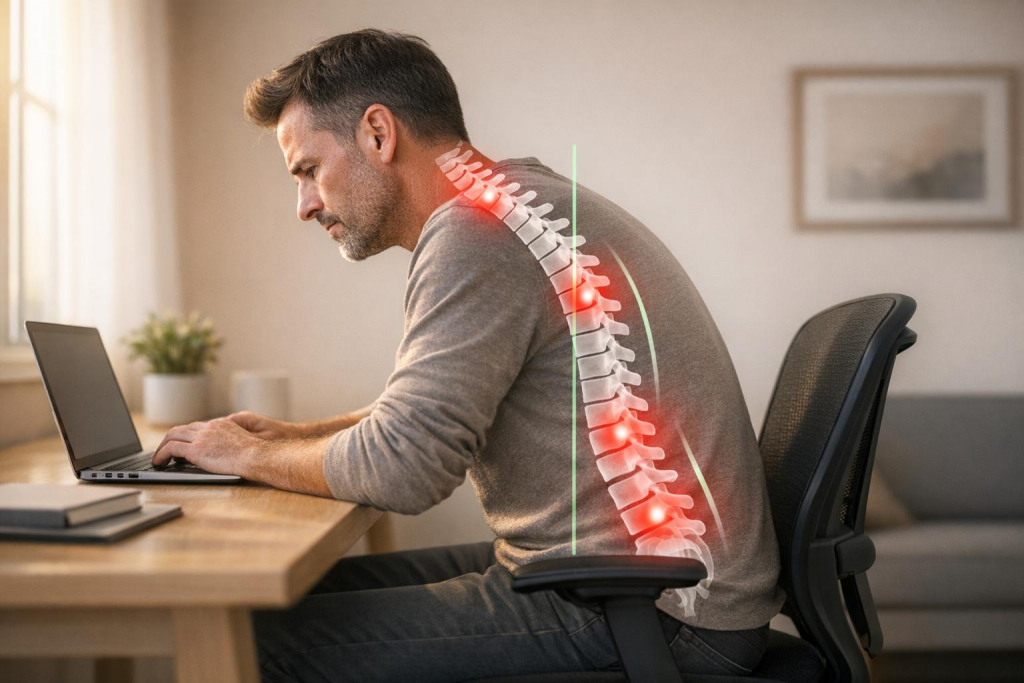
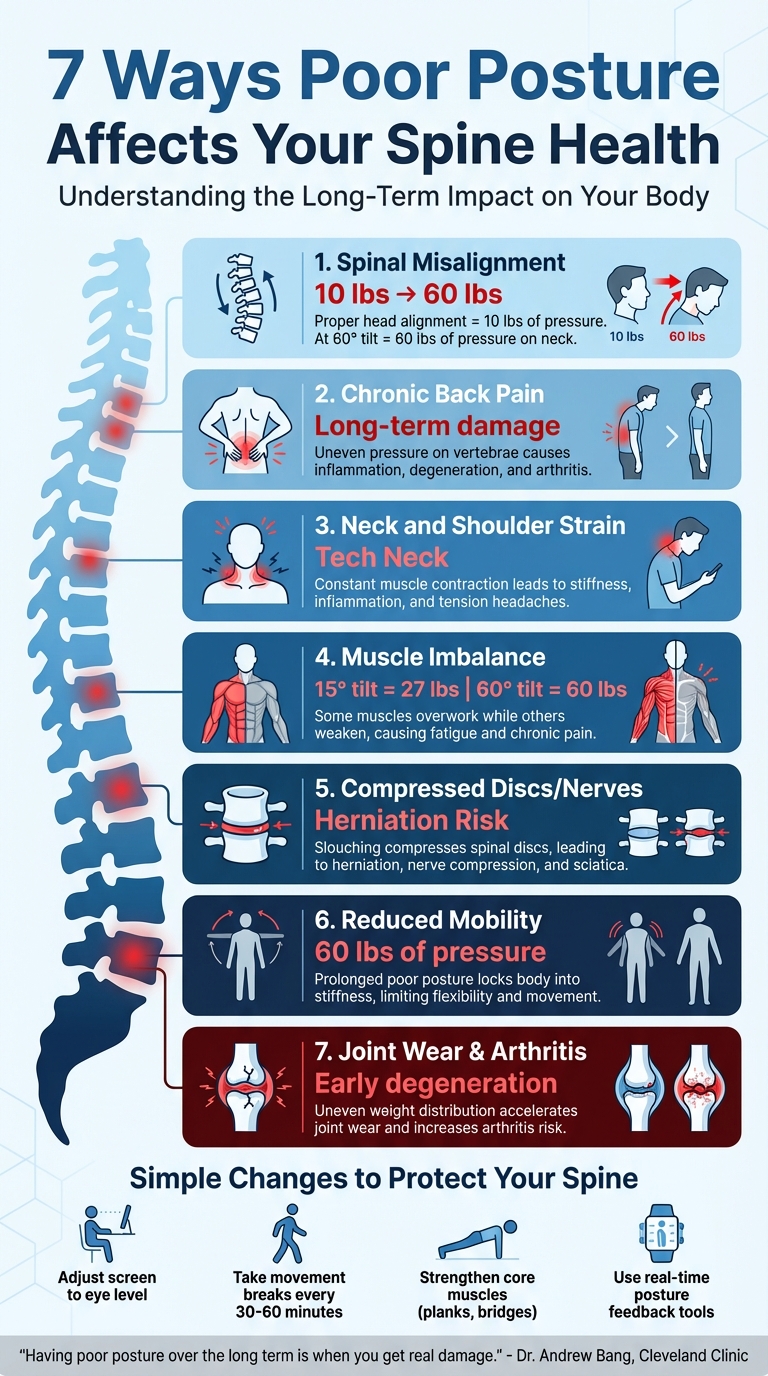
Poor posture can lead to serious spine health issues over time. From misalignment to chronic pain, it impacts your body in ways that are often overlooked. Here’s what you need to know:
- Spinal Misalignment: Disrupts the natural S-curve, forcing muscles and ligaments to overcompensate.
- Chronic Back Pain: Uneven pressure on vertebrae and discs leads to inflammation and long-term pain.
- Neck and Shoulder Strain: "Tech neck" increases strain on muscles, causing stiffness and tension headaches.
- Muscle Imbalance: Overworks some muscles while weakening others, creating fatigue and discomfort.
- Compressed Spinal Discs/Nerves: Slouching can lead to herniated discs and nerve compression, causing radiating pain.
- Reduced Mobility: Prolonged poor posture locks your body into stiffness, limiting flexibility.
- Joint Wear and Arthritis Risk: Misalignment accelerates joint degeneration and increases arthritis risk.
Key Takeaway:
Simple changes like adjusting your screen, taking movement breaks, and strengthening your core can prevent long-term damage. Tools like AI-powered devices (e.g., aiSpine) provide real-time posture feedback to help maintain alignment and protect your spine health.
7 Ways Poor Posture Affects Your Spine Health and How to Prevent Damage
How Posture Affects Disc Pressure (Pinched Nerve, Herniated Disc, Spinal Degeneration) – Dr Mandell
1. Spinal Misalignment
Your spine has natural S-shaped curves designed to absorb impact and evenly distribute weight. These include the inward curve at the neck (cervical), the outward curve in the upper back (thoracic), and another inward curve in the lower back (lumbar).
Poor posture – like slouching or craning your neck – throws these curves out of alignment, placing extra strain on the spine. When your head is properly aligned, it exerts about 10 pounds of pressure on your neck. But tilt it forward just an inch, and that load nearly doubles. At a 60-degree angle, your neck could be supporting as much as 60 pounds.
"The human spine is a sophisticated structure of bones and tissues crafted meticulously to keep us upright and protect the pivotal spinal cord." – Darren Sherwood, Founder of Experteasy
This misalignment doesn’t just affect your neck – it disrupts the entire mechanics of your body. As your head leans forward and your shoulders round, your weight shifts unevenly. This forces muscles and ligaments to work harder to compensate, leading to fatigue and discomfort.
Spending hours in front of screens only makes things worse. To keep tabs on your posture, simple tools like a wall alignment test can help identify any deviations.
Left unchecked, these misalignments can lead to bigger issues, such as chronic pain and muscle imbalances.
2. Chronic Back Pain
Slouching might seem harmless at first, but over time, it can pave the way for chronic back pain. Poor posture forces your back muscles and ligaments to work overtime, leading to fatigue, tightness, and even weakness in your trunk muscles.
Experts warn about the long-term consequences of neglecting proper posture.
"Having poor posture may lead to aches and pains, but having it over the long term is when you get real damage."
- Andrew Bang, DC, Chiropractor, Cleveland Clinic
When your spine is misaligned, it puts uneven pressure on the vertebral joints. This can cause inflammation, which may progress to degeneration or arthritis. Sitting with a forward slouch, for instance, forces your spine into an unnatural curve, compressing the discs. Over time, this increases the risk of herniation, nerve compression, and sciatica.
Additionally, poor posture restricts blood flow, reducing the delivery of oxygen and nutrients to tissues. This slows down healing and can turn temporary discomfort into chronic pain. Once pain becomes persistent, many people adopt "pain-avoidance" postures, which only worsen spinal alignment and perpetuate the cycle.
To break the cycle and prevent long-term issues, make small but impactful changes: shift your position every 30–60 minutes, raise your monitor to eye level, use proper lower back support, and strengthen your core with exercises like planks and bridges. These adjustments can help keep minor aches from turning into lasting pain.
3. Neck and Shoulder Strain
Looking down at your phone or leaning toward your computer screen may seem harmless, but it puts a surprising amount of strain on your neck and shoulders. Your head, when properly aligned, weighs about 10 pounds. However, even a slight forward tilt can double that load, making your neck and shoulders work much harder.
This posture, often referred to as "tech neck", forces the muscles in your neck and upper back to stay constantly contracted. Over time, this can lead to inflammation and even increase the risk of arthritis. Meghan Markowski, a physical therapist at Brigham and Women’s Hospital, explains: "It’s a common and important health problem among Americans, and it can lead to neck pain, back problems, and other aggravating conditions".
When your head is out of alignment, the strain on your spine shifts to your neck and shoulders, speeding up wear and tear. Hunching over for extended periods also reduces blood flow to tired muscles, which can result in stiffness and weakness. Many people experience tension headaches caused by neck muscle spasms that send pain radiating into the head. In more severe cases, misalignment can compress nerves, leading to sharp, electric-like pain, tingling, or numbness that travels down into the shoulders, arms, and hands.
Thankfully, small changes can make a big difference. Try these tips:
- Position your monitor at eye level.
- Hold your phone at eye height instead of looking down.
- Practice chin tucks by pulling your chin toward your neck for five seconds and repeating 10 times.
- Counteract rounded shoulders by pulling your shoulder blades back and squeezing them together for five seconds.
Movement is essential. Regularly shift your position to avoid locking your muscles into a strained posture. Chairs with sturdy armrests can also help support your arms, reducing the burden on your shoulder muscles. These simple adjustments can prevent minor discomfort from turning into chronic pain that affects your spine health in the long run.
4. Muscle Imbalance
Poor posture does more than just cause discomfort – it throws your muscles out of sync. When you slouch or hunch forward, some muscles become tight and overworked, while others are stretched and weakened. This imbalance forces your body to compensate, making it work harder just to keep you upright, which can lead to fatigue and chronic pain.
Instead of relying on your large, stable postural muscles, your body shifts the burden to smaller, weaker muscles that aren’t designed for long-term support. These muscles tire out quickly, leading to stiffness and spasms. For example, forward head posture tightens the muscles in the front of your neck while weakening those in the back. Rounded shoulders compress the chest muscles and weaken the upper back. Similarly, a swayback posture tightens the lower back and hip flexors while weakening your abdominals and glutes.
"Poor posture causes imbalances in the body, which we then fight. Some muscles are getting stretched and weakened while others are becoming shortened and tight." – Brown Health
Slouching also places immense pressure on your spine. For instance, tilting your head forward just 15 degrees increases the load on your neck from about 10–12 pounds to 27 pounds. At a 60-degree tilt – common when looking at your phone – that load skyrockets to 60 pounds. These imbalances not only drain your energy but also pave the way for chronic muscle dysfunction. Tight, fatigued muscles struggle to get enough blood and oxygen, which can worsen pain and prolong discomfort.
To combat these issues, focus on strengthening your core with exercises like planks and bridges to stabilize your spine. Stretch tight areas such as your chest, shoulders, and hip flexors. Simple movements like chin tucks (hold for five seconds) and shoulder blade squeezes can help correct rounded shoulders. Lastly, make a habit of changing positions every 30–60 minutes to prevent muscle fatigue. These small changes can go a long way toward restoring balance and reducing strain on your body.
sbb-itb-44aa802
5. Compressed Spinal Discs and Nerves
When you slouch, you put unnecessary pressure on the intervertebral discs – the gel-filled, fibrous cushions between your vertebrae. These discs act like shock absorbers for your spine, but poor posture throws off your spine’s natural S-curve, forcing uneven weight distribution. This imbalance places extra stress on specific discs, weakening their ability to cushion effectively.
Over time, this constant pressure can lead to serious issues. Prolonged stress may cause a disc to bulge or herniate, where the inner gel pushes through the outer layer. A herniated disc can press on nearby spinal nerves, causing what’s commonly referred to as a "pinched nerve." This often results in radiating pain, tingling, numbness, or even muscle weakness in your arms, legs, or back. A classic example is sciatica, where compressed nerves in the lower back send sharp pain down the leg. Studies have consistently linked poor posture to these kinds of spinal problems.
"Biomechanical and cohort studies have demonstrated that people who have deviations from the body’s natural position have increased and uneven pressure on intervertebral discs – the fibrous and gel-filled structure that cushions the vertebrae, contributing to back pain." – Brook Martin, Research Associate Professor of Orthopedics, University of Utah School of Medicine
Compressed nerves don’t just cause physical pain; they can also interfere with nerve signaling, which may affect cognitive function and even dampen motivation. Dr. Praveen Mummaneni, a spine surgeon at the University of California, San Francisco, explains: "Over the course of our lives, our joints and ligaments get less elastic and less adaptable to poor posture, which can eventually lead to nerve or spinal cord compression, poor tolerance of physical activity, and chronic pain".
The good news? You can take steps to protect your spine and keep your discs healthy. Stand up and move around every hour to relieve static pressure. Use lumbar support, like an ergonomic chair or a rolled-up towel, to help maintain your spine’s natural curve. Adjust your screen to eye level to avoid "text neck", and strengthen your core with exercises like planks to support proper alignment. When lifting heavy objects, always bend at your knees to avoid putting sudden, intense pressure on your lower back. Simple habits like these can go a long way in keeping your spine and nerves in good shape.
6. Reduced Spinal Mobility and Flexibility
Poor posture doesn’t just cause discomfort or misalignment – it also limits your spine’s ability to move freely, creating a cycle of stiffness and long-term issues. Spending hours hunched over a desk can strain your muscles, restrict blood flow, and lock your body into a pattern of reduced mobility. Over time, this stiffness reinforces poor posture, making it even harder to break free from the cycle.
Take something as seemingly minor as tilting your head forward. This small adjustment can dramatically increase the strain on your spine. For example, “text neck” can place as much as 60 pounds of pressure on your neck. Dr. Praveen Mummaneni, a spine surgeon at the University of California, San Francisco, explains:
"Over the course of our lives, our joints and ligaments get less elastic and less adaptable to poor posture, which can eventually lead to nerve or spinal cord compression, poor tolerance of physical activity, and chronic pain".
As your flexibility decreases, even routine activities can become harder. Tasks like bending to tie your shoes, reaching for a high shelf, or walking without discomfort might feel more challenging. Visible signs like rounded shoulders, a forward head posture, and balance struggles often point to reduced mobility.
To combat this, regular movement and targeted exercises are key. Simple activities like shoulder blade squeezes, neck extensions, and core-strengthening exercises (like planks) can help restore flexibility and support your spine’s natural curves. Andrew Bang, a chiropractor at Cleveland Clinic, highlights the importance of mixing things up:
"Your body loves variety, so don’t allow your muscles to get too fatigued".
Stretching areas prone to tightness – like the chest, neck, and hamstrings – can counteract the pull that misaligns your body. Even small adjustments, like using a lumbar support pillow or a rolled-up towel for your lower back, can help maintain proper posture while sitting. Staying active and incorporating regular movement into your day is essential for keeping your spine flexible and healthy.
7. Faster Joint Wear and Arthritis Risk
Poor posture doesn’t just affect how you look – it can also speed up joint wear and increase your risk of arthritis. When your spine is out of alignment, your body’s weight isn’t evenly distributed. This imbalance forces joints like your hips and knees to take on loads they weren’t designed to handle, leading to faster wear and tear.
Here’s a startling fact: a well-aligned head weighs about 10 pounds. But even a slight forward tilt can dramatically increase the strain on your spine. At a 15-degree tilt, your spine may bear around 27 pounds of force. At 60 degrees, that number jumps to about 60 pounds. This uneven pressure not only causes inflammation but also speeds up joint degeneration. These effects highlight how poor posture can have a cascading impact on your overall spine health.
Dr. Shashank J. Davé, a physiatrist at Indiana University Health, explains:
"With years of poor posture, muscles start to fatigue due to overuse, and the joints they move also become progressively dysfunctional and can start showing signs of wear and tear, such as early arthritis."
Misalignment doesn’t just affect your joints – it also puts extra pressure on your intervertebral discs, which can lead to premature degeneration and chronic back pain.
Spotting the early warning signs is essential. If you notice discomfort after setting up a new desk, pain that comes and goes during the day, or stiffness that improves when you change positions, these could be signs of posture-related joint stress. Other red flags include aching joints, localized inflammation, and uneven wear in areas like the hips and knees. Catching these signs early is key to addressing the problem before it worsens.
The good news? Improving your posture can help slow or even prevent joint degeneration. Simple changes like positioning your monitor at eye level, taking breaks to move every 30 minutes, and strengthening your core muscles can make a big difference. Dr. Laura Deon, a Physical Medicine and Rehabilitation Specialist at RUSH University Medical Center, stresses:
"Proper posture also allows you to distribute your weight evenly, which is important because when your weight is evenly distributed, your musculoskeletal system is in proper alignment – allowing your body to function more effectively with less joint and bone stress and overall decreased wear and tear."
Maintaining good posture throughout your life isn’t just about comfort – it’s linked to a lower chance of needing hip and knee replacements as you age. These insights underline the importance of taking steps to improve posture now, as outlined in our AIH LLC solutions.
AIH LLC Solutions for Better Posture

AIH LLC’s aiSpine device is designed to combat poor posture with three standout features: real-time posture tracking, vibration alerts, and a 7-day battery life. Let’s take a closer look at how these features work together to address common spine health challenges.
The real-time tracking system keeps a constant eye on your posture, ensuring your ears, shoulders, and hips stay aligned in a vertical line. If you start to slouch or tilt your head, the device gently vibrates to remind you to correct your posture. As Sports Medicine Physician Vijay Vad, MD, explains:
"Changing from a habitual incorrect posture may take time and constant awareness".
With its 7-day battery life, the aiSpine ensures uninterrupted monitoring throughout your week. This consistency helps reinforce good posture habits, making it harder to slip back into unhealthy patterns.
Here’s a breakdown of how aiSpine’s features directly address various spine health concerns:
| Spine Health Problem | How aiSpine Features Help |
|---|---|
| Spinal Misalignment | Real-time tracking keeps your head, shoulders, and hips in proper vertical alignment. |
| Chronic Back Pain | Vibration alerts interrupt prolonged unsupported postures, reducing strain. |
| Neck and Shoulder Strain | Prevents "forward head" posture, which reduces the cervical spine’s load from 60 lbs to about 12 lbs. |
| Muscle Imbalance | Alerts stop the nervous system from creating imbalances between overly tight and overstretched muscles. |
| Compressed Discs/Nerves | Real-time feedback discourages forward bending that stresses lower spinal discs, lowering herniation risks. |
| Reduced Mobility | Maintains neutral posture, preventing fascia from tightening and restricting movement. |
| Joint Wear/Arthritis | Ensures even pressure distribution across joints, avoiding premature wear. |
Whether you’re sitting at a desk or moving around, the device adapts to both static and dynamic posture adjustments. When you feel a vibration alert, a quick chin tuck or a shoulder blade squeeze can help you return to a neutral alignment.
Conclusion
Poor posture doesn’t just impact how you look – it takes a toll on your spine. Over time, it can cause spinal misalignment, chronic pain, compressed discs, muscle imbalances, reduced mobility, and even speed up joint wear.
These issues don’t stay minor for long. Left unchecked, they can snowball into lasting damage.
"Having poor posture may lead to aches and pains, but having it over the long term is when you get real damage." – Andrew Bang, DC, Chiropractor, Cleveland Clinic
The good news? Recognizing these risks early can make a big difference. Small changes, like adjusting your monitor to eye level, taking regular movement breaks, and strengthening your core, can significantly improve your posture in just 4 to 6 weeks.
"Be vigilant, and good posture will contribute to many aspects of health." – Meghan Markowski, Physical Therapist, Brigham and Women’s Hospital
For added support, AIH LLC’s aiSpine offers a smart solution. This device provides real-time posture tracking, gentle vibration reminders, and a 7-day battery life to help you stay aligned – whether you’re working at your desk or on the go. By combining simple daily adjustments with aiSpine, you can build habits that not only protect your spine but also improve your overall well-being.
FAQs
How can I tell if poor posture is affecting my spine?
Poor posture often reveals itself through a range of physical symptoms. You might notice persistent pain in your back or neck, uneven shoulders, stiffness that limits your movement, or muscle tension and weakness. Sometimes, there’s also tingling or numbness, which could signal nerve compression linked to spinal misalignment.
Recognizing these signs is the first step toward improvement. Adjusting your posture can make a big difference. Consider small but impactful changes like incorporating ergonomic furniture, trying exercises designed to enhance posture, or even using posture-monitoring devices to keep yourself on track. These steps can go a long way in supporting your spine and boosting your daily comfort.
What are some simple exercises to improve posture and relieve back pain?
Two simple exercises can go a long way in improving posture and easing back pain:
- Wall Angels: Stand with your back flat against a wall and your feet slightly forward. Make sure your lower back, elbows, and the backs of your hands stay in contact with the wall. Slowly move your arms up and down, as if making a snow angel. This motion strengthens the muscles in your upper back and helps align your shoulders properly.
- Pelvic Tilts: Lie on your back with your knees bent and feet flat on the floor. Gently tilt your pelvis upward, pressing your lower back into the floor. Hold the position for a few seconds and then relax. This exercise engages your core and helps maintain a healthy curve in your spine.
Adding these exercises to your daily routine can gradually improve your posture and support better spinal health.
How can poor posture lead to arthritis in the spine?
Poor posture places uneven stress on the joints and ligaments in your spine. Over time, this imbalance can lead to inflammation and wear-and-tear on cartilage, raising the risk of developing arthritis. When your spine stays misaligned for long periods, it speeds up joint degeneration, which can worsen arthritis symptoms and limit your mobility.
By maintaining good posture, you ensure that your weight is evenly distributed along your spine. This reduces unnecessary strain and helps protect your joints for the long haul.