
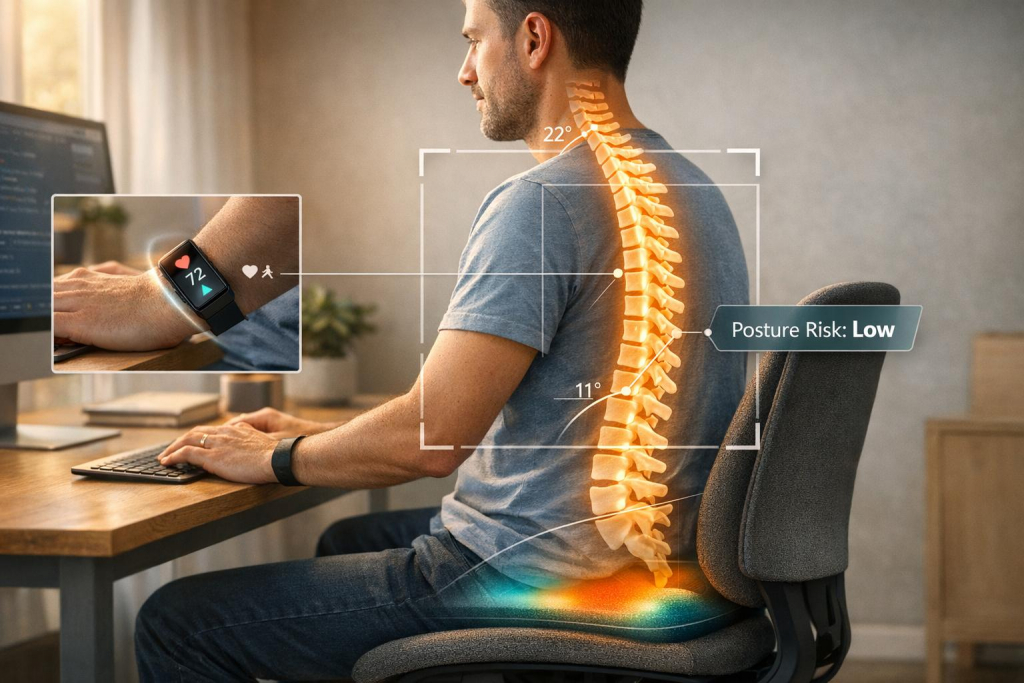
Poor posture is a leading cause of chronic pain and musculoskeletal disorders (MSDs), costing the U.S. $41.5 billion annually. Traditional posture assessments are often subjective, time-consuming, and fail to capture long-term risks. Machine learning (ML) changes this by enabling real-time, objective posture monitoring using tools like cameras, wearable sensors, and pressure mats. These systems not only detect poor posture but also predict future risks, offering personalized solutions for spine health.
Key Takeaways:
- Why It Matters: Poor posture contributes to neck, shoulder, and back pain, affecting productivity and quality of life.
- ML in Action: Algorithms like CNNs and tools like OpenPose analyze posture with high accuracy, transforming workplace ergonomics and daily spine health monitoring.
- Wearables: Devices like aiSpine provide real-time feedback and long-term tracking, making posture correction accessible in everyday settings.
- Applications: From office workers to adolescents, ML-powered systems are reducing posture-related risks across diverse populations.
This shift from subjective evaluations to data-driven insights is reshaping how we manage spine health, offering a proactive approach to prevent chronic issues.
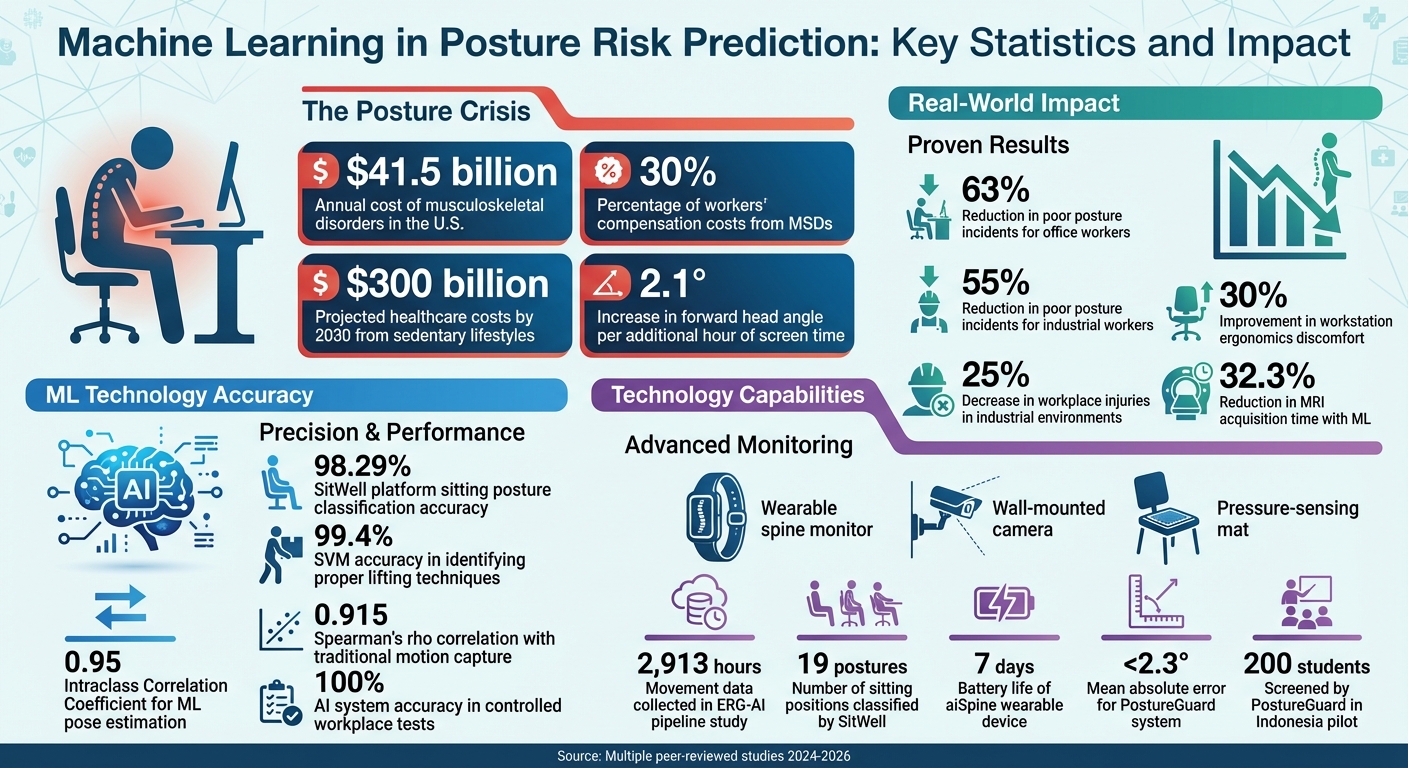
Machine Learning in Posture Risk Prediction: Key Statistics and Impact
Machine Learning Technologies in Posture Assessment
Data Sources and Sensing Technologies
Machine learning models rely on accurate and consistent data to effectively assess posture risks. To achieve this, various sensing technologies play a critical role, each offering distinct advantages.
Vision-based sensors are widely used due to their accessibility. Standard RGB cameras are cost-effective and deliver high-resolution visuals, making them suitable for home or office environments. For more advanced applications, depth cameras like Microsoft Kinect and Intel RealSense provide 3D spatial data, enabling precise skeletal tracking and joint angle measurements. However, these systems can struggle with privacy concerns and performance in low-light settings.
Wearable inertial sensors offer a portable solution. These devices, equipped with Inertial Measurement Units (IMUs), combine accelerometers, gyroscopes, and magnetometers to monitor movement in real time. For example, in September 2024, researchers tested the ERG-AI pipeline using data from 114 home care workers wearing five tri-axial accelerometers. Over 2,913 hours of movement data were collected, demonstrating that even a single arm-mounted sensor could reliably detect lying and sitting postures, though dynamic activities introduced more uncertainty. These sensors are particularly useful in environments where cameras are impractical, such as outdoor locations or crowded workplaces.
Pressure-sensing technologies provide another effective method. High-resolution pressure mats, like those with 32 × 32 sensor grids, can be integrated into furniture such as chairs or insoles to capture detailed weight distribution patterns. In September 2025, researchers at the University of South Wales developed the SitWell platform, which used two Tekscan CONFORMat pressure mats embedded in an office chair to classify 19 different sitting postures with 98.29% accuracy. This approach is both privacy-friendly and non-intrusive but is limited to specific setups.
Motion capture systems are also a key tool. Marker-based systems like Vicon and OptiTrack deliver unmatched precision for biomechanical studies. Meanwhile, marker-less systems such as OpenPose and MediaPipe use computer vision to track joints without physical markers. Marker-less methods reduce costs and setup time, making them more practical for continuous workplace monitoring compared to traditional marker-based systems.
These diverse data sources provide the foundation for machine learning algorithms to analyze and interpret posture-related information, offering actionable insights for various applications.
ML Algorithms Used for Posture Prediction
With high-quality data from these sensors, machine learning algorithms can effectively predict posture risks. The choice of algorithm depends on the data type and task complexity.
Convolutional Neural Networks (CNNs) are particularly well-suited for spatial data from images and pressure mats. They excel at identifying visual patterns and spatial relationships, making them ideal for classifying complex sitting postures and detecting risky positions.
Human Pose Estimation (HPE) frameworks such as OpenPose, MediaPipe, and MovePose automate the identification of key anatomical landmarks from video inputs. These tools can calculate critical postural parameters like head tilt, spinal curvature, and hip alignment. For instance, a 2024 study reported a strong correlation (Spearman’s rho of 0.915) between traditional motion capture systems and a Convolutional Pose Machine (CPM)-based system across 12 postures, demonstrating the reliability of deep learning in posture analysis.
Traditional machine learning algorithms, including Support Vector Machines (SVM), K-Nearest Neighbors (KNN), Random Forest (RF), and Decision Trees (DT), are effective for structured data from sensors like Force-Sensitive Resistors and Load Cells. These algorithms are computationally efficient and perform well with well-organized and labeled datasets.
For tasks involving sequential data, such as tracking movements over time, Recurrent Neural Networks (RNNs) and Long Short-Term Memory (LSTM) networks are highly effective. These models can analyze posture sequences to identify risks during dynamic activities like repetitive bending or manual lifting. Some advanced systems also use Monte Carlo Dropout to estimate uncertainty, which helps clinicians understand when predictions may be less reliable due to limited training data or measurement errors. This added transparency is crucial in clinical settings, where understanding a model’s confidence can guide more personalized and informed treatment decisions.
sbb-itb-44aa802
Practical Applications of ML in Posture Monitoring
Workplace and Occupational Health
Machine learning (ML) is reshaping workplace health by offering real-time posture monitoring and risk evaluation, going beyond the limitations of occasional manual assessments. For industries like manufacturing and construction – where heavy lifting and awkward postures are common – ML systems provide objective, instant feedback that helps prevent musculoskeletal disorders. These disorders make up nearly 30% of workers’ compensation costs.
In October 2024, New Balance introduced AI-powered tools in its manufacturing facilities to reduce repetitive strain injuries among assembly workers.
A study led by Balachandar Jeganathan in March 2025 showcased the impact of ML on workplace ergonomics. Conducted over six weeks, the study included 100 participants – 50 office workers and 50 industrial employees – who used TensorFlow MoveNet and Random Forest classifiers. The results were impressive, with the AI system achieving 100% accuracy in controlled tests and reducing poor posture incidents by 63% for office workers and 55% for industrial workers. This kind of immediate feedback eliminates delays in intervention, making workplaces safer and more efficient.
"AI-powered posture correction can reduce workplace injuries by 25% in industrial environments and improve workstation ergonomics, decreasing discomfort by 30%." – Balachandar Jeganathan, Master of Science in AI and ML
Posture Monitoring for Specific Populations
ML-based posture monitoring systems cater to various groups, each with unique challenges.
For adolescents, increased screen time has led to growing concerns about spinal health. Research shows that every additional hour of screen use increases the forward head angle by 2.1°. To address this, the PostureGuard system uses AI to screen students with a mean absolute error of less than 2.3°, helping schools identify and assist at-risk students before permanent issues develop.
Office workers are another key group, especially those spending long hours at desks. In September 2025, researchers at the University of South Wales developed the SitWell platform, which uses pressure sensor mats integrated into office chairs. This system, powered by a Convolutional Neural Network, classified 19 sitting postures with an accuracy of 98.29%. SitWell also incorporated OpenAI’s GPT-4o to provide users with personalized feedback and historical posture analytics, turning complex data into actionable insights.
For manual laborers and healthcare workers, who often perform physically demanding tasks, ML systems focus on dynamic movement analysis. Algorithms like Support Vector Machines, using IMU data, have achieved 99.4% accuracy in identifying proper lifting techniques. Similarly, LSTM-based systems reached 93.75% accuracy in real-time risk assessments for manual lifting. These tools are particularly valuable in unsupervised settings, such as home healthcare environments.
With these tailored solutions, wearable devices are now extending posture monitoring into everyday life.
AI-Powered Wearables for Spine Health
Wearable technology, powered by ML, offers continuous spine health monitoring – something traditional clinical check-ups can’t provide. These devices track spinal alignment and joint angles around the clock, detecting issues like hyperlordosis, hyperkyphosis, and scoliosis early on.
One standout example is AIH LLC’s aiSpine device, which combines real-time posture tracking with vibration alerts and historical analytics. It monitors spinal alignment and provides haptic feedback when non-neutral positions are detected. With Bluetooth® connectivity and a battery life of up to seven days, aiSpine integrates with the AIH Health App to deliver personalized guidance based on individual musculoskeletal profiles.
Modern wearables use multimodal feedback – vibrations, visual alerts via mobile apps, and auditory cues – to prompt immediate corrections. This real-time feedback eliminates the lag between poor posture and corrective action. For instance, the ERG-AI pipeline, tested in September 2024 with 114 home care workers over 2,913 hours, used Monte Carlo dropout for uncertainty estimation, showing users when recommendations were highly reliable or less certain. This added transparency builds trust and improves user engagement.
The integration of Large Language Models like GPT-4 has further enhanced wearable technology. These models translate complex biomechanical data into easy-to-understand explanations, helping users grasp why a posture is problematic and offering tailored advice for improvement.
"The integration of a comprehensive feedback system that provides both informative analysis of a user’s sitting behaviors as well as actionable insights has the potential to yield positive behavioral change and improve overall user outcomes." – David Faith Odesola, University of South Wales
Battery life is often a concern for users of wearable devices. Research shows that reducing accelerometer sampling rates from 25Hz to 1Hz maintains high accuracy for static postures like sitting and standing while significantly extending battery life. This optimization makes continuous monitoring practical for daily use without the hassle of frequent recharging.
Posture detection using PoseNet | Machine Learning in Javascript | ml5js PoseNet | Deep Learning
Effects on Spine Health Management
Machine learning (ML) is reshaping spine health management, moving from simple monitoring to driving precise clinical decisions and long-term care strategies.
Clinical Decision Support and Preventive Care
ML is revolutionizing how clinicians approach posture-related spine conditions by delivering objective insights that complement traditional diagnostic methods. For instance, deep convolutional neural networks (CNNs) can now automate the analysis of radiological images, identifying vertebrae, discs, and measuring spinopelvic parameters with accuracy that rivals human experts. Tools like SpineNet go even further, detecting conditions such as disc herniation, spinal stenosis, and fractures, while also grading disc degeneration using the Pfirrmann scale.
This level of automation isn’t just impressive – it’s practical. A study involving 1.5T cervical spine MRI scans found that deep learning reconstruction not only improved interobserver agreement from 0.89 to 0.92 but also reduced acquisition time by 32.3%. Similarly, ML-driven human pose estimation has replaced subjective visual inspections with reliable measurements, achieving an Intraclass Correlation Coefficient of up to 0.95 in a study of 200 healthy individuals. AI-powered wearables further enhance care by integrating real-time monitoring data with diagnostic insights, enabling clinicians to make highly personalized recommendations.
"ML’s potential in spine care is particularly notable in radiological image analysis, including the localization and labeling of anatomical structures, detection and classification of radiological findings, and prediction of clinical outcomes, thereby paving the way for personalized medicine." – Andrea Cina and Fabio Galbusera, Schulthess Clinic
This shift toward personalized medicine is a game-changer. Instead of relying on one-size-fits-all treatment protocols, clinicians can now use ML systems that factor in a patient’s unique musculoskeletal structure and ergonomic environment. Advanced tools even incorporate uncertainty estimation techniques, like Monte Carlo dropout, to offer clinicians confidence metrics for each prediction. When combined with large language models like GPT-4, these systems can translate complex biomechanical data into actionable recommendations that are easy for both patients and providers to understand.
In preventive care, ML enables large-scale early risk identification. For example, in February 2026, Indonesia implemented the PostureGuard system in 15 schools, screening 200 students under the country’s 2024 Digital Wellness Mandate. The system achieved a mean absolute error of less than 2.3° for forward head angle estimation and uncovered a dose–response relationship between screen time and posture: every additional hour of daily screen time correlated with a 2.1° increase in forward head angle. By identifying issues early, healthcare providers can intervene before postural problems become chronic, setting the stage for long-term tracking and remote care.
Long-Term Tracking and Remote Therapeutic Monitoring
AI-powered platforms have made continuous spine health monitoring a reality, going beyond the limits of periodic clinical visits. Unlike traditional assessments, these systems deliver real-time, objective tracking of anatomical landmarks and postural parameters, creating a detailed picture of a patient’s spine health over time. This is especially critical for managing chronic conditions, where long-term data can guide treatment adjustments.
Remote therapeutic monitoring addresses a common challenge in healthcare: keeping patients engaged and ensuring they stick to their treatment plans. Modern systems now integrate natural language models to generate personalized health risk assessments that patients can easily understand. Even with optimized sensors and reduced sampling rates to save battery life, these platforms maintain reliable posture detection for everyday use.
Take AIH LLC’s aiSpine device as an example. This wearable combines real-time posture tracking with vibration alerts and historical analytics, all accessible through the AIH Health App. With Bluetooth connectivity and a battery life of up to seven days, the device offers continuous monitoring without constant recharging. It provides personalized guidance tailored to each user’s musculoskeletal profile, supporting both self-management and clinician oversight.
Immediate feedback is another key feature. Multimodal systems use apps and haptic alerts to correct posture in real time, creating feedback loops that encourage neuromuscular adaptation over time. This is especially valuable for tele-rehabilitation, where patients often receive care remotely. The SitWell platform, developed in September 2025 by researchers at the University of South Wales, exemplifies this approach. Using pressure sensor mats integrated into office chairs, the system achieved 98.29% accuracy in classifying 19 sitting postures. By incorporating OpenAI’s GPT-4o, SitWell also provided users with personalized insights based on their historical posture data, helping them make lasting behavioral changes.
The economic stakes are huge. Sedentary lifestyles currently contribute to an estimated $27 billion in annual healthcare costs, a figure projected to hit $300 billion by 2030. By identifying risks early and keeping patients actively involved in their care, AI-powered platforms offer a scalable way to shift spine health management from reactive treatment to proactive prevention.
Future Directions in Machine Learning for Posture Risk Prediction
Emerging Trends in ML and Wearable Technology
Next-generation systems are leveraging large language models like GPT-4 and Llama-2 to simplify complex biomechanical data into actionable health insights. This shift is transforming spine health management from a reactive approach to one that is more personalized and proactive.
Another exciting development is uncertainty-aware machine learning, which adds a layer of reliability to predictions. By using techniques like Monte Carlo dropout, these systems provide confidence scores for each assessment, helping both patients and clinicians make better-informed decisions.
Wearable technology is also advancing at an impressive pace. Devices like the aiNeuro, which combines real-time posture tracking with stroke monitoring, and the aiRing, a waterproof ring that tracks vital signs, are pushing the boundaries of health monitoring. These tools aim to provide a more comprehensive view of spine and cardiovascular health.
On the hardware side, advanced sensing technologies are enabling more precise and detailed posture data collection without the need for bulky equipment. The integration of edge computing has made these innovations even more practical. For example, models optimized for TensorFlow Lite can perform continuous posture analysis directly on mobile devices, eliminating the need for constant cloud connectivity. While these trends are promising, they also come with challenges and ethical concerns that need addressing.
Challenges and Ethical Considerations
Despite the rapid progress, several hurdles must be overcome for these innovations to reach their full potential. Key concerns include data privacy, algorithmic bias, clinical validation, and environmental impact.
Data privacy is a top priority, especially for systems that rely on cameras or continuous monitoring through wearables. Protecting sensitive biomechanical data requires robust security measures, yet many current systems fall short. The urgency to deploy these technologies is growing, with sedentary lifestyles projected to push healthcare costs to $300 billion annually by 2030. However, this rush could compromise privacy safeguards.
Algorithmic bias is another pressing issue. Many machine learning models are trained on data from limited demographic groups, often excluding diverse populations. This raises questions about the accuracy and fairness of these systems. Researchers are addressing this by developing region-specific frameworks, such as the PostureGuard system introduced in Indonesia in 2026, which achieved a mean absolute error of less than 2.3° for forward head angle estimation. While promising, scaling these efforts globally will require significant investment in more diverse datasets.
The lack of large-scale clinical validation is a major barrier to widespread adoption. Although lab studies report impressive accuracy – such as the SitWell system’s 98.29% accuracy rate in 2025 – these technologies have yet to undergo rigorous testing in real-world clinical settings. Without this validation, healthcare providers remain cautious about integrating AI-driven posture monitoring into standard care.
"To fully realize this potential, future work must extend beyond technical innovation to include rigorous clinical validation, user-centered design, and the establishment of ethical and regulatory frameworks that ensure safe, effective, and equitable implementation." – Journal of Orthopaedic Surgery and Research
Another concern is the environmental impact of training complex machine learning models, which consumes significant energy and contributes to carbon emissions. As these systems scale, developers will need to find ways to balance performance with sustainability.
Finally, regulatory frameworks are struggling to keep up with the pace of innovation. Clear guidelines for AI-assisted healthcare are needed to address issues like patient autonomy and algorithmic transparency. Establishing these standards is critical to ensure that these technologies are implemented safely and equitably.
Conclusion
Machine learning is reshaping how we approach spine health management. By moving away from traditional, subjective observation methods to systems that offer objective and continuous monitoring, posture risk prediction has become far more precise. Modern machine learning models now deliver real-time reliability, with intraclass correlation coefficients (ICC) reaching up to 0.95 – on par with clinical assessments.
The financial implications are hard to ignore. Work-related musculoskeletal disorders cost the U.S. economy around $41.5 billion each year. Meanwhile, the global rise in sedentary lifestyles is expected to drive healthcare costs to a staggering $300 billion by 2030. These numbers highlight the urgent need for preventive measures that can mitigate these growing health and economic burdens.
Real-world applications, such as PostureGuard and SitWell, demonstrate the ability of machine learning to identify risks early. These examples showcase how practical implementations are already making a difference, reinforcing the transformative role of machine learning in this field.
"AI holds considerable potential to transform postural management through continuous, objective, and accessible assessment and intervention." – Journal of Orthopaedic Surgery and Research
The combination of wearable technology and advanced machine learning algorithms opens the door to personalized and proactive care. Devices like AIH LLC’s aiSpine bring clinical-grade posture monitoring into everyday settings, offering long-term tracking and instant corrective feedback. As these technologies evolve, addressing challenges like validation and privacy will be key to making spine care more accessible, affordable, and effective for everyone.
FAQs
Which sensor type is best for posture tracking at home?
Inertial measurement units (IMUs) are excellent sensors for tracking posture at home. They offer precise monitoring for both still and moving postures and can easily be incorporated into everyday clothing, making them a practical choice for regular use.
How does ML predict future posture-related injury risk?
Machine learning is making strides in predicting posture-related injury risks by examining biomechanical and kinematic data to uncover patterns associated with potentially harmful postures. With the help of wearable sensors and advanced algorithms – such as support vector machines – these systems can classify postures with impressive accuracy. They detect subtle deviations in joint angles and trunk movements that signal biomechanical stress.
What’s even more impactful is how these models are being used. By enabling real-time monitoring and offering personalized feedback, they provide opportunities for early intervention. When paired with smart devices, like those developed by AIH LLC, this technology becomes a powerful tool for proactive injury prevention.
What privacy measures protect camera or wearable posture data?
Adversarial training techniques play a key role in protecting privacy by obscuring video data while still allowing for accurate pose estimation. This approach ensures that only the necessary information is shared, keeping user privacy intact.