
Wearable health devices are improving how we monitor chronic conditions like diabetes and heart disease. But their biggest challenge? Power consumption. Smaller devices mean smaller batteries, and features like continuous data tracking and Bluetooth quickly drain energy. This creates a need for smarter, energy-efficient designs to ensure long-term use without constant recharging.
Key Points:
- Problem: Wearables often require frequent charging due to small batteries and power-hungry features.
- Solutions: Advances in low-power batteries, energy harvesting (body heat, motion, sweat), and AI-driven power management are extending battery life or even eliminating charging needs.
- Examples:
- A battery-free wristband powered by indoor light.
- Sweat-powered biofuel cells generating electricity for sensors.
- Hybrid systems combining multiple energy sources for reliability.
These innovations make wearable devices more practical for continuous use, even for elderly users or those with chronic conditions. Companies like AIH LLC are leading this shift with devices like the aiSpine and aiRing, which offer efficient, real-time health tracking while conserving energy.
Why Energy Efficiency Matters in Wearable Biomarker Monitoring
Power Consumption Challenges in Wearable Devices
Wearable devices face a tough design challenge: smaller sizes mean smaller batteries. As these devices get sleeker, their battery capacity shrinks, but users still expect them to last for days – or even weeks – without needing a charge.
This issue is amplified by the demands of their features. Advanced functionalities use up power quickly. For example, accurate heart rate variability tracking requires a sampling rate of 100–200 Hz, which significantly increases energy usage. Lowering the rate to 40–50 Hz might save power, but it introduces a 20% bias in the data, which compromises clinical accuracy. On top of that, wireless data transmission, especially via Bluetooth Low Energy, is one of the biggest drains on battery life.
"The main challenge is to balance these design requirements with reliability and user comfort, an essential factor for the advancement and adoption of wearable health technologies." – Shihong Chen and Esther Rodriguez-Villegas, Imperial College London
Another hurdle is the difficulty of miniaturizing traditional batteries. Smaller or less rigid batteries often make devices uncomfortable, which discourages long-term use – particularly among elderly users who rely on continuous monitoring. If a device feels bulky or needs daily charging, people are more likely to stop using it altogether.
These limitations highlight the importance of finding smarter ways to save energy, as explored below.
How Energy-Saving Solutions Benefit Users
Energy-efficient designs tackle these challenges head-on. Onboard data processing can cut power consumption by as much as 53% compared to sending raw data wirelessly. Instead of streaming every bit of sensor data to a smartphone, the device processes the information locally and only transmits essential health metrics. In one instance, this approach reduced wireless transmission from 400 bytes per second to just 4 bytes per second – a 99% reduction.
In July 2025, researchers Shihong Chen and Esther Rodriguez-Villegas introduced a battery-free smart wristband that achieved self-sustainability with just 1.45 hours of indoor light exposure (1,000 lux) per day at a 50 Hz sampling rate. By incorporating onboard processing, the wristband saved about 2 joules of energy by minimizing Bluetooth Low Energy transmissions. This innovation allowed the device to function indefinitely under normal indoor lighting without ever needing to be plugged in.
Another breakthrough is adaptive sampling strategies, which optimize power use without sacrificing performance. Modern wearables can adjust sensor frequencies based on energy availability and the user’s activity level. For instance, they might lower sampling rates during rest and ramp them up during physical activity or when precise data is crucial. This "energy-aware" design ensures continuous monitoring, even in challenging conditions like nighttime or low-light environments, where energy harvesting is limited.
sbb-itb-44aa802
SenSys 2016 – Amulet: An Energy-Efficient, Multi-Application Wearable Platform
Energy-Saving Technologies in Wearables
Wearable devices face significant challenges when it comes to power consumption. To tackle this, innovative approaches focus on improving energy storage, generating power from the human body, capturing energy from movement, or combining multiple sources into one system. Let’s dive into the latest advancements in these areas.
Low-Power Batteries for Wearable Sensors
Most wearable sensors rely on Lithium-ion (Li-ion) and Lithium-ion polymer (Li-Po) batteries, which provide energy densities of about 200 Wh/kg and 550 Wh/L, respectively, with minimal self-discharge of only 2% per month. These batteries are durable, offering over 1,000 charge cycles, making them well-suited for long-term use. For example, glucose and lactate monitors often use Li-Po batteries with a working voltage of 3.7 V.
A great example of this technology in action is the FreeStyle Libre by Abbott Laboratories. This device uses an electrochemical sensor embedded in an adhesive patch for continuous glucose monitoring. Its low-profile battery system allows for multi-day wear without the need for finger pricks.
For flexible applications, thin-film lithium-ion batteries are gaining traction. These are ideal for "skin-patch" designs, maintaining performance while comfortably monitoring biomarkers like lactate. Meanwhile, zinc-ion batteries are emerging as lighter and more biocompatible options for healthcare uses. Researchers are also exploring flexible supercapacitors that conform to the body and integrate with energy-harvesting systems to maintain consistent power delivery.
"Wearable sensors have large limitations in size. Thus, in order to minimize device size, large and rigid battery packs are not expected." – Guoguang Rong, Researcher, Westlake University
Despite these advancements, traditional coin cell batteries still dominate many devices, often dictating their size and rigidity. But wearable tech is also finding ways to harness energy directly from the body.
Body-Powered Energy Sources
Wearable devices are now tapping into the body’s own energy to power themselves. One exciting development is thermoelectric generators (TEGs), which convert body heat into electricity using the temperature difference between the skin and air. The human body produces about 5.82 W/m² of waste heat at rest, and flexible TEGs can generate over 1 mW of power with just a 3.6°F (2 K) temperature difference. These generators are particularly useful for stationary monitoring or sleep tracking.
In February 2026, researchers introduced a stretchable flexible thermoelectric generator (SFTEG) system designed for intermittent monitoring of heart rate and blood oxygen levels. This device achieved an open-circuit voltage of 591 mV and a maximum power output of 1,114 μW across a 3.6–28.8°F (2–16°C) temperature range. It also featured an energy management module and Bluetooth Low Energy (BLE) for wireless data transmission, eliminating the need for traditional batteries.
Another innovative approach involves biofuel cells, which generate power from sweat or other bodily fluids. In March 2026, a team led by Associate Professor Isao Shitanda at Tokyo University of Science developed a battery-free patch that produces 165 µW/cm² of power from sweat lactate. This device, made using a single-pass screen-printing process, delivers 0.63 V to power biosensors.
"We need to bring an enzyme ink to the market that can be printed uniformly and is suitable for mass production." – Dr. Isao Shitanda, Associate Professor, Tokyo University of Science
Energy management circuits play a key role here, boosting the low voltages produced by body-powered systems (sometimes just millivolts) to usable levels of 3.3V–5V for sensors and Bluetooth modules. Some systems can even recharge from body heat at input voltages as low as 30 mV. While body-powered systems work best for continuous energy, motion-based harvesters excel during physical activity.
Motion-Based Energy Harvesting
Wearables are also leveraging movement to generate power. Piezoelectric generators (PEG) and triboelectric nanogenerators (TENG) convert mechanical stress into electricity. Unlike thermoelectric systems that provide steady power, these motion-based technologies produce bursts of high power during activity.
In early 2025, researchers unveiled the TEP-WS, a hybrid sensor that combines triboelectric, piezoelectric, and electromagnetic mechanisms. At a 4 Hz excitation frequency, it achieved peak power outputs of 13.28 nW (TENG), 0.63 µW (PEG), and 1.31 µW (EMG). This device charged a 10 µF capacitor in just 14 seconds, offering a sustainable power supply for long-term rehabilitation monitoring.
"The TENG exhibits high-voltage and low-current characteristics. In contrast, both PEG and EMG display low-voltage and high-current properties." – Scientific Reports
The TEP-WS also demonstrated impressive health-monitoring capabilities, achieving over 93.3% accuracy in gesture recognition and more than 95.0% accuracy in detecting gait impairments using the Random Forest algorithm. These advancements highlight the potential of motion-based systems to power both energy collection and advanced health tracking.
Hybrid Energy Systems
To address the limitations of individual energy sources, hybrid systems combine multiple methods for reliable power. These systems integrate biomechanical, biochemical, thermal, and solar energy sources with storage units like batteries or supercapacitors. This ensures consistent power whether the user is active, stationary, or in varying light conditions.
By pairing complementary outputs, hybrid systems enhance efficiency. For instance, high-voltage/low-current triboelectric generators can work alongside low-voltage/high-current electromagnetic or piezoelectric generators. Energy management modules then boost these harvested voltages to stable DC levels needed for sensors and wireless communication.
In September 2024, researchers at the University of California San Diego, including Shichao Ding and Joseph Wang, developed a fingertip-wearable microgrid. This system combined enzymatic biofuel cells for harvesting energy from sweat with AgCl-Zn batteries for storage. It powered multi-metabolite sensing for glucose, vitamin C, lactate, and levodopa, all driven by fingertip perspiration.
"Integrated energy-autonomous wearable microgrids offer a compelling solution to support the growing power demands of long-term health care and wellness monitoring." – Shichao Ding, Researcher, University of California San Diego
Advanced hybrid systems are now incorporating Artificial Intelligence (AI) to predict energy needs and balance production, storage, and demand in real time. By storing energy in supercapacitors and powering intermittent data collection instead of continuous operation, these systems significantly extend the lifespan of wearable devices, especially for low-risk users.
AIH LLC Energy-Saving Wearables
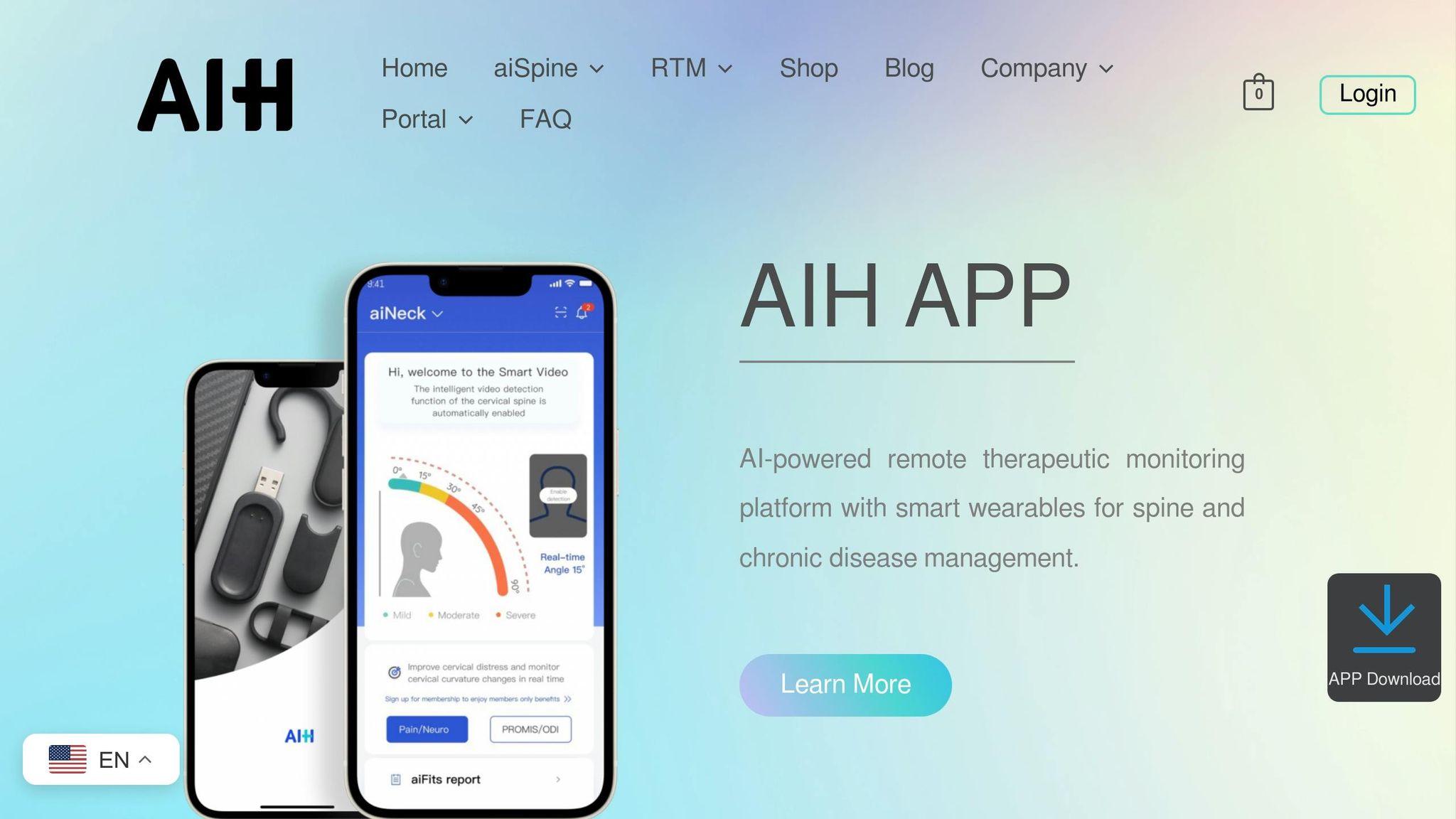
AIH LLC has developed wearables that combine advanced low-power technologies with reliable health monitoring, designed to support chronic disease management. Here’s a closer look at how these devices achieve energy efficiency while delivering accurate results.
aiSpine: Smart Posture Tracking with Minimal Energy Use

The aiSpine device uses Bluetooth 4.0 and a 9-axis IMU to track posture in real-time, offering a standby time of up to 7 days to reduce the need for frequent charging. It monitors spinal angles and curvature with low power consumption, providing gentle vibration reminders and app notifications when posture corrections are needed. Currently priced at $49.00 (marked down from $99.00), the aiSpine makes posture monitoring more affordable. It also offers four flexible wearing options – over-ear, attached to glasses, front clip-on, and back clip-on – ensuring seamless tracking throughout daily activities.
aiRing: Continuous Monitoring, Low Power Demand

The aiRing is designed for efficient tracking of vital signs, featuring ultra-low power Bluetooth chips and precision sensors. Its AI algorithms optimize data collection, reducing unnecessary energy use by limiting high-power sensor activations and transmissions. Available in two models – the aiRing Ultra at $57.00 (discounted from $169.00) and the aiRing Lite at $49.90 (down from $69.00) – this device provides constant connectivity with the AIH Health App while conserving energy for extended use.
aiNeuro Device: Upcoming Energy-Saving Innovations
The aiNeuro, an upcoming addition to AIH LLC’s lineup, will focus on preemptive stroke monitoring and posture correction. It uses Bluetooth Band technology to create personalized health models based on both standing and sitting postures, delivering feedback through low-energy vibrations and app alerts. Like the other devices, the aiNeuro will integrate with AIH LLC’s Remote Therapeutic Monitoring (RTM) platform, which gathers physiological and non-physiological data to support musculoskeletal and respiratory health tracking. Together, these wearables highlight AIH LLC’s dedication to energy-efficient health solutions.
Comparing Energy-Saving Technologies for Biomarker Wearables
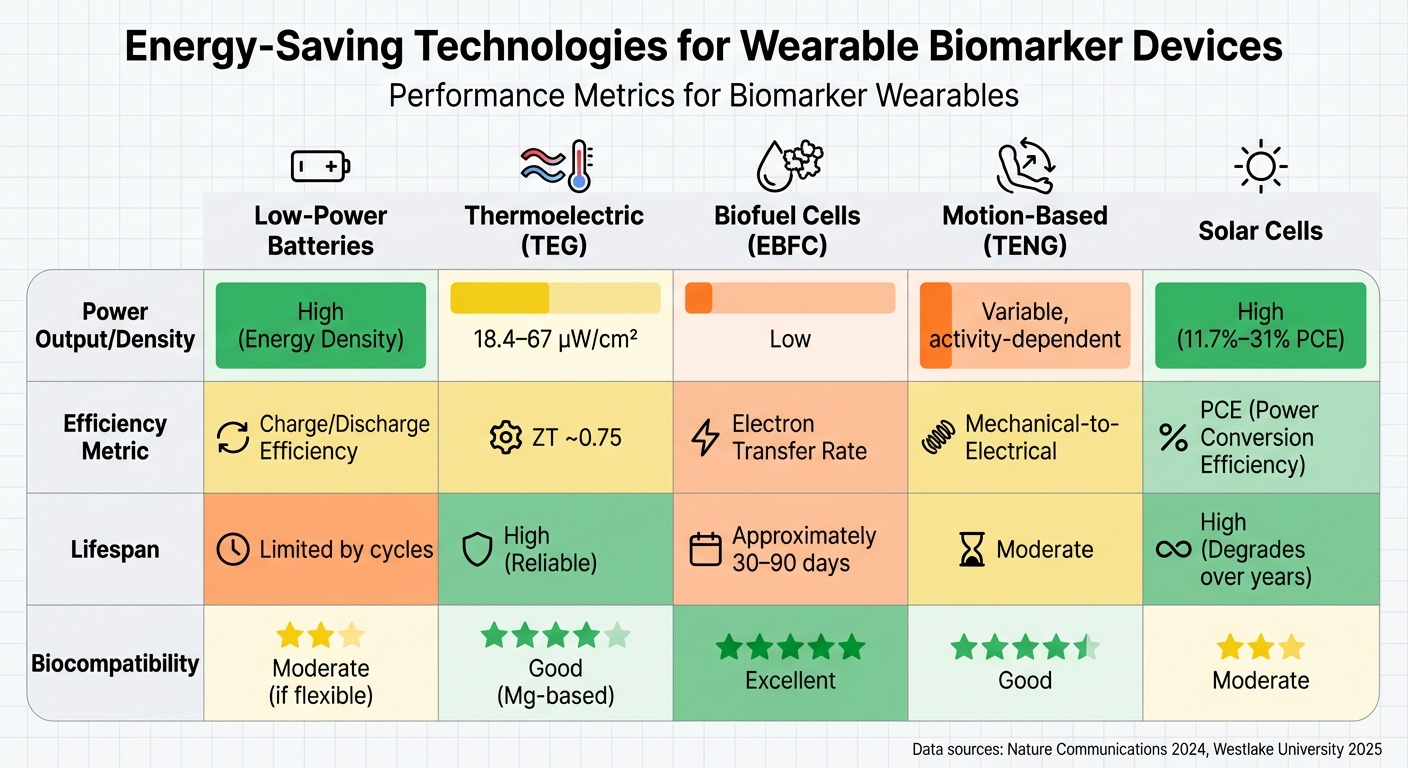
Energy-Saving Technologies for Wearable Biomarker Devices: Power Output and Performance Comparison
When designing energy-efficient biomarker wearables, choosing the right power source is a balancing act. Each technology offers unique strengths and weaknesses in terms of power output, reliability, and longevity.
Thermoelectric generators (TEGs) convert body heat into a steady power supply. A 2024 study in Nature Communications demonstrated a wearable TEG made with magnesium-based materials that achieved a power density of 18.4 μW/cm² at a skin temperature of 91.4°F. This breakthrough showed that safer materials could effectively replace toxic ones. TEGs are ideal for continuous monitoring since they don’t depend on user activity and require minimal upkeep.
Enzymatic biofuel cells (EBFCs) take a different approach, using enzymes to turn sweat into electricity. In March 2025, researchers at Westlake University showed that EBFCs built with multiwalled carbon nanotubes and glucose dehydrogenase retained 90% of their initial current response after 90 days. This progress addressed concerns about stability in wearable biosensors. While highly compatible with the human body, EBFCs generally produce less power and have shorter lifespans compared to other options.
Motion-based generators, such as triboelectric nanogenerators (TENGs), harness energy from body movements. These can generate up to 420.3 mW/cm², though their output depends heavily on the user’s activity level. Meanwhile, solar cells offer another option, achieving indoor power conversion efficiencies exceeding 31% under standard lighting conditions. Each of these technologies brings distinct advantages to the table, making them suitable for different scenarios.
For consistent power, hybrid systems combine various energy sources. The table below outlines the key performance metrics of these energy technologies.
Energy Technologies Comparison Table
| Technology | Power Output/Density | Efficiency Metric | Lifespan | Biocompatibility |
|---|---|---|---|---|
| Low-Power Batteries | High (Energy Density) | Charge/Discharge Efficiency | Limited by cycles | Moderate (if flexible) |
| Thermoelectric (TEG) | 18.4–67 μW/cm² | ZT ~0.75 | High (Reliable) | Good (Mg-based) |
| Biofuel Cells (EBFC) | Low | Electron Transfer Rate | Approximately 30–90 days | Excellent |
| Motion-Based (TENG) | Variable, activity-dependent | Mechanical-to-Electrical | Moderate | Good |
| Solar Cells | High (11.7%–31% PCE) | PCE (Power Conversion Eff.) | High (Degrades over years) | Moderate |
Future Trends in Energy-Saving Wearables for Biomarker Monitoring
The future of energy-saving wearables is heading toward battery-free operation, leveraging cutting-edge nanotechnology and AI-driven energy management. A standout example comes from January 2026, when researchers at the University of Surrey‘s Advanced Technology Institute created a nano-sensor using borophene – a two-dimensional material based on boron – integrated into nanofibers. This innovation powers low-energy electronics using only gentle movements like breathing or walking. Commercialized by Z-PULSE Ltd, the device is designed for applications such as dementia and sleep care monitoring, showing its potential in managing chronic diseases. Lead researcher Sajib Roy highlighted its significance:
"The key achievement of our work is that the sensor is extremely sensitive to very small movements while powering itself at the same time".
This advancement opens the door for AI-powered strategies to further cut down on power consumption.
AI is also transforming how wearables handle energy. In October 2023, a team led by Mark C. Hersam at Northwestern University developed a nanoelectronic device that combines two-dimensional molybdenum disulfide with one-dimensional carbon nanotubes. The device processed 10,000 ECG samples, identifying six heartbeat types with 95% accuracy – all while consuming 100 times less energy than traditional silicon-based systems. Hersam explained:
"Our device is so energy efficient that it can be deployed directly in wearable electronics for real-time detection and data processing, enabling more rapid intervention for health emergencies".
By processing data locally, these devices eliminate the need for energy-draining cloud transmissions.
Another exciting development is wearable microgrids, which combine multiple energy sources into one seamless system. These systems integrate technologies like solar cells, sweat-powered biofuel cells, and motion-based generators to ensure continuous power. For instance, advanced perovskite/silicon tandem solar cells for wearables now achieve power conversion efficiencies of 32.60%, while flexible quasi-2D perovskite solar modules deliver over 31% efficiency under indoor lighting. AI algorithms play a critical role here, predicting energy demands and balancing production, storage, and consumption in real time.
As demand for wearables grows, innovation continues to accelerate. The global market for wearable electronics, valued at $70–80 billion in 2023, is expected to hit $138.5 billion by 2029. This growth drives the development of fiber-based electronics that can be seamlessly woven into everyday clothing. These advancements signal a future where health monitoring is effortless and unobtrusive, aligning perfectly with the mission of energy-efficient wearables for continuous biomarker tracking.
Conclusion
Energy-saving technologies are reshaping wearable biomarker monitoring, turning it into a long-term health solution without the constant hassle of charging or battery replacement. By integrating advancements like hybrid energy harvesting and ultra-low-power AI processing, these devices have reached a point where the energy they generate matches or surpasses their consumption. This progress allows for continuous tracking of vital signs, posture, and chronic disease markers, paving the way for more practical and user-friendly health solutions.
AIH LLC is leading this shift with devices such as the aiSpine and aiRing. These wearables feature ultra-low-power Bluetooth chips and precise sensors, enabling real-time health monitoring with minimal energy use. The aiSpine focuses on tracking spine posture and activity, while the aiRing monitors vital signs. Both devices seamlessly connect to the AIH Health App, offering users personalized health feedback. This blend of medical expertise and energy-efficient design showcases how technology can simplify managing chronic conditions and support overall wellness.
Looking ahead, advancements in on-device AI processing could lower power consumption to under 5 mW. At the same time, multimodal energy harvesting systems are set to draw power from sources like body heat, motion, and ambient light. As Shichao Ding from the University of California San Diego explains:
"Integrated energy-autonomous wearable microgrids offer a compelling solution to support the growing power demands of long-term health care and wellness monitoring".
With the wearable healthcare market expected to grow from $80 billion in 2020 to over $491.74 billion by 2032, the demand for energy-efficient designs in chronic disease management is clear.
The future of wearable health lies in making monitoring effortless and nearly invisible. By leveraging multimodal energy sources and on-device AI, these devices will operate autonomously, delivering proactive health insights without the need for constant charging. This evolution marks a significant step forward in digital health management.
FAQs
How can a wearable work without charging?
Wearable devices can function without frequent charging by harnessing energy directly from the body or surroundings. They rely on self-powered sensors that utilize mechanisms such as triboelectric, piezoelectric, electromagnetic, thermoelectric, or biofuel cells. These systems convert physical movements, temperature variations, or bioenergy into electricity, allowing wearables to run continuously without needing an external power source.
Will low-power modes reduce clinical accuracy?
Wearable sensors can operate in low-power modes while still delivering accurate clinical data. Research confirms that these devices can reliably track vital signs even at ultra-low power levels, maintaining consistent performance without major trade-offs.
What is the best energy source for all-day monitoring?
Batteries are a dependable energy source for wearable sensors designed for round-the-clock biomarker monitoring. They deliver steady power and are ideal for supporting the continuous operation of low-power devices.